 Back
DNA and the Gene: Synthesis and Repair – Study Notes
Study Guide - Smart Notes
 Tailored notes based on your materials, expanded with key definitions, examples, and context.
Chapter 15: DNA and the Gene – Synthesis and Repair
Introduction
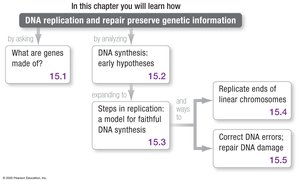
This chapter explores the molecular nature of genes, focusing on DNA replication and repair. It covers foundational experiments, the structure of DNA, mechanisms of DNA synthesis, challenges in replicating chromosome ends, and systems for correcting errors and repairing DNA damage.
What Are Genes Made Of?
Chromosomes and Genetic Material
Chromosomes are composed of DNA and proteins. Early biologists debated whether genes were made of DNA or protein, given the complexity and variability of proteins compared to DNA's four nucleotides.
Evidence That DNA Can Transform Bacteria
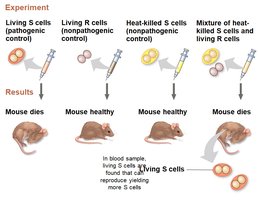
Frederick Griffith's experiments with Streptococcus pneumoniae demonstrated that DNA can transfer genetic traits between bacterial strains, a process called transformation.
S strain: Pathogenic, has a protective capsule.
R strain: Nonpathogenic, lacks capsule.
Mixing heat-killed S cells with living R cells resulted in pathogenic R cells, showing DNA's role in heredity.
The Hershey–Chase Experiment
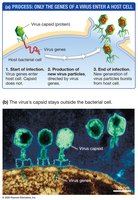
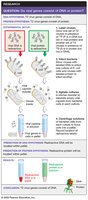
Hershey and Chase used T2 bacteriophages to show that DNA, not protein, is the genetic material. Radioactive labeling revealed that only DNA entered bacterial cells during infection.
32P: Labels DNA
35S: Labels protein
Only radioactive DNA was found inside cells, confirming DNA as the genetic material.
The Structure of DNA
DNA Composition and Directionality
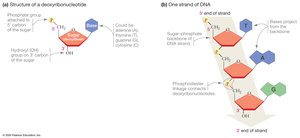
DNA is a double-stranded polymer of deoxyribonucleotides, each consisting of a deoxyribose sugar, phosphate group, and nitrogenous base. Strands have polarity, with distinct 3' and 5' ends.
Phosphodiester linkage: Covalent bond between 3' hydroxyl and 5' phosphate.
Purines: Adenine (A), Guanine (G)
Pyrimidines: Cytosine (C), Thymine (T)
Double Helix and Base Pairing
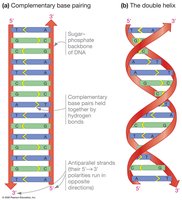
Watson and Crick proposed that DNA strands are antiparallel and twist into a double helix. Complementary base pairing stabilizes the structure:
A-T: Adenine pairs with Thymine
G-C: Guanine pairs with Cytosine
Chargaff's rules: Amount of A ≈ T, G ≈ C
Testing Early Hypotheses about DNA Synthesis
Models of DNA Replication
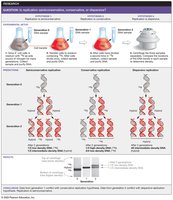
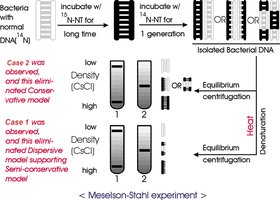
Three hypotheses were proposed for DNA replication:
Semiconservative: Each daughter DNA has one old and one new strand.
Conservative: One daughter has both old strands, other has both new.
Dispersive: DNA is interspersed with old and new segments.
A Model for DNA Synthesis
DNA Polymerase and Directionality
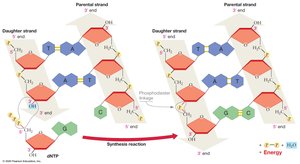
DNA polymerase catalyzes DNA synthesis, adding nucleotides only to the 3' end. Thus, DNA synthesis proceeds in the 5' → 3' direction.
dNTPs: Deoxyribonucleoside triphosphates provide energy for synthesis.
Formation of phosphodiester bonds is exergonic due to dNTPs' high potential energy.
Equation:
Origin of Replication and Replication Forks
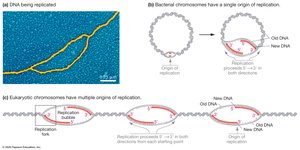
Replication begins at specific sequences called origins of replication. Bacteria have one origin per chromosome; eukaryotes have many. Replication bubbles expand bidirectionally, creating two replication forks.
Opening and Stabilizing the Helix
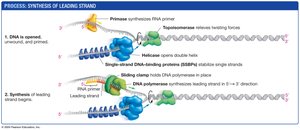
Several proteins facilitate DNA replication:
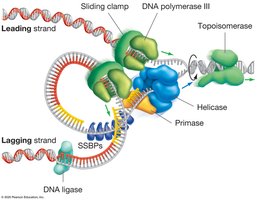
DNA helicase: Separates DNA strands.
SSBPs: Single-strand DNA-binding proteins prevent re-annealing.
Topoisomerase: Relieves tension from unwinding.
Synthesis of Leading and Lagging Strands
Leading Strand Synthesis
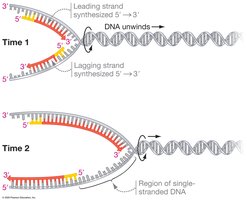
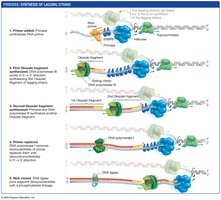
The leading strand is synthesized continuously toward the replication fork. DNA polymerase requires a primer, which is synthesized by primase.
Primer: Short RNA strand provides 3' end for DNA polymerase.
Primase: RNA polymerase that creates primers.
Lagging Strand Synthesis and Okazaki Fragments
The lagging strand is synthesized discontinuously away from the fork, forming short DNA fragments called Okazaki fragments. Primase adds new primers as the fork opens, and DNA polymerase synthesizes fragments.
Okazaki fragments: Short DNA segments on lagging strand.
DNA polymerase I: Removes RNA primers and replaces with DNA.
DNA ligase: Joins Okazaki fragments.
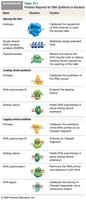
Proteins Required for DNA Synthesis in Bacteria
Key proteins involved in DNA replication include helicase, SSBPs, topoisomerase, primase, DNA polymerase III, DNA polymerase I, sliding clamp, and DNA ligase.
Protein | Function |
|---|---|
Helicase | Catalyzes separation of DNA strands |
SSBPs | Stabilize single strands |
Topoisomerase | Relieves tension |
Primase | Synthesizes RNA primer |
DNA polymerase III | Extends leading strand |
DNA polymerase I | Removes primers, replaces with DNA |
Sliding clamp | Holds polymerase in place |
DNA ligase | Joins Okazaki fragments |
The Replisome
The replisome is a dynamic macromolecular machine containing all enzymes required for DNA synthesis at the replication fork.
Replicating the Ends of Linear Chromosomes
Telomeres and the End Replication Problem
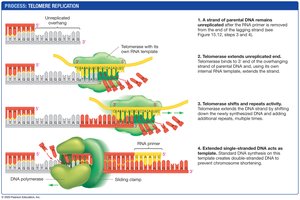
Telomeres are repetitive DNA sequences at chromosome ends. The lagging strand cannot be fully replicated, leading to chromosome shortening with each division.
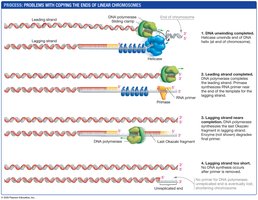
Telomerase Function
Telomerase extends telomeres using an RNA template, preventing chromosome shortening. It is active in gametes and stem cells, but not in most somatic cells.
Effect of Telomere Length on Cell Division
Telomere length limits cell division. Most cancer cells have active telomerase, enabling unlimited division. Inhibiting telomerase may be a strategy to combat cancer.
Repairing Mistakes and DNA Damage
Accuracy of DNA Replication
DNA polymerase is highly accurate, with an error rate of one per billion nucleotides. Errors can contribute to cancer development.
Proofreading and Mismatch Repair
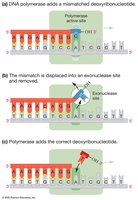
DNA polymerase proofreads its work, removing mismatched bases via exonuclease activity. Mismatch repair enzymes correct errors after synthesis.
Repairing Damaged DNA
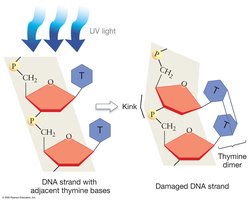
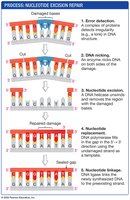
DNA can be damaged by UV light, X-rays, and chemicals. Thymine dimers caused by UV light create kinks that block replication. Nucleotide excision repair removes and replaces damaged DNA.
DNA Repair Defects in Humans
Xeroderma pigmentosum (XP) is a rare disease caused by defects in nucleotide excision repair, leading to extreme sensitivity to UV light and increased cancer risk. Defects in DNA repair genes are frequently associated with cancer.
