 Back
DNA as the Genetic Material: Historical Experiments and Molecular Structure
Study Guide - Smart Notes
 Tailored notes based on your materials, expanded with key definitions, examples, and context.
DNA as the Genetic Material
Historical Search for the Genetic Material
The identification of DNA as the hereditary material was a pivotal moment in biology. Early 20th-century scientists debated whether proteins or DNA carried genetic information, as proteins were known for their complexity and diversity, while DNA was thought to be too simple. This view changed through a series of landmark experiments.
Griffith's Transformation Experiment
Frederick Griffith's 1928 experiment with Streptococcus pneumoniae provided the first evidence that a "transforming principle" could transfer genetic traits between bacteria.
S strain (smooth): Pathogenic, has a protective capsule.
R strain (rough): Nonpathogenic, lacks a capsule.
When heat-killed S cells were mixed with living R cells and injected into mice, the mice died, and living S cells were recovered from their blood.
This indicated that some heritable substance from the dead S cells transformed the R cells into pathogenic S cells.
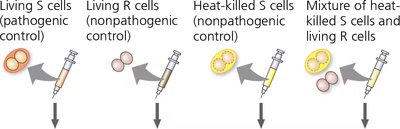
Evidence from Bacteriophages: The Hershey-Chase Experiment
Further evidence came from studies of bacteriophages (viruses that infect bacteria). Hershey and Chase (1952) used radioactive labeling to show that DNA, not protein, is the genetic material that viruses inject into bacteria to program viral replication.
Phages consist of DNA enclosed in a protein coat.
Radioactive sulfur labeled proteins; radioactive phosphorus labeled DNA.
Only radioactive DNA entered bacterial cells and directed the production of new phages.
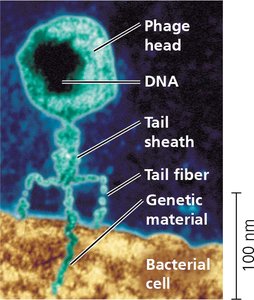
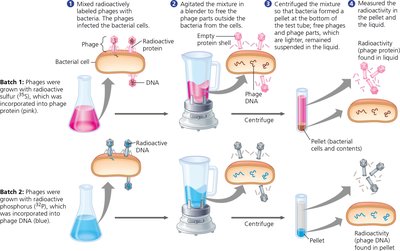
Molecular Structure of DNA
DNA Composition and Chargaff's Rules
DNA is a polymer of nucleotides, each consisting of a nitrogenous base, a deoxyribose sugar, and a phosphate group. Erwin Chargaff discovered two key rules:
Base composition varies between species.
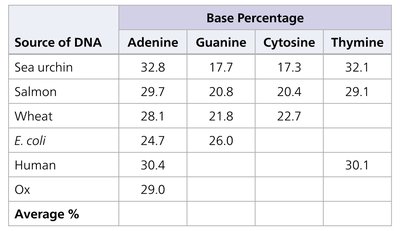
In any species, the amount of adenine (A) equals thymine (T), and the amount of guanine (G) equals cytosine (C).
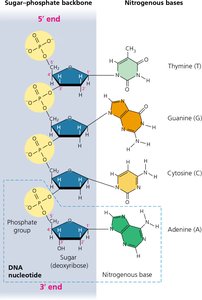
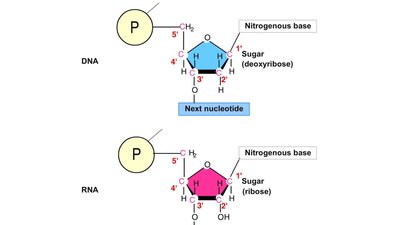
Table: Base Composition in Different Species
This table demonstrates Chargaff's rules by showing the base percentages in DNA from various organisms.
Source of DNA | Adenine (%) | Guanine (%) | Cytosine (%) | Thymine (%) |
|---|---|---|---|---|
Sea urchin | 32.8 | 17.7 | 17.3 | 32.1 |
Salmon | 29.7 | 20.8 | 20.4 | 29.1 |
Wheat | 28.1 | 21.8 | 22.7 | ? |
E. coli | 24.7 | 26.0 | ? | ? |
Human | 30.4 | ? | ? | 30.1 |
Ox | 29.0 | ? | ? | ? |
Discovery of the Double Helix
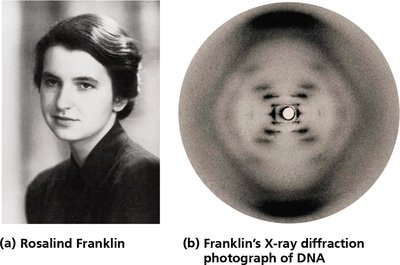
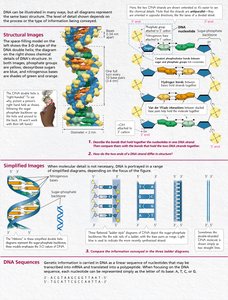
The three-dimensional structure of DNA was elucidated by James Watson and Francis Crick, aided by Rosalind Franklin's X-ray diffraction images. The structure is a double helix with two antiparallel sugar-phosphate backbones and nitrogenous bases paired in the interior.
X-ray diffraction revealed the helical structure and regular spacing of bases.
Antiparallel strands: The two DNA strands run in opposite directions (5' to 3' and 3' to 5').
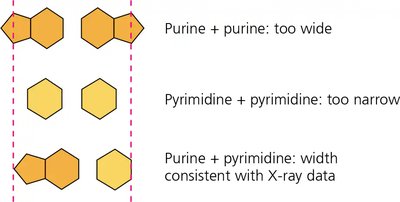
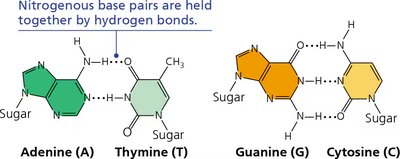
Base pairing: Adenine pairs with thymine (A-T) via two hydrogen bonds; guanine pairs with cytosine (G-C) via three hydrogen bonds.
Summary Table: Key Features of DNA Structure
Feature | Description |
|---|---|
Polymer type | Polynucleotide |
Backbone | Sugar-phosphate, covalently bonded |
Strand orientation | Antiparallel (5' to 3' and 3' to 5') |
Base pairing | A-T (2 H-bonds), G-C (3 H-bonds) |
Helix | Right-handed double helix |
Significance of the Double Helix Model
The double helix structure explained how DNA could store genetic information and be faithfully replicated. The sequence of bases encodes genetic instructions, and complementary base pairing enables accurate copying during cell division.
Key Terms
Transformation: Uptake of external DNA by a cell, resulting in a change in genotype and phenotype.
Bacteriophage (phage): A virus that infects bacteria.
Nucleotide: The building block of DNA, consisting of a phosphate group, deoxyribose sugar, and nitrogenous base.
Antiparallel: Refers to the opposite orientation of the two DNA strands.
Double helix: The spiral structure formed by two complementary strands of DNA.
Key Equations
Base pairing: and
Total base percentage:
