 Back
DNA as the Genetic Material: Structure, Replication, and Packaging
Study Guide - Smart Notes
 Tailored notes based on your materials, expanded with key definitions, examples, and context.
DNA as the Genetic Material
Discovery of DNA as Genetic Material
The identification of DNA as the molecule of heredity was a pivotal moment in biology. Early experiments demonstrated that DNA, not protein, carries genetic information and can transform organisms.
Griffith's Transformation Experiment (1928): Demonstrated that a "transforming principle" from dead pathogenic bacteria could permanently change harmless bacteria into a pathogenic form.
Avery-MacLeod-McCarty Experiment (1944): Used enzymatic destruction to show that DNA was the transforming principle responsible for genetic change.
Hershey-Chase Experiment (1952): Used radioactive labeling to prove that viral DNA, not protein, enters bacteria and directs viral replication.
Conclusion: Uptake of foreign DNA can alter an organism's genotype and phenotype, establishing DNA as the genetic material.
DNA Structure
The structure of DNA explains its ability to store, copy, and transmit genetic information. Key discoveries revealed DNA as a double helix with specific base pairing.
DNA Composition: DNA is a polymer of nucleotides, each containing a nitrogenous base (adenine, guanine, cytosine, thymine), a deoxyribose sugar, and a phosphate group.
Chargaff's Rules: The amount of adenine equals thymine, and guanine equals cytosine, indicating complementary base pairing.
Rosalind Franklin's X-ray Crystallography: Revealed the helical structure and uniform width of DNA.
Watson and Crick's Double Helix Model: DNA consists of two antiparallel strands forming a double helix. The sugar-phosphate backbone forms the sides, and the bases form the rungs.
Base-Pairing Rules: A pairs with T (two hydrogen bonds), G pairs with C (three hydrogen bonds).
Example: If a DNA sample contains 30% adenine, it must also contain 30% thymine. The remaining 40% is split equally between guanine and cytosine (20% each).
DNA Replication
DNA replication is the process by which genetic information is accurately copied for cell division. The semi-conservative model ensures each new DNA molecule contains one parental and one new strand.
Semi-conservative Model: Each new DNA molecule consists of one original strand and one newly synthesized strand.
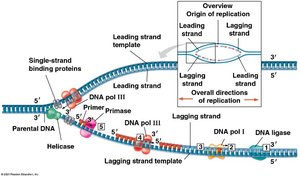
Replication Process: Begins at origins of replication, forming replication bubbles and forks. Replication proceeds in both directions.
Key Enzymes:
Helicase: Unwinds the DNA double helix.
Single-strand binding proteins: Stabilize separated strands.
Topoisomerase: Relieves strain ahead of the fork.
Primase: Synthesizes RNA primers.
DNA Polymerase III: Adds nucleotides to the 3' end and proofreads.
DNA Polymerase I: Removes RNA primers and fills gaps.
DNA Ligase: Seals breaks in the DNA backbone.
Leading vs. Lagging Strands:
Leading strand: Synthesized continuously toward the replication fork.
Lagging strand: Synthesized discontinuously in Okazaki fragments, away from the fork. DNA ligase seals the fragments.
Example: The replication fork is like a zipper; the leading strand is zipped continuously, while the lagging strand is zipped in segments.
DNA Damage and Mutations
DNA replication is highly accurate, but errors and environmental factors can cause mutations, which are the source of genetic variation and essential for evolution.
Causes of Mutations:
Errors during replication
Mutagens (chemicals)
High-energy radiation (UV, X-rays)
DNA Repair Mechanisms: Nucleotide excision repair and other pathways fix most errors.
Example: UV radiation can cause thymine dimers, distorting the DNA helix and potentially leading to skin cancer if unrepaired.
Telomeres
Telomeres are specialized structures at the ends of linear chromosomes in eukaryotes, protecting essential genes from erosion during replication.
Replication Challenge: DNA polymerase cannot complete the very end of the lagging strand, leading to chromosome shortening.
Telomeres: Repetitive, non-coding sequences act as buffers.
Telomerase: Enzyme that lengthens telomeres in germ and some cancer cells, preventing shortening.
Example: Telomeres are like plastic tips on shoelaces, protecting the important part from fraying.
DNA Packaging
Efficient DNA packaging is essential for fitting the genome into the nucleus and regulating gene expression. Packaging differs between prokaryotes and eukaryotes.
Prokaryotes: Single circular chromosome, supercoiled in the nucleoid.
Eukaryotes: Linear DNA wraps around histones to form nucleosomes ("beads on a string"). Chromatin is further compacted into chromosomes.
Euchromatin: Loosely packed, transcriptionally active.
Heterochromatin: Tightly packed, transcriptionally inactive.
Example: DNA is like a long string wrapped around spools (histones) and packed into a small box (nucleus), with some sections easily accessible and others tightly locked away.
Additional info:
DNA replication in eukaryotes involves multiple origins of replication, allowing rapid duplication of large genomes.
Mutations can be beneficial, neutral, or harmful, contributing to genetic diversity and evolution.
