 Back
BackDNA Replication and Repair: Mechanisms and Molecular Players
Study Guide - Smart Notes
 Tailored notes based on your materials, expanded with key definitions, examples, and context.
DNA Replication: Principles and Models
Base Pairing and the Template Mechanism
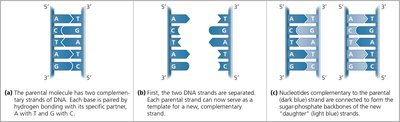
DNA replication is the process by which a cell copies its genetic material, ensuring faithful transmission of hereditary information. The double helix structure of DNA, with its specific base pairing (A with T, G with C), allows each strand to serve as a template for the synthesis of a new complementary strand.
Base Pairing: Each parental DNA strand dictates the sequence of the new strand by complementary base pairing.
Template Mechanism: The two strands of the parental DNA separate, and new nucleotides are added according to base-pairing rules, resulting in two identical DNA molecules.
Semiconservative Replication: Each daughter DNA molecule consists of one parental and one newly synthesized strand.
Example: If the parental sequence is 5'-ATGC-3', the new strand will be 3'-TACG-5'.
Alternative Models of DNA Replication
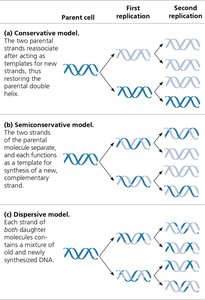
Three models were proposed to explain how DNA replicates:
Conservative Model: The parental double helix remains intact, and an entirely new double helix is synthesized.
Semiconservative Model: Each daughter molecule contains one parental and one new strand (supported by experimental evidence).
Dispersive Model: Each strand of both daughter molecules contains a mixture of old and new DNA.
Experimental Evidence: Meselson-Stahl Experiment
Design and Results
The Meselson-Stahl experiment provided strong evidence for the semiconservative model of DNA replication. They used isotopic labeling to distinguish old and new DNA strands.
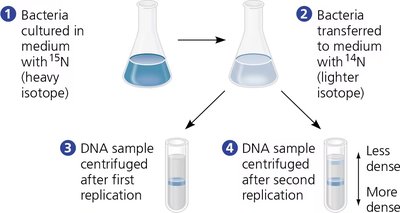
Method: E. coli were grown in a medium containing heavy nitrogen (15N), then transferred to a medium with light nitrogen (14N). DNA was extracted after each replication round and analyzed by density gradient centrifugation.
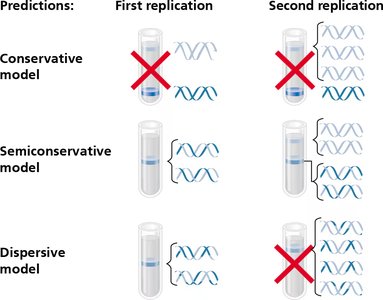
Results: After one replication, DNA was of intermediate density (hybrid), ruling out the conservative model. After two replications, both light and hybrid DNA were present, ruling out the dispersive model and supporting the semiconservative model.
Mechanism of DNA Replication
Origins of Replication
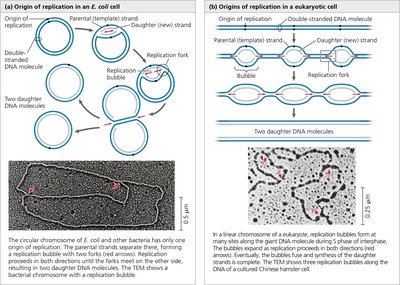
Replication begins at specific sequences called origins of replication. Prokaryotes typically have a single origin, while eukaryotes have multiple origins per chromosome, allowing rapid and efficient DNA synthesis.
Replication Bubble: The DNA unwinds at the origin, forming a bubble with two replication forks moving in opposite directions.
Bidirectional Replication: Both prokaryotic and eukaryotic DNA replication proceed in both directions from each origin.
Key Enzymes and Proteins in DNA Replication
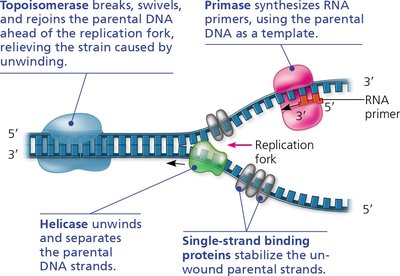
Multiple proteins and enzymes coordinate the unwinding and synthesis of new DNA strands at the replication fork:
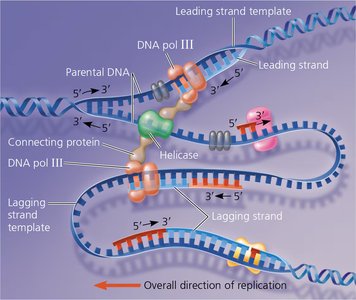
Helicase: Unwinds and separates the parental DNA strands.
Single-Strand Binding Proteins: Stabilize unwound DNA, preventing re-annealing.
Topoisomerase: Relieves strain ahead of the replication fork by breaking, swiveling, and rejoining DNA strands.
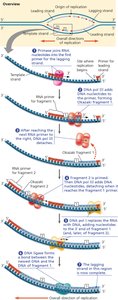
Primase: Synthesizes short RNA primers needed to start DNA synthesis.
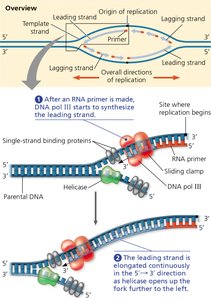
DNA Polymerase III: Extends the new DNA strand from the primer by adding nucleotides in the 5'→3' direction.
DNA Polymerase I: Replaces RNA primers with DNA nucleotides.
DNA Ligase: Joins Okazaki fragments on the lagging strand, forming a continuous DNA strand.
Synthesis of New DNA Strands
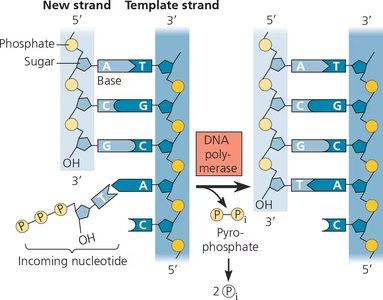
DNA polymerases add nucleotides to the 3' end of a growing DNA strand. Each nucleotide added is a deoxynucleoside triphosphate (dNTP), and the energy for polymerization comes from the hydrolysis of the released pyrophosphate.
Directionality: DNA synthesis always proceeds in the 5'→3' direction.
Energy Source: Hydrolysis of pyrophosphate (PPi) drives the reaction.
Equation:
Leading and Lagging Strand Synthesis
Because DNA polymerases can only add nucleotides to the 3' end, the two new strands are synthesized differently:
Leading Strand: Synthesized continuously toward the replication fork.
Lagging Strand: Synthesized discontinuously away from the fork as short Okazaki fragments, each requiring a new primer.
Okazaki Fragments: Short DNA segments on the lagging strand, later joined by DNA ligase.
Coordination of Replication
The DNA replication complex, or "replisome," coordinates the activities of all enzymes and proteins involved. The lagging strand forms a loop so that both leading and lagging strand synthesis can occur simultaneously at the replication fork.
Proofreading and DNA Repair
Proofreading by DNA Polymerases
DNA polymerases possess proofreading activity, correcting errors during DNA synthesis. If an incorrect nucleotide is incorporated, the enzyme removes it and replaces it with the correct one, greatly increasing fidelity.
Error Rate: Initial error rate is 1 in 105 nucleotides; after proofreading and repair, the error rate drops to 1 in 1010.
DNA Repair Mechanisms
Cells have multiple repair systems to correct DNA damage and replication errors:
Mismatch Repair: Enzymes recognize and replace incorrectly paired nucleotides missed by DNA polymerase.
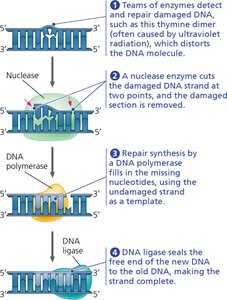
Nucleotide Excision Repair: Damaged DNA segments are excised by nucleases and replaced using the undamaged strand as a template. This is crucial for correcting lesions such as thymine dimers caused by UV light.
Telomeres and the End-Replication Problem
Telomeres
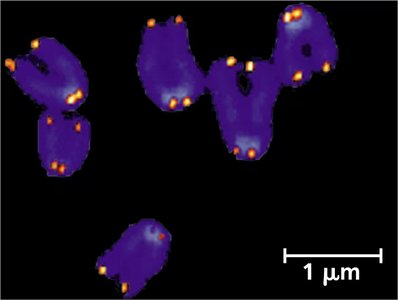
Linear eukaryotic chromosomes face the end-replication problem, where the 5' ends cannot be fully replicated, leading to progressive shortening. Telomeres are repetitive, noncoding sequences at chromosome ends that protect genes from erosion.
Function: Telomeres act as buffers, postponing the loss of essential genes.
Telomerase: An enzyme that extends telomeres in germ cells, maintaining chromosome length across generations.
Clinical Relevance: Telomere shortening is associated with aging; telomerase activity is often upregulated in cancer cells.
Summary Table: Key Proteins in DNA Replication (E. coli)
Protein/Enzyme | Function |
|---|---|
Helicase | Unwinds parental double helix at replication forks |
Single-strand binding protein | Stabilizes single-stranded DNA |
Topoisomerase | Relieves overwinding strain ahead of replication fork |
Primase | Synthesizes RNA primers |
DNA polymerase III | Main enzyme for DNA synthesis |
DNA polymerase I | Removes RNA primers and replaces with DNA |
DNA ligase | Joins Okazaki fragments on lagging strand |
Evolutionary Significance of DNA Replication Fidelity
High fidelity in DNA replication and repair is essential for organismal survival and inheritance. However, rare mutations that escape repair are the source of genetic variation, driving evolution and the emergence of new species.
Mutation: A permanent change in DNA sequence; can be harmful, neutral, or beneficial.
Evolution: Mutations provide the raw material for natural selection and evolutionary change.
