 Back
DNA Replication and Structure: Study Notes for General Biology
Study Guide - Smart Notes
 Tailored notes based on your materials, expanded with key definitions, examples, and context.
DNA Replication and the Central Dogma
Overview of the Central Dogma
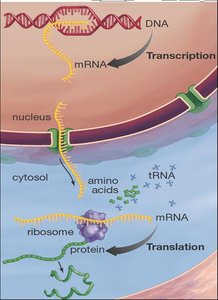
The central dogma of molecular biology describes the flow of genetic information within a biological system. It explains how DNA is transcribed into RNA and then translated into protein, which determines cellular structure and function.
DNA Replication: The process by which DNA makes an identical copy of itself before cell division.
Transcription: The synthesis of RNA from a DNA template.
Translation: The synthesis of proteins from an mRNA template.
Language Change: Information is converted from nucleic acid language (DNA/RNA) to amino acid language (protein).
Properties of Life and DNA
Key Properties
DNA is fundamental to life because it is self-replicating, stores and transmits genetic instructions, and is capable of evolving through mutation.
Self-replication: DNA can duplicate itself, ensuring genetic continuity.
Instruction Storage and Execution: DNA encodes instructions for cellular processes, executed via transcription and translation.
Evolution: Mutations in DNA provide genetic variation, the raw material for evolution.
DNA Structure
Double Helix and Nucleotide Composition
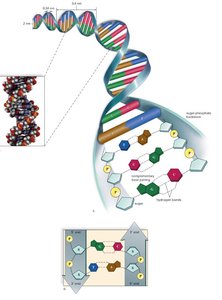
DNA is composed of two antiparallel strands forming a double helix. Each strand is a polymer of nucleotides, which consist of a phosphate group, a deoxyribose sugar, and a nitrogenous base.
Antiparallel Strands: The two DNA strands run in opposite directions (5' to 3' and 3' to 5').
Backbone: The sugar-phosphate backbone provides structural stability.
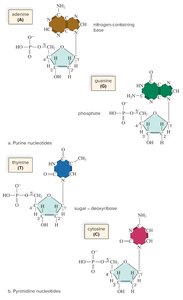
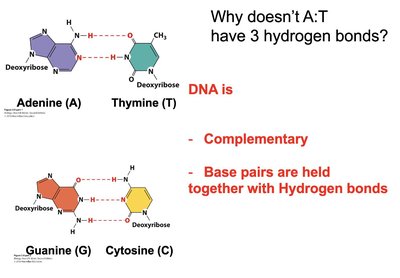
Bases: Adenine (A), Thymine (T), Guanine (G), and Cytosine (C) pair specifically (A with T, G with C) via hydrogen bonds.
Nucleotide Structure
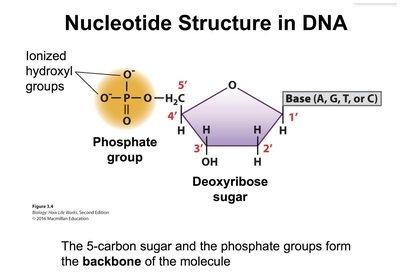
Each nucleotide contains a 5-carbon deoxyribose sugar, a phosphate group, and a nitrogenous base. The 5' carbon is attached to the phosphate group, and the 1' carbon is attached to the base.
Phosphodiester Bonds: Link nucleotides together, forming the backbone.
Directionality: DNA strands have polarity, defined by the 5' and 3' ends.
Base Pairing and Hydrogen Bonds
Base pairs are held together by hydrogen bonds: A pairs with T (2 hydrogen bonds), and G pairs with C (3 hydrogen bonds). This complementarity ensures accurate DNA replication.
Complementary Base Pairing: Maintains the double helix structure and fidelity during replication.
DNA Replication
General Process
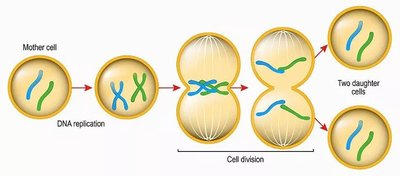
DNA replication is the process by which a cell duplicates its DNA before cell division. It is semi-conservative, meaning each new DNA molecule contains one parental and one newly synthesized strand.
Initiation: Replication begins at specific origins of replication, where initiator proteins bind and recruit helicase to unwind the DNA.
Elongation: DNA polymerase synthesizes new DNA strands by adding nucleotides to the 3' end of the primer.
Termination: Replication ends when the entire molecule has been copied.
Enzymes and Proteins Involved
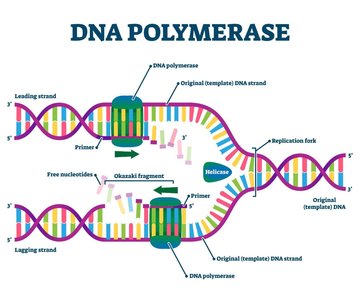
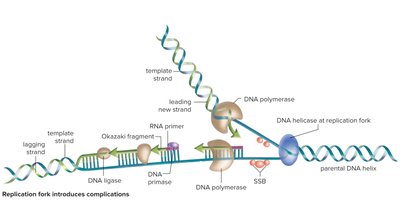
Helicase: Unwinds the DNA double helix.
RNA Primase: Synthesizes short RNA primers to provide a starting point for DNA polymerase.
DNA Polymerase: Adds nucleotides to the growing DNA strand in the 5' to 3' direction.
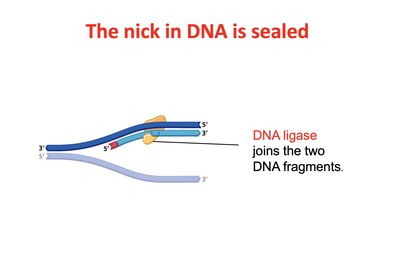
DNA Ligase: Seals nicks in the sugar-phosphate backbone, joining Okazaki fragments on the lagging strand.
Leading and Lagging Strands
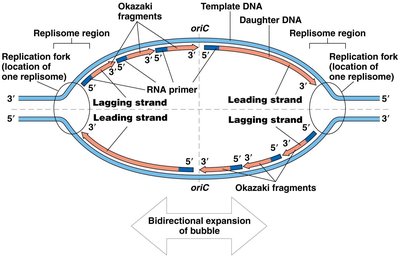
Because DNA polymerase can only synthesize DNA in the 5' to 3' direction, replication is continuous on the leading strand and discontinuous on the lagging strand, forming Okazaki fragments.
Leading Strand: Synthesized continuously toward the replication fork.
Lagging Strand: Synthesized discontinuously away from the fork in short segments (Okazaki fragments).
Proofreading and Mutation
DNA polymerase has proofreading activity to correct mismatched nucleotides. If errors are not corrected, they become mutations, which are permanent changes in the DNA sequence.
Proofreading: Reduces the error rate during DNA replication.
Mutation: Source of genetic variation and evolution.
Replication in Prokaryotes vs. Eukaryotes
Prokaryotic DNA replication typically starts from a single origin and proceeds bidirectionally around a circular chromosome. Eukaryotic chromosomes are linear and have multiple origins of replication, allowing for rapid duplication of large genomes.
Prokaryotes: Single origin, circular DNA, rapid replication.
Eukaryotes: Multiple origins, linear DNA, slower polymerase but faster overall due to many origins.
Summary Table: Key Enzymes in DNA Replication
Enzyme/Protein | Function |
|---|---|
Helicase | Unwinds the DNA double helix |
RNA Primase | Synthesizes RNA primers |
DNA Polymerase | Adds nucleotides to the 3' end of the primer |
DNA Ligase | Seals nicks in the DNA backbone |
Additional info: The process of DNA replication is highly regulated and involves additional proteins such as single-strand binding proteins (SSBs) and topoisomerases, which prevent supercoiling and stabilize unwound DNA.
