 Back
DNA Replication and Structure: Study Notes for General Biology
Study Guide - Smart Notes
 Tailored notes based on your materials, expanded with key definitions, examples, and context.
DNA Replication and the Central Dogma
The Central Dogma of Molecular Biology
The central dogma describes the flow of genetic information within a biological system. It explains how DNA is transcribed into RNA, which is then translated into protein. This process is fundamental to all living organisms.
Transcription: The process by which a segment of DNA is copied into messenger RNA (mRNA).
Translation: The process by which the mRNA sequence is used to synthesize a protein.
Replication: The process by which DNA makes an identical copy of itself before cell division.
Language Change: Transcription and translation involve changing the 'language' from nucleic acids to amino acids.
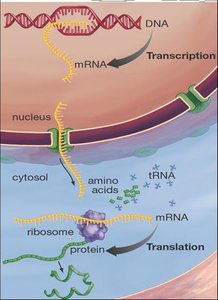
Additional info: The central dogma is essential for understanding how genetic information is expressed and inherited.
Properties of Life and DNA
Key Properties of Living Systems
Life is characterized by the ability to replicate, store and follow genetic instructions, and evolve through mutation.
Self-replication: DNA replication ensures genetic continuity between generations.
Information Storage: DNA stores instructions for cellular processes.
Evolution: Mutations in DNA provide genetic variation, the raw material for evolution.
DNA Structure
Overview of DNA Structure
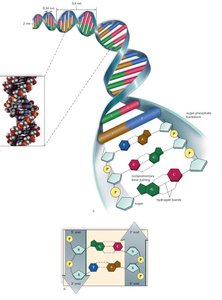
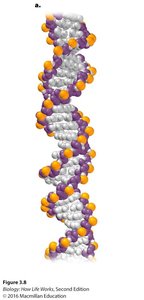
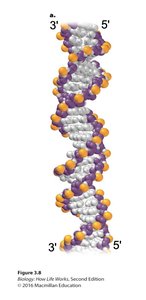
DNA (deoxyribonucleic acid) is a double helix composed of two antiparallel strands of nucleotides. Each nucleotide consists of a phosphate group, a deoxyribose sugar, and a nitrogenous base.
Double Helix: Two strands twist around each other, forming a helical structure.
Antiparallel Strands: The two strands run in opposite directions (5' to 3' and 3' to 5').
Backbone: The sugar-phosphate backbone provides structural support.
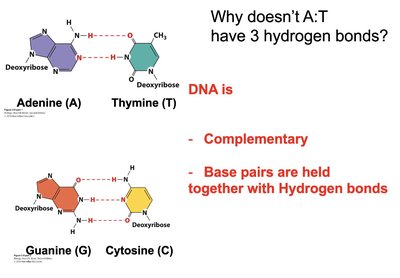
Base Pairing: Nitrogenous bases pair specifically (A with T, G with C) via hydrogen bonds.
Nucleotide Structure
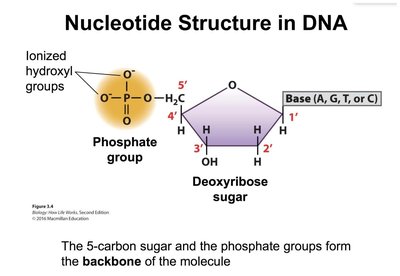
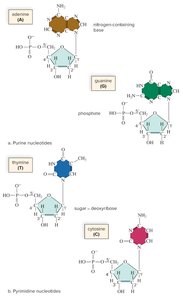
Nucleotides are the building blocks of DNA. Each nucleotide contains a phosphate group, a five-carbon deoxyribose sugar, and a nitrogenous base (adenine, thymine, guanine, or cytosine).
Phosphate Group: Attached to the 5' carbon of the sugar.
Deoxyribose Sugar: Lacks an oxygen atom at the 2' position compared to ribose.
Nitrogenous Base: Attached to the 1' carbon of the sugar.
Types of Nitrogenous Bases
Nitrogenous bases are classified as purines (adenine and guanine) or pyrimidines (cytosine and thymine).
Purines: Double-ring structures (adenine, guanine).
Pyrimidines: Single-ring structures (cytosine, thymine).
Base Pairing and Hydrogen Bonds
Base pairs are held together by hydrogen bonds, ensuring the specificity of DNA replication and transcription.
Adenine (A) pairs with Thymine (T): Two hydrogen bonds.
Guanine (G) pairs with Cytosine (C): Three hydrogen bonds.
Antiparallel Orientation
The two DNA strands run in opposite directions, which is critical for replication and enzyme function.
5' End: Phosphate group attached to the 5' carbon.
3' End: Hydroxyl group attached to the 3' carbon.
DNA Replication
Overview of DNA Replication
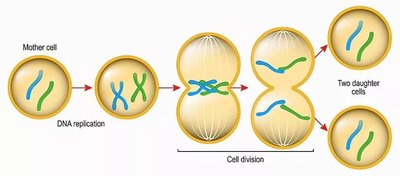
DNA replication is the process by which a cell copies its DNA before cell division, ensuring that each daughter cell receives an identical set of genetic information.
Semi-conservative: Each new DNA molecule consists of one parental and one newly synthesized strand.
Occurs before cell division: Essential for growth, repair, and reproduction.
Enzymes and Steps in DNA Replication
Several enzymes coordinate the accurate and efficient replication of DNA.
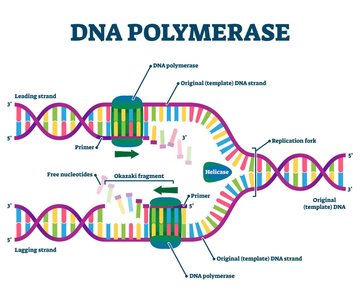
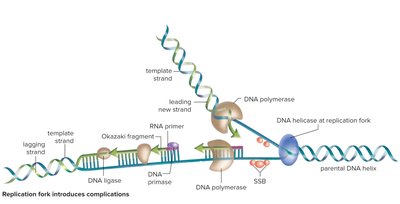
Helicase: Unwinds the DNA double helix by breaking hydrogen bonds.
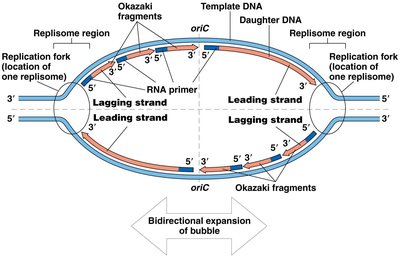
RNA Primase: Synthesizes short RNA primers to provide a starting point for DNA polymerase.
DNA Polymerase: Adds nucleotides to the 3' end of the primer, synthesizing new DNA in the 5' to 3' direction.
DNA Ligase: Seals nicks in the sugar-phosphate backbone, joining Okazaki fragments on the lagging strand.
Directionality of DNA Synthesis
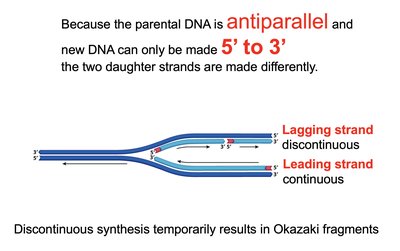
DNA polymerase can only add nucleotides to the 3' end, so new DNA is always synthesized in the 5' to 3' direction.
Leading Strand: Synthesized continuously toward the replication fork.
Lagging Strand: Synthesized discontinuously away from the fork in short segments called Okazaki fragments.
Proofreading and Mutation
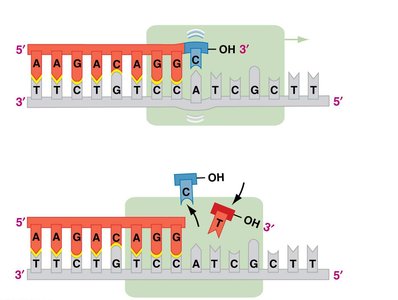
DNA polymerase has proofreading activity to correct errors during replication. If mistakes are not corrected, mutations can occur, leading to genetic variation or disease.
Proofreading: DNA polymerase removes mismatched nucleotides and replaces them with the correct ones.
Mutation: A permanent change in the DNA sequence.
Replication in Prokaryotes vs. Eukaryotes
Replication mechanisms are conserved, but there are differences between prokaryotic and eukaryotic cells.
Prokaryotes: Typically have a single, circular chromosome and one origin of replication.
Eukaryotes: Have multiple, linear chromosomes and thousands of origins of replication per chromosome, allowing rapid duplication.
Summary Table: Key Enzymes in DNA Replication
Enzyme | Function |
|---|---|
Helicase | Unwinds the DNA double helix |
RNA Primase | Synthesizes RNA primers |
DNA Polymerase | Adds nucleotides to the growing DNA strand; proofreads |
DNA Ligase | Seals nicks in the DNA backbone |
Key Equations and Concepts
Phosphodiester Bond Formation:
Base Pairing:
(2 hydrogen bonds), (3 hydrogen bonds)
Additional info: Understanding DNA replication is essential for topics such as genetics, cell division, and biotechnology.
