 Back
DNA Replication and Structure: Study Notes for General Biology
Study Guide - Smart Notes
 Tailored notes based on your materials, expanded with key definitions, examples, and context.
DNA Replication and the Central Dogma
The Central Dogma of Molecular Biology
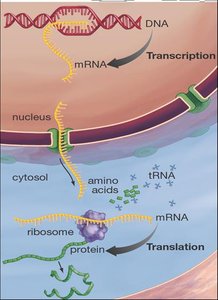
The central dogma describes the flow of genetic information within a biological system. It explains how DNA is transcribed into RNA, which is then translated into protein. This process is fundamental to all living organisms and underlies the mechanisms of heredity and gene expression.
Transcription: The process by which a segment of DNA is copied into messenger RNA (mRNA).
Translation: The process by which the sequence of the mRNA is decoded to produce a specific polypeptide (protein).
Replication: The process by which DNA makes an identical copy of itself before cell division.
Language Change: During translation, the language changes from nucleic acids (DNA/RNA) to amino acids (proteins).
Properties of Life Related to DNA
Key Properties
DNA is central to the properties of life because it is self-replicating, stores and transmits instructions, and evolves through mutation. These properties enable organisms to reproduce, maintain homeostasis, and adapt to their environment.
Self-replication: DNA can make copies of itself, ensuring genetic continuity.
Instruction Storage and Execution: DNA contains genes that are transcribed and translated to produce proteins.
Evolution: Mutations in DNA provide genetic variation, the raw material for evolution.
DNA Replication and Cell Division
Overview of DNA Replication
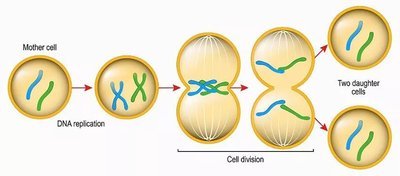
Before a cell divides, it must replicate its DNA so that each daughter cell receives an identical set of genetic instructions. DNA replication is a highly regulated and accurate process, ensuring genetic fidelity across generations.
Timing: DNA replication occurs before cell division (mitosis or meiosis).
Outcome: Two identical DNA molecules are produced, each consisting of one parental and one newly synthesized strand (semi-conservative replication).
DNA Structure
Double Helix and Nucleotide Composition
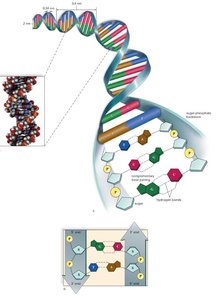
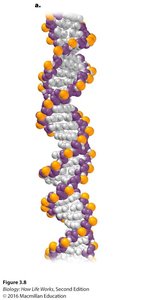
DNA is composed of two antiparallel strands forming a double helix. Each strand is a polymer of nucleotides, which consist of a phosphate group, a deoxyribose sugar, and a nitrogenous base. The strands are held together by complementary base pairing via hydrogen bonds.
Backbone: The sugar-phosphate backbone forms the structural framework of DNA.
Bases: The four nitrogenous bases are adenine (A), thymine (T), guanine (G), and cytosine (C).
Antiparallel Orientation: One strand runs 5' to 3', the other 3' to 5'.
Nucleotide Structure
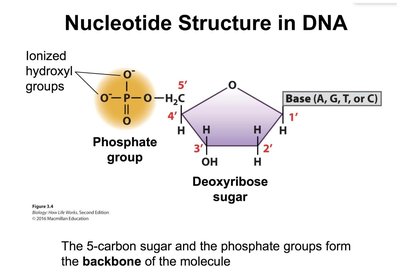
Each nucleotide in DNA consists of three components: a phosphate group, a deoxyribose sugar, and a nitrogenous base. The 5-carbon sugar and phosphate groups form the backbone, while the bases project inward to form base pairs.
Phosphate Group: Attached to the 5' carbon of the sugar.
Deoxyribose Sugar: A five-carbon sugar lacking an oxygen atom at the 2' position.
Nitrogenous Base: Attached to the 1' carbon of the sugar (A, T, G, or C).
Purines and Pyrimidines
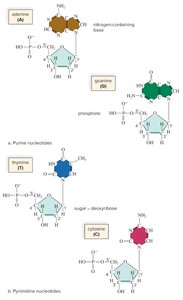
Nitrogenous bases are classified as purines (adenine and guanine) or pyrimidines (cytosine and thymine). Purines have a double-ring structure, while pyrimidines have a single-ring structure.
Purines: Adenine (A), Guanine (G)
Pyrimidines: Thymine (T), Cytosine (C)
Antiparallel Strands
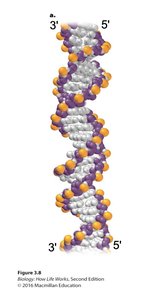
The two strands of DNA run in opposite directions, described as antiparallel. One strand runs from 5' to 3', and the other from 3' to 5'. This orientation is essential for replication and other DNA processes.
Formation of the DNA Polymer
Dehydration Synthesis and Phosphodiester Bonds
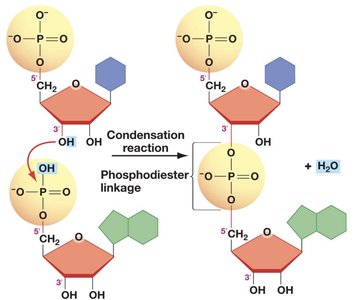
DNA polymerization occurs through dehydration synthesis, forming phosphodiester bonds between the 3' hydroxyl group of one nucleotide and the 5' phosphate of the next. This reaction is catalyzed by DNA polymerase during replication.
Directionality: DNA is synthesized in the 5' to 3' direction.
Phosphodiester Bond: The covalent bond linking nucleotides in the backbone.
Base Pairing and Complementarity
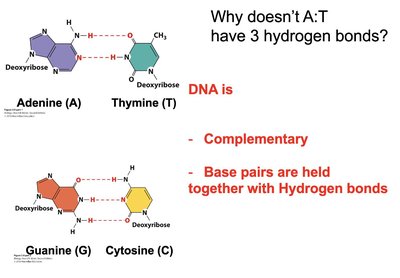
Hydrogen Bonding Between Bases
Base pairs are held together by hydrogen bonds, ensuring specificity and stability of the double helix. Adenine pairs with thymine (A-T) via two hydrogen bonds, and guanine pairs with cytosine (G-C) via three hydrogen bonds.
Complementary Base Pairing: Ensures accurate DNA replication and transcription.
Hydrogen Bonds: Provide stability but allow the strands to separate during replication and transcription.
Mechanism of DNA Replication
Initiation of Replication
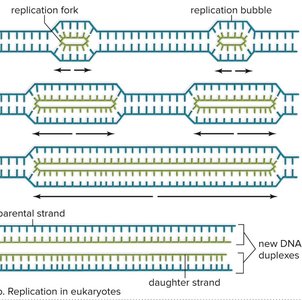
DNA replication begins at specific locations called origins of replication. Initiator proteins bind to these sites, recruiting helicase to unwind the DNA and create replication forks.
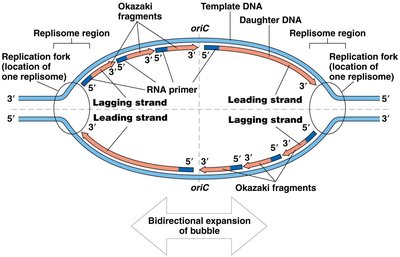
Replication Bubble: The region where the DNA is unwound and replication occurs in both directions.
Helicase: Enzyme that unwinds the DNA double helix.
Primer Synthesis and Elongation
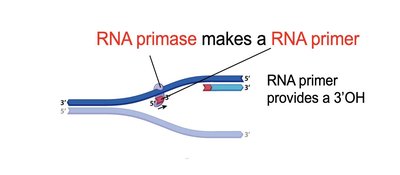
RNA primase synthesizes short RNA primers to provide a starting point for DNA polymerase. DNA polymerase then adds nucleotides to the 3' end of the primer, synthesizing the new DNA strand in the 5' to 3' direction.
RNA Primer: Short RNA sequence that provides a free 3' hydroxyl group for DNA polymerase.
DNA Polymerase: Enzyme that adds nucleotides to the growing DNA strand.
Leading and Lagging Strands
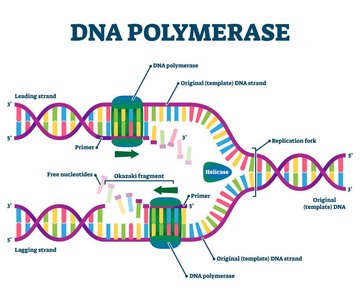
Because DNA polymerase can only synthesize DNA in the 5' to 3' direction, replication is continuous on the leading strand and discontinuous on the lagging strand. The lagging strand is synthesized in short fragments called Okazaki fragments.
Leading Strand: Synthesized continuously toward the replication fork.
Lagging Strand: Synthesized discontinuously away from the replication fork in Okazaki fragments.
Proofreading and Error Correction
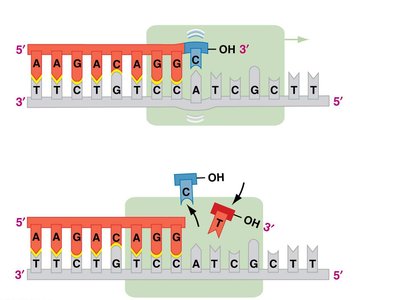
DNA polymerase has proofreading activity, allowing it to remove incorrectly paired nucleotides and replace them with the correct ones. This ensures high fidelity during DNA replication.
Proofreading: Reduces the error rate during DNA synthesis.
Mutation: If errors are not corrected, they become permanent mutations in the DNA sequence.
Primer Removal and Ligation
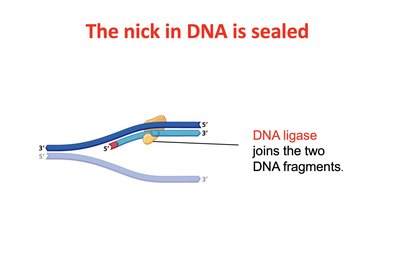
After DNA synthesis, RNA primers are removed and replaced with DNA. DNA ligase then seals the nicks between adjacent DNA fragments, forming a continuous strand.
DNA Ligase: Enzyme that forms the final phosphodiester bond, sealing the DNA backbone.
Semi-Conservative Replication
Mechanism and Evidence
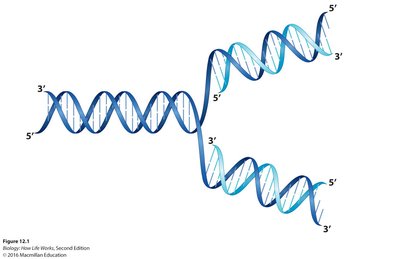
DNA replication is semi-conservative, meaning each new DNA molecule consists of one parental and one newly synthesized strand. This mechanism ensures genetic continuity and was confirmed by the Meselson-Stahl experiment.
Parental Strands: Serve as templates for new strand synthesis.
Daughter Strands: Each contains one old and one new strand.
Prokaryotic vs. Eukaryotic DNA Replication
Comparison of Replication Mechanisms
Prokaryotic DNA replication typically starts from a single origin and proceeds bidirectionally around a circular chromosome. Eukaryotic chromosomes are linear and have multiple origins of replication, allowing for rapid duplication of large genomes.
Feature | Prokaryotes | Eukaryotes |
|---|---|---|
Chromosome Structure | Circular | Linear |
Number of Origins | One | Multiple |
Replication Speed | Fast (entire genome in ~20 min) | Slower per fork, but many forks |
Summary Table: Key Enzymes in DNA Replication
Enzyme | Function |
|---|---|
Helicase | Unwinds the DNA double helix |
Primase | Synthesizes RNA primers |
DNA Polymerase | Adds nucleotides to the growing DNA strand |
Ligase | Seals nicks in the DNA backbone |
Proofreading Activity | Removes mismatched nucleotides |
Key Equations
Phosphodiester Bond Formation:
Base Pairing:
Additional info: These notes integrate foundational concepts from the central dogma, DNA structure, and the molecular mechanisms of DNA replication, as covered in introductory college biology courses.
