 Back
BackDNA Replication: History, Mechanism, and Enzymology
Study Guide - Smart Notes
 Tailored notes based on your materials, expanded with key definitions, examples, and context.
DNA Replication
A. DNA’s History
The discovery of DNA as the genetic material was a pivotal moment in biology, involving a series of experiments with bacteria and viruses. These studies established DNA as the molecule responsible for heredity.
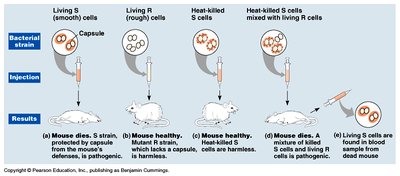
Griffith’s Experiment (1928): Frederick Griffith worked with two strains of Streptococcus pneumoniae: the smooth (S) strain, which is pathogenic due to its polysaccharide capsule, and the rough (R) strain, which lacks a capsule and is non-pathogenic. He discovered the phenomenon of transformation, where genetic material from dead S cells could convert R cells into pathogenic S cells.
Avery, MacLeod, and McCarty: Identified DNA as the transforming principle, though many scientists initially believed proteins were the genetic material.
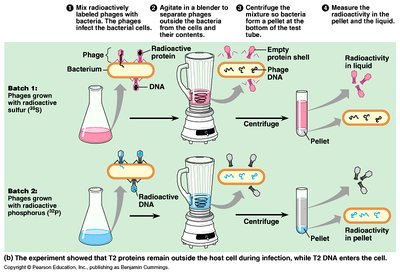
Hershey-Chase Experiment (1952): Used bacteriophages labeled with radioactive isotopes to show that DNA, not protein, is the genetic material transferred to bacteria during infection.
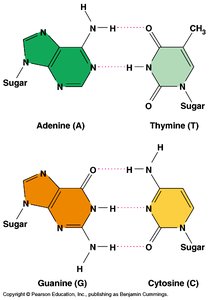
Chargaff’s Rules: Erwin Chargaff found that in DNA, the amount of adenine (A) equals thymine (T), and the amount of guanine (G) equals cytosine (C), leading to the base-pairing rules.
B. The Double Helix
The structure of DNA was elucidated through the combined efforts of several scientists, culminating in the double helix model.
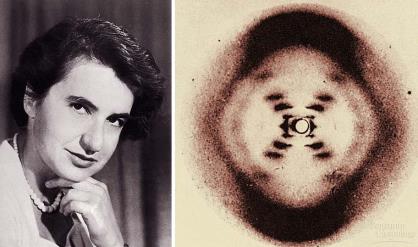
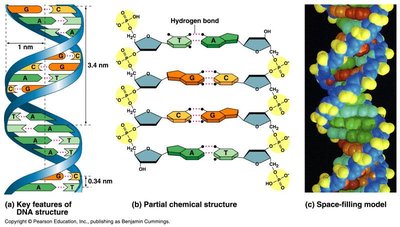
Watson and Crick: Built the first accurate model of DNA, using X-ray crystallography data from Rosalind Franklin and Maurice Wilkins. The model revealed DNA as a double helix with sugar-phosphate backbones on the outside and paired nitrogenous bases on the inside.
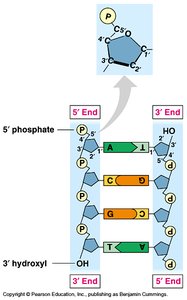
Base Pairing: Adenine pairs with thymine via two hydrogen bonds, and guanine pairs with cytosine via three hydrogen bonds, ensuring accurate replication.
C. DNA Replication Overview
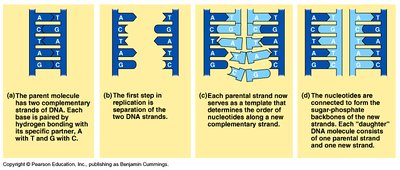
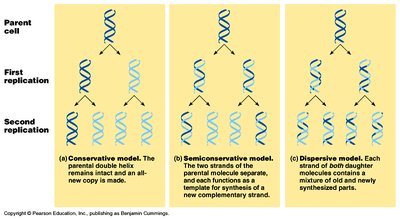
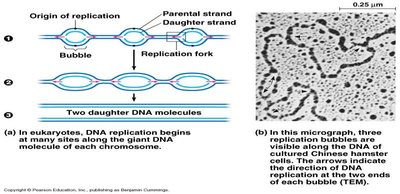
DNA replication is the process by which a cell copies its DNA before cell division. It is semi-conservative, meaning each new DNA molecule consists of one old and one new strand.
Initiation: Hydrogen bonds between bases are broken, and each strand serves as a template for a new complementary strand.
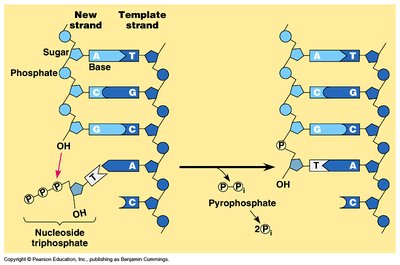
Nucleotide Addition: Free nucleotides align with complementary bases on the template strand, catalyzed by DNA polymerase.
Semi-Conservative Model: Each daughter DNA molecule contains one parental and one newly synthesized strand.
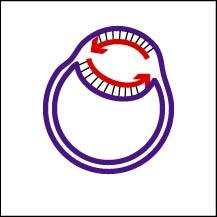
Prokaryotic vs. Eukaryotic Replication: Prokaryotes have a single origin of replication on their circular chromosome, while eukaryotes have multiple origins on their linear chromosomes to speed up replication.
D. DNA is Antiparallel
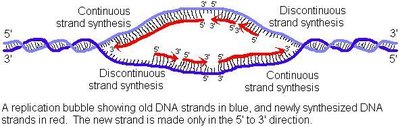
The two strands of DNA run in opposite directions, described as antiparallel. One strand runs 5' to 3', and the other 3' to 5'. DNA polymerase can only add nucleotides to the 3' end, so new DNA is always synthesized in the 5' to 3' direction.
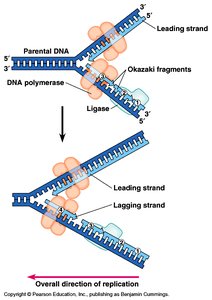
Leading Strand: Synthesized continuously toward the replication fork.
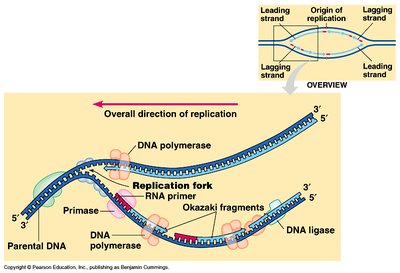
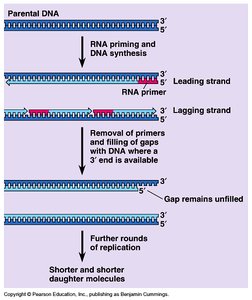
Lagging Strand: Synthesized discontinuously away from the fork in short segments called Okazaki fragments, which are later joined by DNA ligase.
E. The Enzymes of DNA Replication
Several enzymes coordinate the process of DNA replication:
Helicase: Unwinds the DNA double helix.
Single-Strand Binding Proteins: Stabilize unwound DNA.
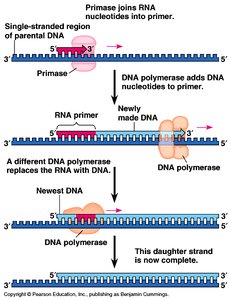
Primase: Synthesizes short RNA primers to provide a starting point for DNA polymerase.
DNA Polymerase III: Extends the new DNA strand from the primer.
DNA Polymerase I: Replaces RNA primers with DNA nucleotides.
DNA Ligase: Joins Okazaki fragments on the lagging strand.
F. Proofreading and DNA Repair
DNA replication is highly accurate due to proofreading and repair mechanisms:
Proofreading: DNA polymerase checks and corrects mismatched bases during replication.
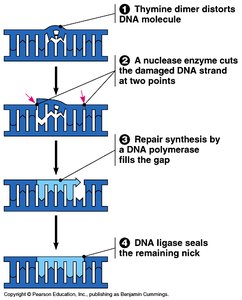
Excision Repair: Damaged DNA is recognized and removed by nucleases, filled in by DNA polymerase, and sealed by DNA ligase.
G. DNA Ends and Telomeres
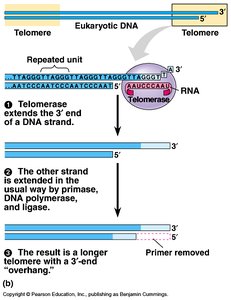
Linear chromosomes in eukaryotes face the problem of incomplete replication at their ends, leading to progressive shortening with each cell division. Telomeres and the enzyme telomerase help address this issue.
Telomeres: Repetitive, non-coding sequences at chromosome ends that protect genes from erosion.
Telomerase: An enzyme that extends telomeres in germ cells, maintaining chromosome length across generations.
Cellular Aging: Telomere shortening is associated with cellular aging; artificially increasing telomerase activity may increase cancer risk.
Key Terms and Concepts
Transformation: Uptake of foreign DNA by a cell, changing its genotype and phenotype.
Phage: A virus that infects bacteria.
Origin of Replication: Specific sequence where DNA replication begins.
Okazaki Fragments: Short DNA segments synthesized on the lagging strand.
Semiconservative Replication: Each new DNA molecule contains one old and one new strand.
Summary Table: Main Enzymes in DNA Replication
Enzyme | Function |
|---|---|
Helicase | Unwinds DNA double helix |
Single-Strand Binding Proteins | Stabilize unwound DNA |
Primase | Synthesizes RNA primer |
DNA Polymerase III | Adds nucleotides to new DNA strand |
DNA Polymerase I | Replaces RNA primers with DNA |
DNA Ligase | Joins Okazaki fragments |
Telomerase | Extends telomeres in germ cells |
Key Equations
Base Pairing: ,
Energy for DNA Synthesis:
