 Back
DNA Replication: Mechanisms, Models, and Experimental Evidence
Study Guide - Smart Notes
 Tailored notes based on your materials, expanded with key definitions, examples, and context.
DNA/RNA Processes and the Central Dogma
Overview of DNA and RNA Functions
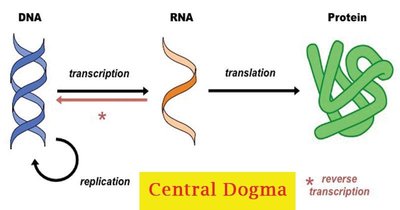
DNA and RNA are essential molecules in the cell, participating in three major processes: DNA replication, transcription, and translation. These processes are fundamental to cell division, gene expression, and protein synthesis.
DNA Replication: The process by which a copy of DNA is made for cell division, occurring in the nucleus.
Transcription: Messenger RNA (mRNA) is synthesized from DNA, also in the nucleus.
Translation: RNA is translated in the cytoplasm to produce proteins.
The Central Dogma of molecular biology describes the flow of genetic information: DNA → RNA → Protein.
Structure of DNA and Its Role in Replication
DNA Structure and Complementary Base Pairing
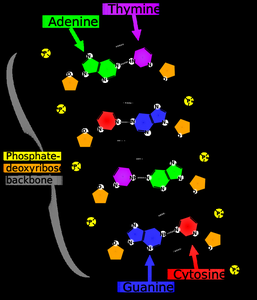
The double helix structure of DNA is held together by hydrogen bonds between complementary bases. This structure allows each strand to serve as a template for replication.
Complementary Base Pairing: Adenine pairs with Thymine, and Guanine pairs with Cytosine.
Hydrogen Bonds: These are weak and can break and reform, enabling strand separation during replication.
Template Function: Knowing the sequence of one strand allows inference of the other.
Models of DNA Replication
Three Proposed Models
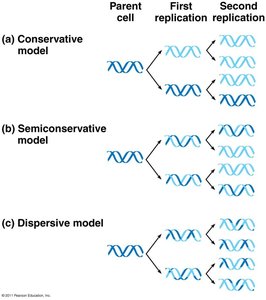
Before the mechanism was understood, three models were proposed for DNA replication:
Conservative Model: The parent DNA remains intact, and a completely new molecule is synthesized.
Semiconservative Model: Each daughter molecule contains one old (parental) strand and one newly synthesized strand.
Dispersive Model: Each strand of both daughter molecules contains a mix of old and new DNA.
Experimental Evidence: Meselson and Stahl Experiment
Testing DNA Replication Models
Meselson and Stahl's experiment in 1958 provided evidence for the semiconservative model of DNA replication.
Bacteria were grown in a medium containing heavy nitrogen (15N).
Bacteria were then transferred to a medium with lighter nitrogen (14N).
DNA samples were separated by density after each replication cycle.
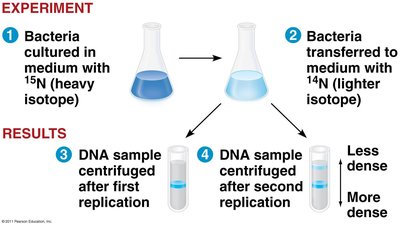
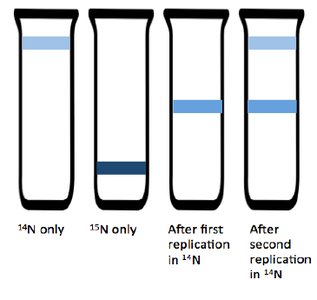
Results showed that after the first replication, DNA was intermediate in density, and after the second replication, two bands appeared: one intermediate and one light, supporting the semiconservative model.
Mechanism of DNA Replication
General Features
DNA replication is a highly coordinated process involving multiple proteins and enzymes. It is fast and accurate, with a low error rate.
Occurs in the nucleus (eukaryotes).
Copies the entire DNA strand prior to cell division.
Each new double helix contains one original and one new strand (semiconservative).
Enzymes and proteins perform the replication; DNA serves as the template.
Origins of Replication
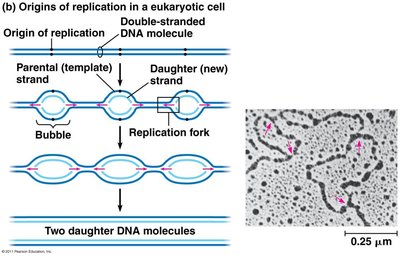
Replication begins at specific sites called origins of replication. Bacteria have a single origin, while eukaryotes have multiple origins on their linear chromosomes.
Proteins bind to the origin and separate the DNA strands, forming a replication bubble.
Replication proceeds in both directions from the origin.
Key Proteins and Enzymes in DNA Replication
Several proteins are essential for unwinding and stabilizing DNA during replication:
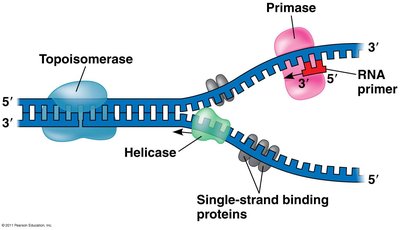
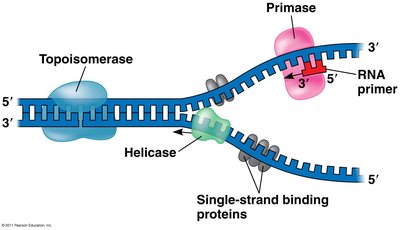
Helicase: Untwists the double helix at the replication fork.
Single-strand binding proteins (SSBPs): Stabilize separated strands.
Topoisomerase: Relieves strain ahead of the replication fork by breaking and rejoining DNA.
Initiating DNA Synthesis: Primase and Primers
DNA synthesis cannot begin without a primer. Primase synthesizes a short RNA primer to provide a 3' end for DNA polymerase.
Primers are 5-10 nucleotides long.
RNA can start from scratch; DNA cannot.
DNA Polymerase and Elongation
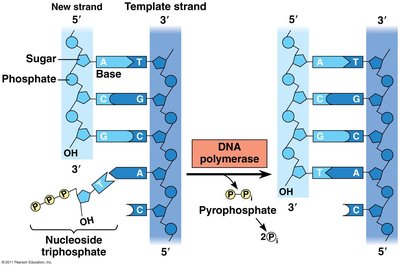
DNA polymerases add nucleotides to the growing DNA strand. In prokaryotes, DNA polymerase III is the main enzyme for elongation.
Adds nucleotides complementary to the template strand.
Catalyzes covalent bonds between the 3' end of the existing strand and the incoming nucleotide.
Nucleotides arrive as triphosphates, providing energy for polymerization.
Directionality of DNA Synthesis
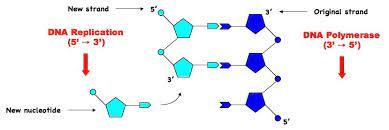
DNA polymerase can only add nucleotides to the 3' end, building the new strand in the 5' to 3' direction while reading the template from 3' to 5'.
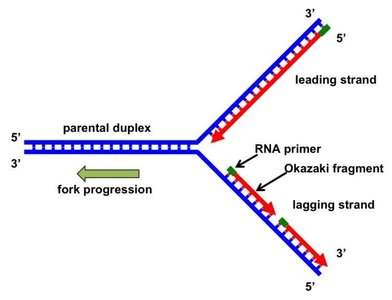
Leading strand is synthesized continuously.
Lagging strand is synthesized discontinuously in Okazaki fragments.
Leading and Lagging Strands
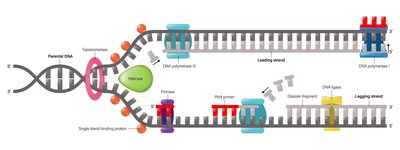
The leading strand is synthesized continuously, while the lagging strand is synthesized in short segments called Okazaki fragments.
Each Okazaki fragment requires a new RNA primer.
DNA polymerase III extends the fragment, then DNA polymerase I replaces the RNA primer with DNA.
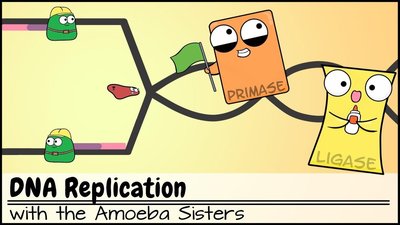
DNA ligase joins the fragments together.
Summary of DNA Replication Machinery
All replication proteins work together in a complex called the replication machine, synthesizing both leading and lagging strands at the replication fork.
The lagging strand loops through the replication machine to generate Okazaki fragments.
Replication is attached to the nuclear matrix in eukaryotes.
Proofreading and DNA Repair
Proofreading Mechanisms
DNA polymerases have proofreading abilities, allowing them to remove incorrectly paired nucleotides during replication.
Error rate is about 1 in 1010 nucleotides.
Replication machinery makes an error every 105 nucleotides, but most are corrected.
Mismatch Repair
Additional enzymes detect and repair mismatches that escape proofreading, as well as damage from environmental sources.
130 different repair enzymes have been identified in humans.
Mismatched nucleotides are cut out and replaced with correct ones.
Summary Table: Key Enzymes in DNA Replication
Enzyme/Protein | Function |
|---|---|
Helicase | Unwinds DNA at the replication fork |
Single-strand binding proteins | Stabilize separated DNA strands |
Topoisomerase | Relieves strain ahead of the fork |
Primase | Synthesizes RNA primer |
DNA polymerase III | Main enzyme for DNA synthesis |
DNA polymerase I | Replaces RNA primer with DNA |
DNA ligase | Joins Okazaki fragments |
Key Equations and Concepts
Base Pairing: ,
Directionality: DNA polymerase builds 5' → 3', reads 3' → 5'
Energy for Polymerization:
Additional info: The notes expand on the original content by providing definitions, examples, and a summary table for clarity and completeness.
