 Back
DNA Replication, Structure, and Repair: Study Notes for General Biology
Study Guide - Smart Notes
 Tailored notes based on your materials, expanded with key definitions, examples, and context.
DNA Structure and Function
Nucleic Acids and Deoxyribonucleotides
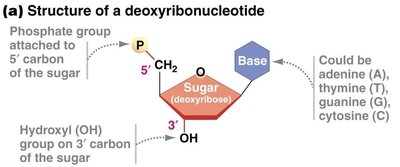
DNA is a nucleic acid composed of nucleotide monomers, each consisting of a phosphate group, a deoxyribose sugar, and a nitrogenous base. The structure and chemical properties of these components are fundamental to DNA's function in heredity and cellular processes.
Nucleotide Structure: Each nucleotide contains a phosphate group attached to the 5' carbon of deoxyribose, a hydroxyl group on the 3' carbon, and a nitrogenous base (adenine, thymine, guanine, or cytosine).
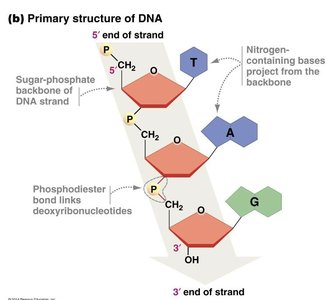
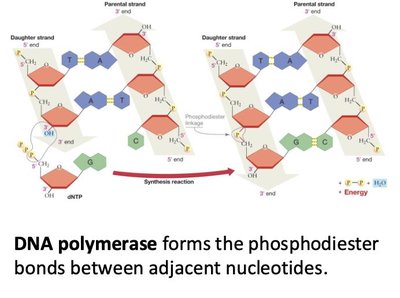
Phosphodiester Bond: Nucleotides are linked by covalent phosphodiester bonds between the 3' hydroxyl and 5' phosphate groups, forming the sugar-phosphate backbone.
Directionality: DNA strands have directionality, running from 5' to 3'.
Base Pairing: Nitrogenous bases project from the backbone and participate in complementary base pairing.
Reaction Type: Formation of the phosphodiester backbone is catalyzed by a dehydration synthesis reaction.
DNA Secondary Structure
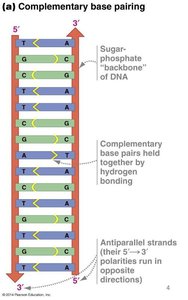
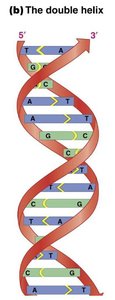
The secondary structure of DNA is defined by the double helix, stabilized by hydrogen bonds and hydrophobic interactions. The two strands are antiparallel and held together by specific base pairing.
Complementary Base Pairing: Adenine pairs with thymine (A-T), and guanine pairs with cytosine (G-C).
Antiparallel Strands: The two DNA strands run in opposite directions (5' to 3' and 3' to 5').
Hydrogen Bonding: Hydrogen bonds between complementary bases stabilize the double-stranded structure.
Base Stacking: Hydrophobic interactions between stacked bases further stabilize the helix.
Example Calculation: If a DNA molecule has 40% A, it also has 40% T (A=T), and the remaining 60% is split equally between G and C (30% each).
DNA Replication
Overview and Semiconservative Model
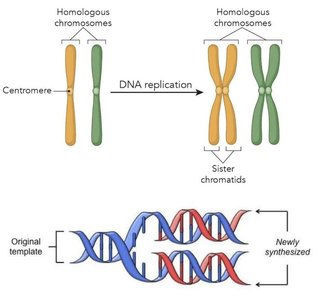
DNA replication is the process by which cells duplicate their genetic material before cell division. It is semiconservative, meaning each new DNA molecule consists of one old (parental) strand and one newly synthesized strand.
Timing: Occurs during the S-phase of interphase in preparation for mitosis or meiosis.
Semiconservative Process: Parental strands separate and serve as templates for new strands.
Sister Chromatids: Resulting DNA molecules are joined as sister chromatids.
Origins of Replication
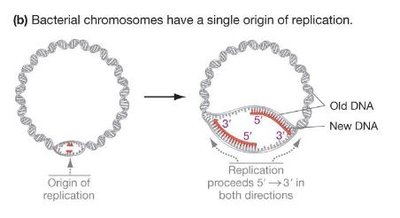
Replication begins at specific nucleotide sequences called origins of replication (ORI). The process differs between prokaryotes and eukaryotes.
ORI Features: AT-rich regions and specific protein binding sites facilitate strand separation.
Replication Fork: The site where DNA strands are separated and replication occurs.
Multiple Origins: Eukaryotic chromosomes have multiple ORIs, while prokaryotic chromosomes typically have a single ORI.
Why AT-rich? AT pairs have fewer hydrogen bonds, making them easier to separate.

Enzymes and Proteins in DNA Replication
Several enzymes and proteins coordinate the opening, stabilization, and synthesis of DNA during replication.
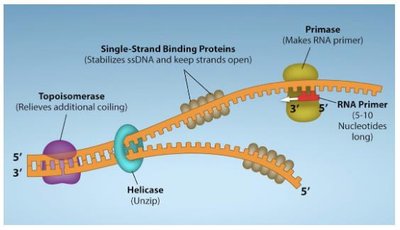
DNA Helicase: Breaks hydrogen bonds to separate DNA strands.
Single-Strand DNA-Binding Proteins (SSBPs): Prevent separated strands from re-annealing.
Topoisomerase: Relieves tension caused by unwinding the helix by cutting and rejoining DNA.
DNA Polymerase and Primer Requirement
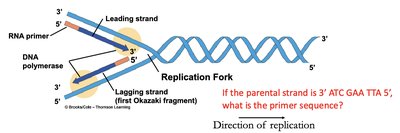
DNA polymerase is the enzyme responsible for synthesizing new DNA strands. It requires a primer to initiate synthesis and adds nucleotides only to the 3' end of the template strand.
Directionality: DNA is read in the 3' to 5' direction, but synthesized in the 5' to 3' direction.
Primer Requirement: DNA polymerase cannot start synthesis de novo; it needs a short RNA primer made by RNA primase.
RNA Primase: Synthesizes the RNA primer without needing a free 3' end.
Leading and Lagging Strand Synthesis
DNA replication occurs differently on the two template strands due to their antiparallel orientation.
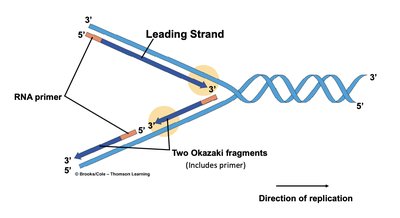
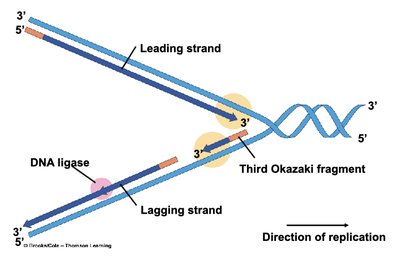
Leading Strand: Synthesized continuously toward the replication fork.
Lagging Strand: Synthesized discontinuously away from the fork in short segments called Okazaki fragments.
Okazaki Fragments: Short DNA segments on the lagging strand, each initiated by an RNA primer.
Replication of Chromosome Ends (Telomeres)
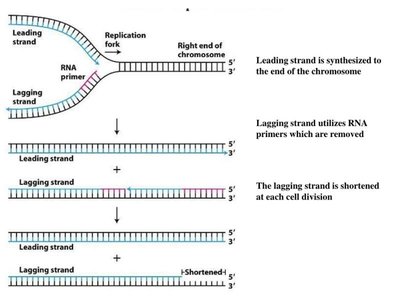
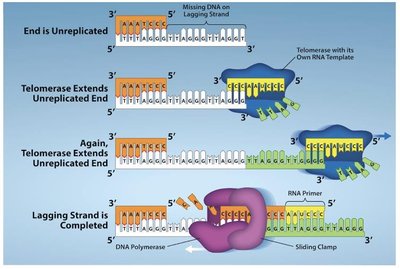
Replicating the ends of linear chromosomes presents unique challenges, especially for the lagging strand. Telomeres are specialized structures at chromosome ends that protect genetic information.
Leading Strand: Can be synthesized to the very end.
Lagging Strand: Leaves a gap after primer removal, resulting in progressive shortening.
Telomerase: An enzyme that extends telomeres using its own RNA template, allowing complete replication of chromosome ends.
Telomeres, Aging, and Cell Division
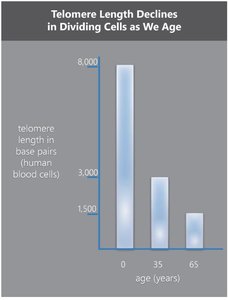
Telomere length is a key factor in cellular aging and division. Most somatic cells lack telomerase, leading to gradual telomere shortening and a limit on cell divisions (Hayflick limit).
Hayflick Limit: Cells can divide 40-60 times before telomere shortening triggers cell death.
Telomerase Expression: Found in gametes and stem cells, but not in most somatic cells.
Correlation: Telomere length correlates with the number of cell divisions and organismal aging.
Lifestyle Factors and Telomere Shortening
Lifestyle choices can influence the rate of telomere shortening, impacting cellular aging and health.
Negative Factors: Smoking, lack of physical activity, and stress can accelerate telomere shortening.
Positive Factors: Proper diet, exercise, and low stress may help reduce the rate of shortening.
DNA Repair Mechanisms
Accuracy and Repair During Replication
DNA replication is highly accurate, but errors can occur, leading to mutations or disease. Cells possess several repair mechanisms to correct these mistakes.
DNA Polymerase Proofreading: Most errors are corrected during replication by DNA polymerase.
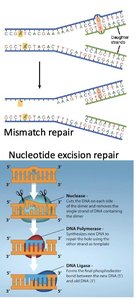
Mismatch Repair: Fixes mismatched bases after replication.
Nucleotide Excision Repair: Removes damaged bases or DNA kinks and replaces them with correct nucleotides.
Summary Table: Key Enzymes in DNA Replication
Enzyme | Function |
|---|---|
DNA Helicase | Unwinds DNA by breaking hydrogen bonds |
SSBPs | Stabilize single-stranded DNA |
Topoisomerase | Relieves tension by cutting and rejoining DNA |
RNA Primase | Synthesizes RNA primers |
DNA Polymerase III | Adds nucleotides to the 3' end of the primer |
DNA Polymerase I | Removes RNA primers and replaces with DNA |
DNA Ligase | Joins Okazaki fragments |
Telomerase | Extends telomeres using RNA template |
Key Equations and Concepts
Phosphodiester Bond Formation:
Base Pair Percentages:
Semiconservative Replication:
Practice Questions
Why is DNA replication considered a semiconservative process?
Why can’t DNA polymerase replicate DNA unless an RNA primer is first attached to template strands?
What direction is DNA read? Synthesized?
What are the enzymes we covered and what are their functions?
Fill in the replication bubble: Where would the lagging and leading strand go? Where are the primers, polymerase, leading, and lagging strands? Okazaki fragments?
