 Back
DNA Replication: Structure, Mechanism, and Biological Significance
Study Guide - Smart Notes
 Tailored notes based on your materials, expanded with key definitions, examples, and context.
DNA Replication: Structure, Mechanism, and Biological Significance
Central Dogma of Molecular Biology
The central dogma describes the flow of genetic information within a biological system. It explains how DNA encodes instructions for life, which are transcribed into RNA and then translated into proteins.
DNA Replication: The process by which DNA makes an identical copy of itself before cell division.
Transcription: The synthesis of RNA from a DNA template.
Translation: The synthesis of proteins from an mRNA template.
Mutation: Changes in DNA sequence that introduce genetic variation, driving evolution.
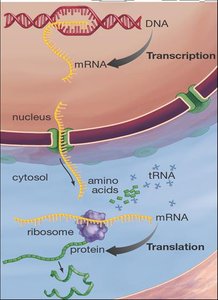
Properties of Life and DNA
DNA is fundamental to life because it is self-replicating, stores and transmits genetic instructions, and evolves through mutation. These properties enable inheritance and adaptation.
DNA Structure
Double Helix and Nucleotide Composition
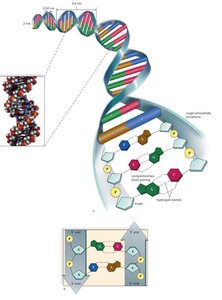
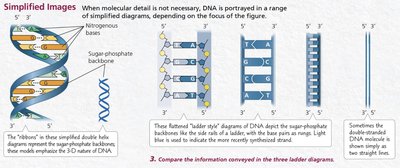
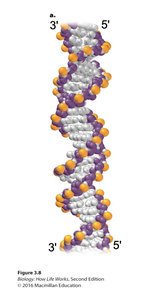
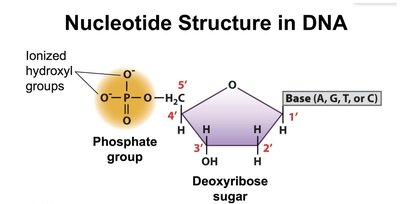
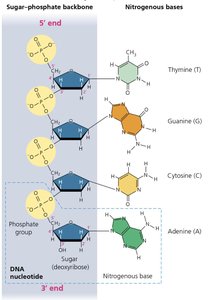
DNA is composed of two antiparallel strands forming a double helix. Each strand is a polymer of nucleotides, which consist of a deoxyribose sugar, a phosphate group, and a nitrogenous base (adenine, thymine, cytosine, or guanine).
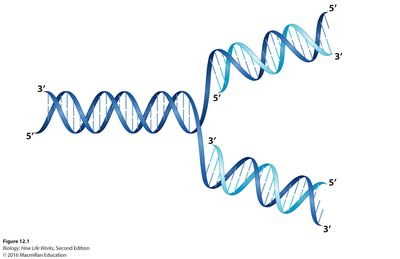
Antiparallel: The two strands run in opposite directions (5' to 3' and 3' to 5').
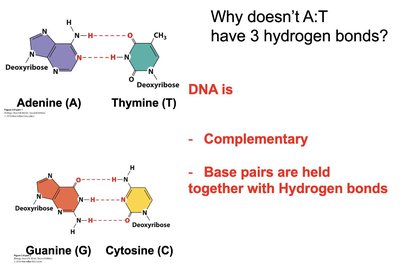
Complementary Base Pairing: Adenine pairs with thymine (A-T) via two hydrogen bonds; guanine pairs with cytosine (G-C) via three hydrogen bonds.
Sugar-Phosphate Backbone: The backbone is formed by covalent bonds between the sugar of one nucleotide and the phosphate of the next.
Directionality and Polarity
Each DNA strand has directionality, defined by the 5' (phosphate) and 3' (hydroxyl) ends. This polarity is crucial for replication and enzyme function.
5' End: Terminates with a phosphate group attached to the 5' carbon of deoxyribose.
3' End: Terminates with a hydroxyl group on the 3' carbon.
Base Pairing and Hydrogen Bonds
Hydrogen bonds between complementary bases stabilize the double helix. The specificity of base pairing ensures accurate replication and transcription.
DNA Replication Mechanism
Overview and Biological Importance
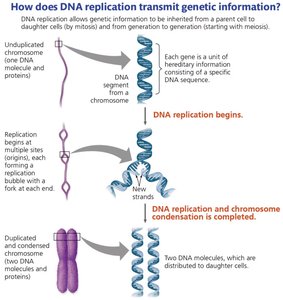
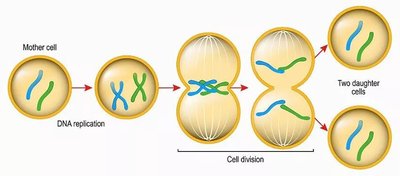
DNA replication is essential for cell division, ensuring that each daughter cell receives an identical copy of genetic material. Replication occurs before mitosis and meiosis.
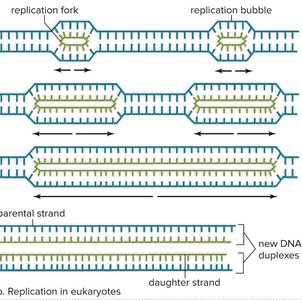
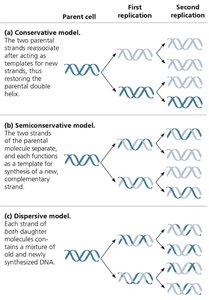
Semiconservative Replication: Each new DNA molecule consists of one parental and one newly synthesized strand.
Replication Bubble: Replication begins at origins, forming bubbles with two replication forks moving in opposite directions.
Enzymes and Steps in DNA Replication
Multiple enzymes coordinate the accurate and efficient replication of DNA:
Initiator Proteins: Bind to the origin of replication and recruit helicase.
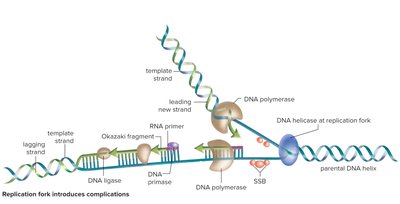
Helicase: Unwinds the DNA double helix by breaking hydrogen bonds.
Single-Strand Binding Proteins (SSB): Stabilize unwound DNA strands.
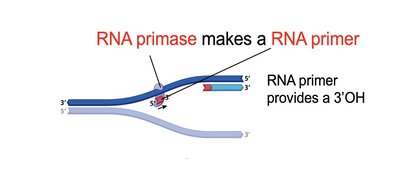
RNA Primase: Synthesizes short RNA primers to provide a 3' OH group for DNA polymerase.
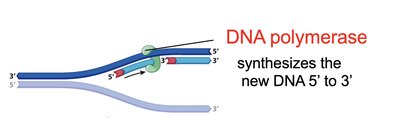
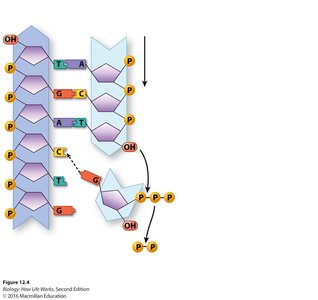
DNA Polymerase: Adds nucleotides to the 3' end of the primer, synthesizing new DNA in the 5' to 3' direction. Also proofreads and corrects errors.
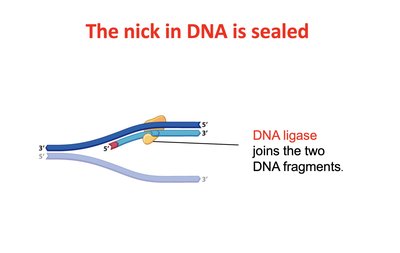
DNA Ligase: Seals nicks between Okazaki fragments on the lagging strand by forming phosphodiester bonds.
Leading and Lagging Strands
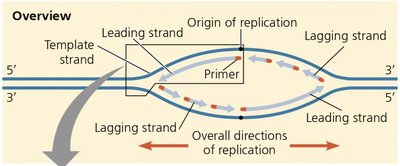
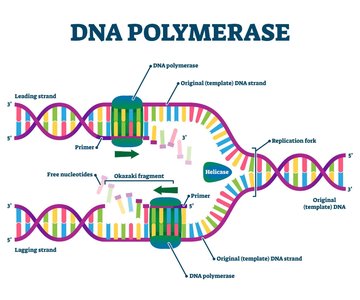
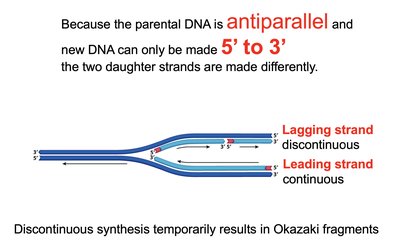
Because DNA polymerase can only synthesize DNA in the 5' to 3' direction, replication is continuous on the leading strand and discontinuous on the lagging strand, forming Okazaki fragments.
Leading Strand: Synthesized continuously toward the replication fork.
Lagging Strand: Synthesized discontinuously away from the fork in short segments (Okazaki fragments).
Proofreading and Mutation
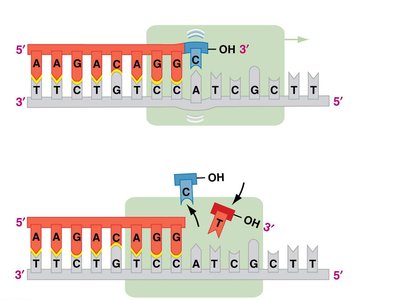
DNA polymerase has proofreading activity, correcting mismatched nucleotides during replication. Uncorrected errors result in mutations, which are permanent changes in the DNA sequence.
Proofreading: DNA polymerase removes and replaces incorrect nucleotides.
Mutation: If errors escape proofreading, they become permanent and may affect gene function.
Summary Table: Key Enzymes in DNA Replication
Enzyme | Function |
|---|---|
Helicase | Unwinds DNA double helix |
Single-Strand Binding Protein | Stabilizes unwound DNA |
RNA Primase | Synthesizes RNA primers |
DNA Polymerase | Adds nucleotides, proofreads, replaces RNA primers |
DNA Ligase | Seals nicks between DNA fragments |
Biological Significance of DNA Replication
Inheritance and Cell Division
DNA replication ensures that genetic information is faithfully transmitted from one generation to the next during cell division. This process is fundamental to growth, development, and reproduction in all living organisms.
Mitosis: Produces genetically identical daughter cells for growth and repair.
Meiosis: Produces gametes with half the genetic material, enabling sexual reproduction and genetic diversity.
Summary of Replication Models
Three models were proposed for DNA replication: conservative, semiconservative, and dispersive. Experiments confirmed the semiconservative model, where each daughter DNA molecule contains one parental and one new strand.
Key Equations and Concepts
Phosphodiester Bond Formation: The 3' OH group of the growing DNA strand attacks the 5' phosphate of the incoming nucleotide, releasing pyrophosphate () and forming a covalent bond.
Example: During DNA replication, if the template strand reads 5'-ATCG-3', the new strand will be synthesized as 3'-TAGC-5'.
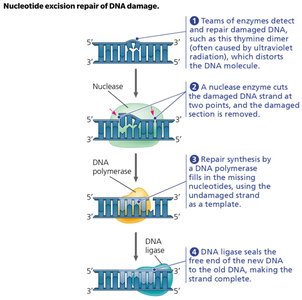
Additional info: DNA repair mechanisms, such as nucleotide excision repair, further ensure the fidelity of genetic information by correcting damage caused by environmental factors.
