 Back
BackDNA Replication: Structure, Mechanism, and Laboratory Applications
Study Guide - Smart Notes
 Tailored notes based on your materials, expanded with key definitions, examples, and context.
DNA Replication: Structure, Mechanism, and Laboratory Applications
DNA Structure and Function
DNA (deoxyribonucleic acid) is the hereditary material in all living organisms, responsible for storing and transmitting genetic information. Its structure and chemical properties enable it to function as a stable information-carrying molecule.
DNA Backbone: The backbone of DNA consists of alternating sugar (deoxyribose) and phosphate groups. These are connected by strong covalent phosphodiester bonds, providing structural stability.
DNA Rungs: The rungs of the DNA ladder are composed of pairs of nitrogenous bases: adenine (A), thymine (T), guanine (G), and cytosine (C). A pairs with T via 2 hydrogen bonds, and G pairs with C via 3 hydrogen bonds. These hydrogen bonds are weaker than covalent bonds, allowing the strands to separate during replication and transcription.
Antiparallel Strands: DNA is double-stranded, with the two strands running in opposite directions (antiparallel). One strand runs 5' to 3', and the other 3' to 5'. The 5' and 3' labels refer to the carbon positions in the deoxyribose sugar, which are important for the directionality of replication.
Information Storage: The sequence of bases encodes genetic information. Complementary base pairing allows for precise copying during replication.
Example: The stability of DNA allows it to persist in fossils for thousands of years, preserving genetic information across generations.
DNA as a Template for Replication
DNA's double-stranded structure enables each strand to serve as a template for the synthesis of a new complementary strand. This is the basis for the accurate transmission of genetic information.
Strand Separation: The two DNA strands separate, exposing the bases.
Base Pairing: Free nucleotides pair with the exposed bases according to base-pairing rules (A with T, G with C).
Polymerization: New nucleotides are added to the 3' end of the growing strand, forming a new sugar-phosphate backbone and restoring the double helix.
Additional info: This process is called semiconservative replication, as each new DNA molecule contains one old and one new strand.
Key Principles of DNA Replication
Role of DNA Polymerase
DNA polymerase is the enzyme responsible for synthesizing new DNA strands. It acts as a catalyst, speeding up the polymerization of deoxyribonucleotide monomers into DNA without being consumed in the reaction.
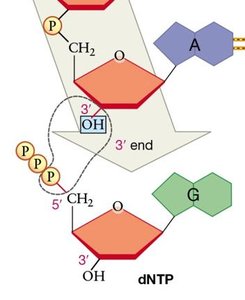
Directionality: DNA polymerase can only add nucleotides to the 3' end of a growing DNA strand, so synthesis always proceeds in the 5' to 3' direction.
Bond Formation: The enzyme catalyzes the formation of a phosphodiester bond between the 3' hydroxyl group of the last nucleotide and the 5' phosphate group of the incoming dNTP (deoxyribonucleoside triphosphate).
Equation:
Energetics of DNA Replication
Synthesis of dNTPs: This process is endergonic, requiring energy input to add phosphate groups to nucleotides.
Polymerization Reaction: The addition of a dNTP to the DNA strand is exergonic. The cleavage of two phosphates (pyrophosphate) from the dNTP releases energy, driving the reaction forward.
Origins of Replication
Bacterial Chromosomes: Typically have a single origin of replication.
Eukaryotic Chromosomes: Have multiple origins of replication to efficiently replicate large genomes.
Initiation of DNA Synthesis
Primase: DNA polymerase cannot start a new strand; it can only elongate an existing one. Primase synthesizes a short RNA primer to provide a starting point.
Elongation: DNA polymerase adds nucleotides to the 3' end of the RNA primer, synthesizing the new DNA strand in the 5' to 3' direction.
Primer Replacement: Later, DNA polymerase replaces the RNA primer with DNA nucleotides.
Accuracy and Proofreading
Speed: DNA polymerase can add 600–1000 nucleotides per second.
Error Rate: The overall error rate is about one nucleotide per billion, due to proofreading and repair mechanisms.
Mutations: Occasional mistakes lead to mutations, which are the source of genetic variation and evolution.
Additional info: Mutations can be beneficial, neutral, or harmful, and are essential for evolutionary processes.
Application of DNA Replication in the Laboratory: Polymerase Chain Reaction (PCR)
Purpose and Principles of PCR
The Polymerase Chain Reaction (PCR) is a laboratory technique used to amplify specific DNA sequences, generating millions of copies from a small initial sample.
Similarity to Natural Replication:
Both require a DNA template and DNA polymerase.
Both synthesize new DNA strands in the 5' to 3' direction.
Differences from Natural Replication:
PCR is performed in vitro (in a test tube) using a thermal cycler, while natural replication occurs in vivo (in cells).
PCR uses synthetic DNA primers, while cells use RNA primers synthesized by primase.
PCR Amplification Calculation
Each PCR cycle doubles the amount of target DNA. After n cycles, the number of copies is .
Example: Starting with 1 copy, after 10 cycles: copies.
Designing DNA Primers
Primer Sequences: To amplify a target region, two primers are designed to flank the sequence of interest, each with a defined 5' to 3' orientation.
Example:
First primer: 5’–TACGTGCCGTTAAAGGGG–3’
Second primer: 5’–TTTCAGTGGG–3’
Applications of PCR
Forensics: PCR enables the amplification of trace amounts of DNA for identification purposes.
Evolutionary Biology: PCR allows the study of ancient DNA from fossils or extinct species.
Medical Diagnostics: PCR is used to detect genetic mutations, pathogens, and for various genetic tests.
Additional info: PCR revolutionized molecular biology by enabling rapid and specific DNA amplification, facilitating research, diagnostics, and biotechnology.
