 Back
DNA Replication: The Molecular Basis of Inheritance
Study Guide - Smart Notes
 Tailored notes based on your materials, expanded with key definitions, examples, and context.
The Molecular Basis of Inheritance
Overview of DNA Replication
DNA replication is a fundamental process that ensures genetic information is accurately passed from cell to cell. It involves a complex interplay of enzymes and proteins, and occurs in both prokaryotic and eukaryotic cells with similar underlying mechanisms.
Speed and Accuracy: DNA replication is remarkably fast and precise, involving more than a dozen enzymes and proteins.
Conservation of Process: While best understood in bacteria, the replication process is fundamentally similar in prokaryotes and eukaryotes.
Origins of Replication, Replication Bubble, and Replication Fork
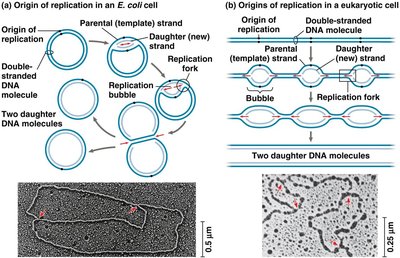
Replication begins at specific sites called origins of replication. At these sites, the DNA strands separate, forming a replication bubble. The ends of each bubble are replication forks, Y-shaped regions where DNA is actively unwound and copied.
Prokaryotes: Typically have a single origin of replication per chromosome.
Eukaryotes: Have hundreds or thousands of origins per chromosome, allowing rapid replication of large genomes.
Replication proceeds bidirectionally from each origin until the entire molecule is copied.
Key Enzymes and Proteins in DNA Replication
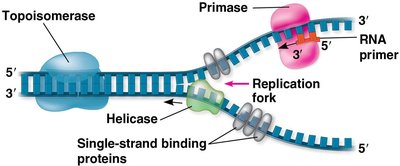
Several enzymes and proteins are essential for the initiation and progression of DNA replication:
Helicase: Unwinds the parental DNA double helix at the replication fork.
Single-strand binding proteins: Stabilize the unwound DNA strands, preventing them from re-annealing.
Topoisomerase: Relieves strain ahead of the replication fork by breaking, swiveling, and rejoining DNA strands.
Primase: Synthesizes short RNA primers needed for DNA polymerase to begin synthesis.
Synthesizing a New DNA Strand
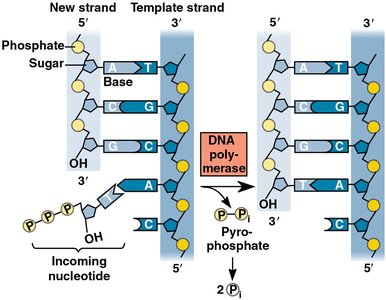
DNA polymerases catalyze the synthesis of new DNA at the replication fork. Most require a primer and a DNA template strand. As each nucleotide is added, a dehydration reaction occurs, releasing two phosphate groups as pyrophosphate.
DNA Polymerase: Adds nucleotides to the growing DNA strand in the 5' to 3' direction.
Primer: Short RNA sequence that provides a starting point for DNA synthesis.
Pyrophosphate Release: Each nucleotide addition releases two phosphate groups (pyrophosphate), driving the reaction forward.
Antiparallel Elongation and Directionality
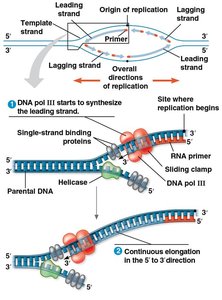
The antiparallel structure of DNA affects replication. DNA polymerases can only add nucleotides to the 3' end of a growing strand, so new DNA is always synthesized in the 5' to 3' direction.
Leading Strand: Synthesized continuously toward the replication fork.
Lagging Strand: Synthesized discontinuously away from the fork as short segments called Okazaki fragments.
DNA Ligase: Joins Okazaki fragments to form a continuous strand.
Replication Complex and Strand Synthesis
The replication complex coordinates the synthesis of both leading and lagging strands. DNA polymerase III synthesizes the leading strand continuously, while the lagging strand is synthesized in fragments.
DNA Pol III: Main enzyme for synthesizing new DNA.
DNA Pol I: Removes RNA primers and replaces them with DNA.
DNA Ligase: Seals nicks between Okazaki fragments.
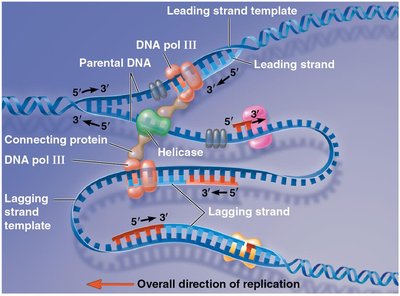
Summary of Bacterial DNA Replication
Bacterial DNA replication involves coordinated action of multiple enzymes and proteins, ensuring accurate and efficient copying of genetic material.
Initiation: Begins at a single origin of replication.
Elongation: Leading and lagging strands synthesized simultaneously.
Termination: Replication ends when forks meet or reach the end of the molecule.
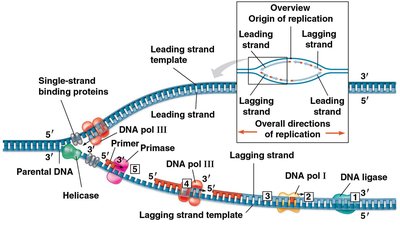
Comparison of DNA Polymerase III and DNA Polymerase I
Both DNA Pol III and DNA Pol I play crucial roles in DNA replication, but their functions differ:
Enzyme | Main Function | Location |
|---|---|---|
DNA Pol III | Synthesizes new DNA strands (leading and lagging) | Replication fork |
DNA Pol I | Removes RNA primers and replaces with DNA | Lagging strand (Okazaki fragments) |
Replication Features Shared by Prokaryotes and Eukaryotes
Both use similar enzymes and proteins for DNA replication.
Replication proceeds bidirectionally from origins.
Both synthesize leading and lagging strands.
Key Terms and Definitions
Origin of Replication: Specific site where DNA replication begins.
Replication Bubble: Region where DNA strands are separated for replication.
Replication Fork: Y-shaped region where DNA is unwound and copied.
Okazaki Fragments: Short DNA segments synthesized on the lagging strand.
DNA Ligase: Enzyme that joins Okazaki fragments.
Example: Predicting Fork Progression
If one initiation protein (e.g., helicase) is inhibited, replication fork progression would halt, as DNA cannot be unwound for synthesis.
Equations and Reactions
Dehydration Reaction for Nucleotide Addition:
Additional info:
Replication is semiconservative: each new DNA molecule consists of one old and one new strand.
Errors during replication are rare due to proofreading by DNA polymerases.
