 Back
BackDNA, RNA, and Protein Synthesis: A Comprehensive Study Guide
Study Guide - Smart Notes
 Tailored notes based on your materials, expanded with key definitions, examples, and context.
DNA: The Blueprint of Life
Definition and Structure
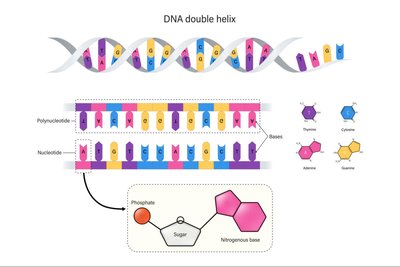
Deoxyribonucleic Acid (DNA) is the hereditary molecule that contains the instructions for the development, functioning, growth, and reproduction of all living organisms. DNA is structured as a double helix, composed of two complementary strands forming a twisted ladder.
Nucleotide: The basic unit of DNA, each consisting of a phosphate group, a deoxyribose sugar, and a nitrogenous base.
Polynucleotide: A long chain of nucleotides joined together.
Nitrogenous Bases: Four types—Adenine (A), Thymine (T), Guanine (G), and Cytosine (C).
Base Pairing: Adenine pairs with Thymine (A-T), and Guanine pairs with Cytosine (G-C) via hydrogen bonds.
Complementary Strands: The sequence of one strand determines the sequence of the other due to specific base pairing.
DNA Replication
Process and Mechanism
DNA replication is the process by which a cell duplicates its DNA before cell division. The double helix "unzips," and each original strand serves as a template for the synthesis of a new complementary strand.
Semi-Conservative Replication: Each new DNA molecule consists of one original (parental) strand and one newly synthesized strand.
Enzymes Involved: DNA helicase unwinds the helix, and DNA polymerase synthesizes the new strand.
RNA: The Intermediate Messenger
Definition and Differences from DNA
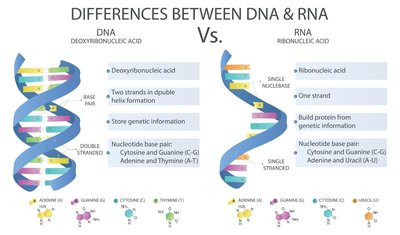
Ribonucleic Acid (RNA) acts as the intermediary that conveys genetic information from DNA to the cellular machinery that synthesizes proteins. RNA differs from DNA in several key ways:
Strands: RNA is single-stranded, not double-helical.
Sugar: RNA contains ribose sugar instead of deoxyribose.
Bases: Thymine (T) is replaced by Uracil (U) in RNA.
The Central Dogma: Genetic Information Flow
Overview of Information Transfer
The central dogma of molecular biology describes the directional flow of genetic information within a biological system:
DNA → RNA → Protein
Transcription: The process by which DNA is used as a template to synthesize RNA.
Translation: The process by which RNA directs the synthesis of proteins.
Proteins: Serve as the primary functional molecules in cells, determining physical traits and catalyzing biochemical reactions.
Transcription: Rewriting the Code
Process and Location
Transcription is the process by which the genetic code in DNA is transcribed into messenger RNA (mRNA). This occurs in the nucleus of eukaryotic cells. Once synthesized, mRNA exits the nucleus and enters the cytoplasm.
Base-Pairing Rules: During transcription, Adenine (A) pairs with Uracil (U) in RNA, replacing Thymine (T).
Enzyme: RNA polymerase catalyzes the synthesis of mRNA from the DNA template.
Translation: Building the Protein
Process and Key Components
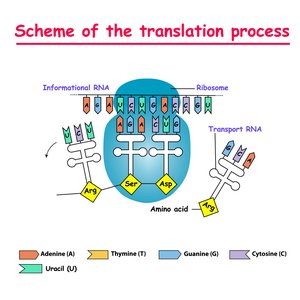
Translation is the process by which the sequence of codons in mRNA is decoded to assemble a chain of amino acids, forming a protein. This occurs at the ribosomes in the cytoplasm.
Gene: A segment of DNA that encodes a specific protein.
mRNA (Messenger RNA): Carries the genetic message from the nucleus to the ribosome.
rRNA (Ribosomal RNA): Structural and catalytic component of ribosomes.
tRNA (Transfer RNA): Brings specific amino acids to the ribosome, matching its anticodon to the mRNA codon.
The Mechanism of Translation
Steps and Molecular Interactions
Translation involves the coordinated action of ribosomes, mRNA, and tRNA to synthesize proteins according to the genetic code.
Ribosome Binding Sites: Ribosomes have sites for both mRNA and tRNA binding.
tRNA Structure: Each tRNA has an anticodon that pairs with a specific mRNA codon and an attached amino acid.
Genetic Code: The sequence of three nucleotides (codon) in mRNA specifies a particular amino acid.
Phases of Translation:
Initiation: Ribosome assembles on the mRNA.
Elongation: tRNAs bring amino acids to the ribosome, and the polypeptide chain grows.
Termination: The process ends when a stop codon is reached, releasing the completed protein.
Summary Table: DNA vs. RNA in the Cell
Feature | DNA | RNA |
|---|---|---|
Primary Role | Information Storage | Information Messenger/Transfer |
Sugar | Deoxyribose | Ribose |
Bases | A, T, C, G | A, U, C, G |
Strands | Double-stranded | Single-stranded |
