 Back
DNA, RNA, and Viruses: Structure, Function, and Replication
Study Guide - Smart Notes
 Tailored notes based on your materials, expanded with key definitions, examples, and context.
DNA and RNA Structure and Function
DNA: Structure and Stability
Deoxyribonucleic acid (DNA) is the primary molecule for storing genetic information in cells. Its structure and chemical properties make it highly stable and suitable for long-term information storage.
Stability: DNA is less reactive and more resistant to chemical degradation than RNA, making it a reliable genetic repository.
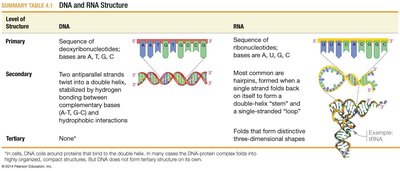
Primary Structure: DNA consists of a sequence of deoxyribonucleotides with bases adenine (A), thymine (T), guanine (G), and cytosine (C).
Secondary Structure: DNA forms a double helix with two antiparallel strands stabilized by hydrogen bonds between complementary bases (A-T, G-C).
Function: DNA directs all cellular functions by encoding the information required for protein synthesis.
RNA: Structure and Versatility
Ribonucleic acid (RNA) differs from DNA in both structure and function, playing multiple roles in the cell, including catalysis and information transfer.
Primary Structure: RNA contains ribose sugar and uracil (U) instead of thymine. The presence of an –OH group on ribose makes RNA more reactive and less stable than DNA.
Secondary Structure: RNA is typically single-stranded but can fold into complex shapes through intramolecular base pairing, forming structures like hairpins.
Tertiary Structure: RNA molecules can fold further into three-dimensional shapes, as seen in tRNAs and ribozymes.
Function: RNA can act as an information carrier, a catalyst (ribozyme), and is capable of self-replication in some cases.
RNA as a Catalytic Molecule
Some RNA molecules, known as ribozymes, possess catalytic activity. The ribosome, essential for protein synthesis, is a ribozyme composed of catalytic RNA and proteins. RNA's ability to fold brings distant nucleotides together at the active site, enabling catalysis.
Example: The ribosome catalyzes peptide bond formation during translation.
Viruses and Nucleic Acids
Basic Structure and Classification of Viruses
Viruses are infectious particles composed of nucleic acid (DNA or RNA) enclosed in a protein coat called a capsid. Some viruses also possess a lipid envelope derived from the host cell membrane.
Obligate Intracellular Parasites: Viruses must infect host cells to replicate, as they lack the machinery for independent reproduction.
Host Range: Viruses have a limited host range determined by the compatibility of viral surface proteins with host cell receptors.
Viral Envelope: Some viruses are enveloped, which helps them evade the host immune system.


Types of Viruses
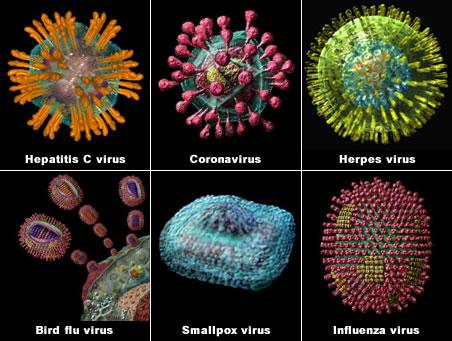
Viruses are classified based on their nucleic acid type (DNA or RNA) and structure. Examples include hepatitis C virus, coronavirus, herpes virus, bird flu virus, smallpox virus, and influenza virus.
Viral Reproductive Cycles
Viruses reproduce by hijacking the host cell's machinery. The two main cycles are the lytic and lysogenic cycles.
Lytic Cycle: The virus injects its genetic material into the host, directs the synthesis of new viral particles, and causes cell lysis to release progeny.
Lysogenic Cycle: The viral genome integrates into the host chromosome and replicates along with it, remaining dormant until triggered to enter the lytic cycle.

DNA Replication
Overview of DNA Replication
DNA replication is the process by which a cell copies its DNA before cell division. It ensures that each daughter cell receives an identical set of genetic instructions.
When: DNA replication occurs during the S phase of the cell cycle.
Why: Accurate replication is essential for genetic continuity; errors can lead to mutations.
Mechanism of DNA Replication
Replication begins at specific sites called origins of replication, forming replication bubbles. The process is bidirectional, with replication forks moving outward from the origin.
Enzymes Involved: Helicase unwinds the DNA, single-strand binding proteins stabilize unwound strands, and DNA gyrase relieves tension ahead of the fork.
Primer Requirement: DNA polymerase requires a short RNA primer synthesized by primase to initiate DNA synthesis.
Directionality: DNA polymerase adds nucleotides only to the 3′ end, so synthesis proceeds in the 5′ → 3′ direction.
Leading and Lagging Strand Synthesis
DNA replication is continuous on the leading strand and discontinuous on the lagging strand, which is synthesized in short fragments called Okazaki fragments.
Leading Strand: Synthesized continuously toward the replication fork.
Lagging Strand: Synthesized away from the fork in Okazaki fragments, which are later joined by DNA ligase.
Replication of Chromosome Ends (Telomeres)
Linear chromosomes have ends called telomeres, which pose a challenge for complete replication. The enzyme telomerase extends the lagging strand, preventing chromosome shortening in germ cells. Most somatic cells lack telomerase, leading to gradual telomere shortening with age.
Telomerase: Adds repetitive sequences to the ends of chromosomes using an RNA template.
Cellular Aging: Telomere shortening may limit the number of cell divisions, contributing to aging.
Comparison of DNA and RNA Structure
Level of Structure | DNA | RNA |
|---|---|---|
Primary | Sequence of deoxyribonucleotides; bases are A, T, G, C | Sequence of ribonucleotides; bases are A, U, G, C |
Secondary | Two antiparallel strands form a double helix, stabilized by hydrogen bonding between complementary bases (A-T, G-C) and hydrophobic interactions | Most common are hairpins, formed when a single strand folds back on itself to form a double-helix "stem" and a single-stranded "loop" |
Tertiary | None* | Folds that form distinctive three-dimensional shapes |
*In cells, DNA can also adopt tertiary structures due to supercoiling and interactions with proteins, but does not form tertiary structure on its own.
