 Back
DNA Structure and Replication: Foundations of Genetic Inheritance
Study Guide - Smart Notes
 Tailored notes based on your materials, expanded with key definitions, examples, and context.
DNA Structure and Replication
Discovery of DNA as Genetic Material
The identification of DNA as the hereditary material was a pivotal moment in biology. Early experiments distinguished DNA from proteins as the carrier of genetic information.
Griffith-Avery Experiment: Demonstrated transformation in bacteria, suggesting a 'transforming principle' (later identified as DNA).
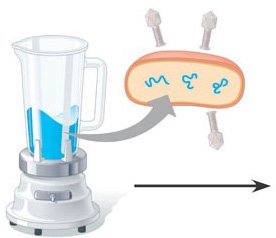
Hershey-Chase Experiment: Used bacteriophages to show that DNA, not protein, enters bacterial cells and directs viral replication.
Watson and Crick: Deduced the double helix structure of DNA, integrating data from Rosalind Franklin's X-ray diffraction studies.
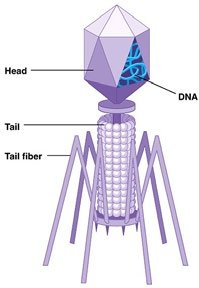
Example: The Hershey-Chase experiment used radioactive isotopes to label DNA and protein, confirming DNA as the genetic material.
DNA Structure
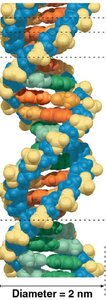
DNA is a double-stranded helical molecule composed of nucleotides. Its structure is essential for its function as genetic material.
Nucleotide: Consists of a phosphate group, deoxyribose sugar, and a nitrogenous base (A, T, G, C).
Double Helix: Two antiparallel strands held together by hydrogen bonds between complementary bases.
Major and Minor Grooves: The helical structure creates grooves that are important for protein binding.
Right-Handed Helix: The DNA helix twists to the right.
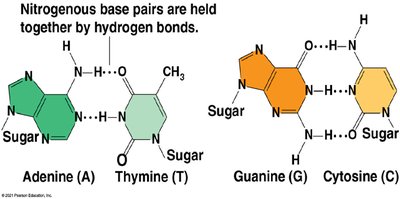
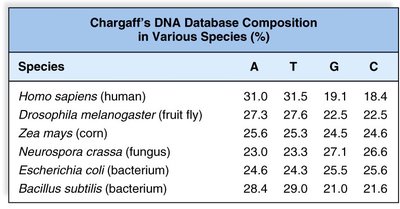
Example: Chargaff's rules state that the amount of adenine equals thymine, and guanine equals cytosine in DNA.
Species | A | T | G | C |
|---|---|---|---|---|
Homo sapiens | 31.0 | 31.5 | 19.1 | 18.4 |
Drosophila melanogaster | 27.3 | 27.6 | 22.5 | 22.5 |
Zea mays | 25.6 | 25.3 | 24.5 | 24.6 |
Neurospora crassa | 23.0 | 23.3 | 27.1 | 26.6 |
Escherichia coli | 24.6 | 24.3 | 25.5 | 25.6 |
Bacillus subtilis | 28.4 | 29.0 | 21.0 | 21.6 |
DNA Packaging in Chromosomes
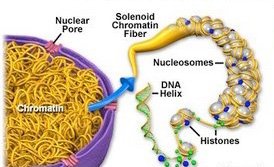
To fit within the nucleus, DNA is highly compacted through association with proteins.
Chromatin: DNA wrapped around histone proteins forms nucleosomes, resembling 'beads on a string.'
Further Compaction: Nucleosomes coil into higher-order structures, forming condensed chromosomes during cell division.

DNA Replication: Mechanism and Models
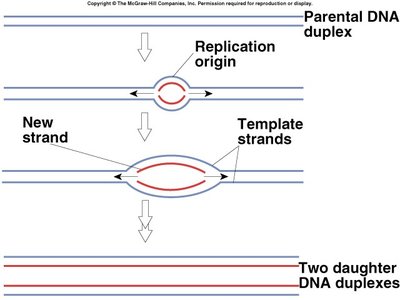
DNA replication ensures genetic information is accurately transmitted to daughter cells. The process is semiconservative, meaning each new DNA molecule contains one parental and one new strand.
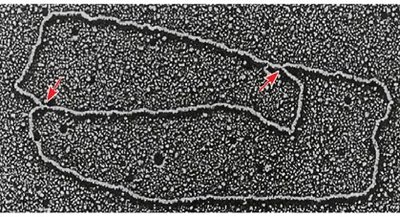
Origin of Replication (ORI): Specific sequence where replication begins.
Replication Bubble: Region where DNA is unwound and replication occurs in both directions.
Semiconservative Model: Each daughter DNA contains one old and one new strand.
Enzymes and Proteins in DNA Replication
Multiple enzymes coordinate the unwinding and synthesis of new DNA strands.
Helicase: Unwinds the DNA double helix.
Single-Strand Binding Proteins (SSBP): Stabilize unwound DNA.
Topoisomerase: Relieves supercoiling ahead of the replication fork.
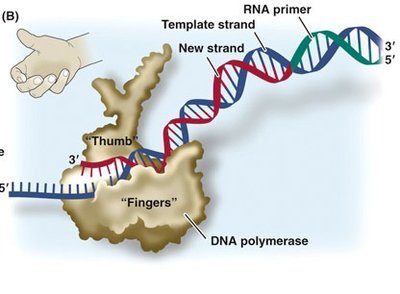
Primase: Synthesizes short RNA primers to initiate DNA synthesis.
DNA Polymerase III: Extends new DNA strand from the primer in the 5' to 3' direction.
DNA Polymerase I: Removes RNA primers and replaces them with DNA.
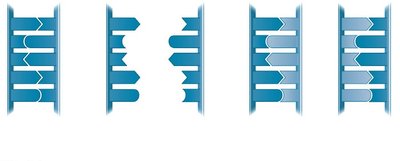
DNA Ligase: Seals nicks between Okazaki fragments on the lagging strand.
Leading and Lagging Strand Synthesis
Due to the antiparallel nature of DNA, replication occurs differently on each strand.
Leading Strand: Synthesized continuously toward the replication fork.
Lagging Strand: Synthesized discontinuously away from the fork in short segments called Okazaki fragments.
Okazaki Fragments: Short DNA segments joined by DNA ligase.
Limitations and Solutions in DNA Replication
DNA polymerase cannot complete the 5' ends of linear chromosomes, leading to progressive shortening. Telomeres and the enzyme telomerase solve this problem.
Telomeres: Repetitive DNA sequences at chromosome ends that protect coding regions.
Telomerase: Enzyme that extends telomeres in germ cells and some stem cells.
DNA Replication Fidelity and Repair
Replication errors are rare due to proofreading and repair mechanisms.
Proofreading: DNA polymerase checks and corrects mismatched bases during synthesis.
Mismatch Repair: Enzymes correct errors missed during replication.
Nucleotide Excision Repair: Removes and replaces damaged DNA segments.
Key Vocabulary
Spontaneous generation: Disproven hypothesis that life arises from nonliving matter.
Replication: The process of copying DNA before cell division.
Germ theory: The concept that microorganisms cause disease.
Polymerize: To join monomers into a polymer.
Pathogenic: Capable of causing disease.
Nucleosome: DNA wrapped around histone proteins.
Chromatin: Complex of DNA and proteins in the nucleus.
Nuclease: Enzyme that cuts DNA or RNA.
Origin of replication (ORI): Sequence where DNA replication begins.
Bacteriophage: Virus that infects bacteria.
Okazaki fragment: Short DNA fragment on the lagging strand.
Summary Table: Leading vs. Lagging Strand
Feature | Leading Strand | Lagging Strand |
|---|---|---|
Synthesis | Continuous | Discontinuous |
Direction | Toward replication fork | Away from replication fork |
Okazaki Fragments | No | Yes |
Role of DNA Ligase | Not required | Joins fragments |
Additional info:
DNA replication is essential for both mitosis and meiosis, ensuring genetic continuity.
Mutations, though rare, are a source of genetic variation and evolution.
