 Back
BackDNA Structure and Replication: Practice Questions & Step-by-Step Guidance
Study Guide - Smart Notes
 Tailored notes based on your materials, expanded with key definitions, examples, and context.
Q16. Compare the figures below. Which one is from a eukaryote? Which one is from a bacterium? Why is there such a difference?
Background
Topic: DNA Replication Origins in Prokaryotes vs. Eukaryotes
This question is testing your understanding of the structural and functional differences in DNA replication between prokaryotic (bacterial) and eukaryotic cells, specifically focusing on the number and organization of replication origins.
Key Terms and Concepts:
Origin of replication: The specific sequence at which DNA replication begins.
Prokaryote (Bacterium): Typically has a single, circular DNA molecule with one origin of replication.
Eukaryote: Has multiple, linear chromosomes, each with many origins of replication.
Replication bubble: The region where the DNA double helix is unwound and replication occurs.
Step-by-Step Guidance
Examine the two provided electron micrographs. Look for differences in the number and arrangement of replication bubbles (the open, unwound regions marked by arrows).
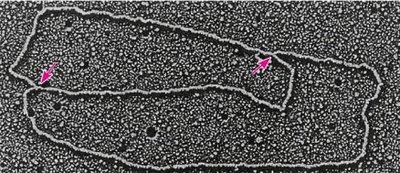
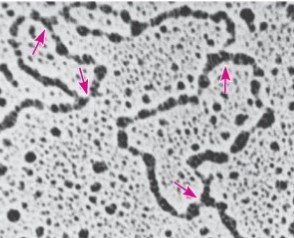
Recall that bacterial (prokaryotic) chromosomes are typically circular and usually have a single origin of replication, resulting in one or two replication bubbles at most.
Remember that eukaryotic chromosomes are linear and contain many origins of replication, so you would expect to see multiple replication bubbles along the length of the DNA.
Compare the images: Identify which image shows a single, circular DNA molecule with one or two bubbles, and which shows a linear DNA molecule with many bubbles.
Think about why eukaryotes need multiple origins of replication (hint: genome size and replication speed) compared to bacteria.
Try solving on your own before revealing the answer!
Final Answer:
The first image (image_1) is from a bacterium (prokaryote), showing a single circular DNA molecule with two replication bubbles. The second image (image_2) is from a eukaryote, showing a linear DNA molecule with multiple replication bubbles.
The difference exists because eukaryotic genomes are much larger and require multiple origins of replication to ensure the entire genome is copied efficiently during S phase, while bacteria have smaller, circular genomes that can be replicated from a single origin.
