 Back
DNA Structure & Replication Study Guide – Step-by-Step Guidance
Study Guide - Smart Notes
 Tailored notes based on your materials, expanded with key definitions, examples, and context.
Q1. What evidence supports the double helix model of DNA structure?
Background
Topic: DNA Structure and Scientific Evidence
This question tests your understanding of how scientists used experimental data to determine the structure of DNA, including the roles of Franklin, Chargaff, Watson, and Crick.
Key Terms:
Double helix
X-ray crystallography
Base pairing
Antiparallel strands
Step-by-Step Guidance
Review the contributions of Rosalind Franklin, especially her X-ray crystallography images and interpretation of DNA's width and structure.
Consider Erwin Chargaff's findings about nucleotide composition and base pairing rules (A=T, C=G).
Think about how Watson and Crick integrated these findings to propose the double helix and antiparallel arrangement.
Summarize how each scientist's evidence contributed to the final model.
Try solving on your own before revealing the answer!
Final Answer:
Franklin's X-ray images showed DNA was a double helix of constant width, with phosphates on the outside. Chargaff discovered base pairing rules (A=T, C=G) and species-specific base composition. Watson and Crick used these data to propose the antiparallel double helix model, satisfying all structural and chemical evidence.
Q2. Explain the “semi-conservative” model of DNA replication.
Background
Topic: DNA Replication Mechanisms
This question tests your understanding of how DNA is copied, specifically the semi-conservative model where each new DNA molecule contains one old and one new strand.
Key Terms:
Semi-conservative replication
Template strand
Complementary base pairing
Step-by-Step Guidance
Recall that DNA strands separate during replication.
Each original strand serves as a template for a new strand.
New nucleotides are added using complementary base pairing rules.
After replication, each DNA molecule consists of one parent strand and one daughter strand.
Try solving on your own before revealing the answer!
Final Answer:
In the semi-conservative model, each new DNA molecule contains one original (parent) strand and one newly synthesized (daughter) strand. This ensures genetic continuity and accuracy during cell division.
Q3. List two ways in which DNA replication differs between prokaryotes and eukaryotes.
Background
Topic: DNA Replication in Different Organisms
This question tests your ability to compare and contrast DNA replication in prokaryotes and eukaryotes.
Key Terms:
Origin of replication (Ori)
Okazaki fragments
Telomeres
Mutation rate
Step-by-Step Guidance
Identify the number and type of chromosomes in prokaryotes (circular, one origin) vs. eukaryotes (linear, multiple origins).
Consider the presence of telomeres and the issue of chromosome shortening in eukaryotes.
Think about the rate of replication and mutation rates in both groups.
List at least two differences based on these features.
Try solving on your own before revealing the answer!
Final Answer:
Prokaryotes have a single origin of replication on their circular chromosome, while eukaryotes have multiple origins on linear chromosomes. Eukaryotes require telomeres to protect chromosome ends, whereas prokaryotes do not. Additionally, prokaryotes replicate DNA much faster and have higher mutation rates.
Q4. List 7 DNA replication proteins in E. coli and briefly describe their roles.
Background
Topic: DNA Replication Enzymes
This question tests your knowledge of the proteins and enzymes involved in DNA replication in prokaryotes.
Key Terms:
Helicase
Single-stranded binding proteins
Topoisomerase
RNA primase
DNA polymerase III
DNA polymerase I
DNA ligase
Step-by-Step Guidance
Recall the function of helicase in unwinding DNA.
Describe how single-stranded binding proteins stabilize separated strands.
Explain the role of topoisomerase in relieving tension.
Identify the function of RNA primase in laying down primers.
Discuss DNA polymerase III's role in synthesizing new DNA.
Describe DNA polymerase I's function in replacing RNA primers with DNA.
Explain how DNA ligase joins DNA fragments.
Try solving on your own before revealing the answer!
Final Answer:
Helicase unwinds DNA; single-stranded binding proteins stabilize strands; topoisomerase relieves tension; RNA primase lays down RNA primers; DNA polymerase III synthesizes DNA; DNA polymerase I replaces RNA primers with DNA; DNA ligase joins DNA fragments.
Q5. What is the work-around for the fact that DNA polymerases cannot initiate DNA synthesis?
Background
Topic: DNA Replication Initiation
This question tests your understanding of how DNA synthesis is initiated, given that DNA polymerases can only add nucleotides to an existing chain.
Key Terms:
Primase
RNA primer
Step-by-Step Guidance
Recall that DNA polymerases require a primer to start synthesis.
Identify the enzyme responsible for creating the primer.
Describe the nature of the primer (RNA, not DNA).
Explain how this primer allows DNA polymerase to begin adding nucleotides.
Try solving on your own before revealing the answer!
Final Answer:
Primase synthesizes a short RNA primer, which provides a starting point for DNA polymerase to begin DNA synthesis. DNA polymerase can then extend the chain from the primer.
Q6. Explain what is meant by “each strand of nucleic acid has directionality.”
Background
Topic: DNA Strand Directionality
This question tests your understanding of the chemical structure of DNA and the concept of 5' and 3' ends.
Key Terms:
5' end
3' end
Phosphate group
Hydroxyl group
Polarity
Step-by-Step Guidance
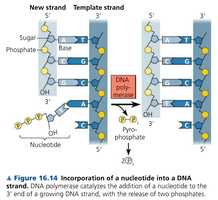
Identify the chemical groups present at the 5' and 3' ends of a DNA strand.
Explain how these groups give the strand its directionality.
Describe why this directionality is important for DNA replication and function.
Try solving on your own before revealing the answer!
Final Answer:
Each DNA strand has a 5' end (with a phosphate group) and a 3' end (with a hydroxyl group). This directionality determines how enzymes interact with DNA and is essential for replication, as new nucleotides are always added to the 3' end.
Q6a. Why does DNA replication only happen in the 5’ → 3’ direction?
Background
Topic: DNA Synthesis Directionality
This question tests your understanding of enzyme specificity and the chemical mechanism of DNA synthesis.
Key Terms:
DNA polymerase
Dehydration synthesis
5' to 3' direction
Step-by-Step Guidance
Recall that DNA polymerase adds nucleotides to the 3' end of the growing strand.
Consider the chemical reaction involved (dehydration synthesis) and the need for a free 3' hydroxyl group.
Explain why the enzyme cannot add nucleotides to the 5' end.
Try solving on your own before revealing the answer!
Final Answer:
DNA polymerase catalyzes the addition of nucleotides to the 3' end because the reaction requires a free 3' hydroxyl group for dehydration synthesis. This ensures that DNA is always synthesized in the 5' to 3' direction.
Q7a. What accounts for the difference between the higher initial “mistake” rate and the lower final mutation rate?
Background
Topic: DNA Replication Fidelity
This question tests your understanding of proofreading and error correction during DNA replication.
Key Terms:
DNA polymerase proofreading
Mutation rate
Step-by-Step Guidance
Recall that DNA polymerase can make mistakes during replication.
Describe the proofreading function of DNA polymerase.
Explain how this reduces the final mutation rate.
Try solving on your own before revealing the answer!
Final Answer:
DNA polymerase III proofreads its work and corrects mistakes, dramatically lowering the initial error rate to a much lower final mutation rate.
Q7b. What roles do nucleases, polymerases, and ligases have in DNA repair?
Background
Topic: DNA Repair Mechanisms
This question tests your understanding of the enzymes involved in DNA repair.
Key Terms:
Nuclease
Polymerase
Ligase
Step-by-Step Guidance
Recall that nucleases cut out damaged or incorrect DNA segments.
Polymerases add new, correct nucleotides to replace the removed segment.
Ligases join the new DNA to the existing strand.
Try solving on your own before revealing the answer!
Final Answer:
Nucleases remove damaged DNA, polymerases fill in the gap with new nucleotides, and ligases seal the new DNA to the original strand.
Q8. What is the main advantage of rare DNA mutations?
Background
Topic: Genetic Variation and Evolution
This question tests your understanding of the evolutionary significance of mutations.
Key Terms:
Genetic variation
Natural selection
Phenotypic variation
Step-by-Step Guidance
Recall that mutations create genetic diversity.
Consider how this diversity can lead to new phenotypes.
Explain how beneficial mutations can be selected for in a population.
Try solving on your own before revealing the answer!
Final Answer:
Rare mutations create genetic variation, which allows populations to adapt to changing environments through natural selection.
Q9. How does telomerase ensure that germ-line cells do not suffer from chromosome shortening?
Background
Topic: Telomeres and Telomerase
This question tests your understanding of chromosome maintenance in germ-line cells.
Key Terms:
Telomeres
Telomerase
Germ-line cells
Step-by-Step Guidance
Recall what telomeres are and their function at chromosome ends.
Describe how telomerase adds telomere sequences to chromosomes.
Explain why this process is important for germ-line cells.
Try solving on your own before revealing the answer!
Final Answer:
Telomerase adds telomere sequences to the ends of chromosomes in germ-line cells, preventing chromosome shortening and ensuring genetic integrity for the next generation.
Q10. Why do researchers believe telomerase may be a useful target for cancer therapy?
Background
Topic: Telomerase and Cancer
This question tests your understanding of the relationship between telomerase activity and cancer cell proliferation.
Key Terms:
Telomerase
Cancer
Cell proliferation
Step-by-Step Guidance
Recall that normal cells stop dividing when telomeres become too short.
Explain how cancer cells often have active telomerase, allowing unlimited division.
Consider how inhibiting telomerase could limit cancer cell proliferation.
Try solving on your own before revealing the answer!
Final Answer:
Telomerase allows cancer cells to keep dividing by maintaining telomere length. Targeting telomerase could limit cancer cell proliferation and slow disease progression.
