 Back
DNA Structure & Replication Study Guide – Step-by-Step Guidance
Study Guide - Smart Notes
 Tailored notes based on your materials, expanded with key definitions, examples, and context.
Q1. What evidence supports the double helix model of DNA structure?
Background
Topic: DNA Structure and Scientific Evidence
This question tests your understanding of how scientists used experimental data to determine the structure of DNA, focusing on contributions from Franklin, Chargaff, Watson, and Crick.
Key Terms:
X-ray crystallography: Technique used to visualize molecular structure.
Base pair composition: The ratio of nucleotide bases (A, T, C, G).
Antiparallel: Two strands running in opposite directions.
Step-by-Step Guidance
Review Franklin's X-ray crystallography data and what it revealed about DNA's shape and width.
Consider Chargaff's findings about base pair ratios and species-specific composition.
Think about how Watson and Crick integrated these findings to propose the double helix and antiparallel arrangement.
Summarize how each scientist's evidence contributed to the final model, but stop before listing all the details.
Try solving on your own before revealing the answer!
Final Answer:
Franklin's X-ray images showed DNA was a double helix of constant width, with phosphates on the outside. Chargaff found that A=T and C=G, and that base composition varies by species. Watson and Crick used these data to propose the antiparallel double helix model, explaining how base pairing and strand orientation fit the evidence.
Q2. Explain the “semi-conservative” model of DNA replication.
Background
Topic: DNA Replication Mechanisms
This question tests your understanding of how DNA is copied, specifically the semi-conservative model where each new DNA molecule contains one old strand and one new strand.
Key Terms:
Semi-conservative replication: Each daughter DNA molecule has one parental and one newly synthesized strand.
Template strand: The original strand used to guide synthesis of the new strand.
Complementary base pairing: A pairs with T, C pairs with G.
Step-by-Step Guidance
Recall that DNA strands must separate before replication begins.
Each separated strand serves as a template for a new strand, using complementary base pairing.
After replication, each DNA molecule consists of one original (parental) strand and one new (daughter) strand.
Stop before describing the experimental evidence or the full process.
Try solving on your own before revealing the answer!
Final Answer:
In the semi-conservative model, each new DNA molecule contains one strand from the original DNA and one newly synthesized strand. This ensures genetic continuity and accurate transmission of information.
Q3. List two ways in which DNA replication differs between prokaryotes and eukaryotes.
Background
Topic: DNA Replication in Different Organisms
This question tests your ability to compare and contrast DNA replication in prokaryotes (bacteria) and eukaryotes (plants, animals, fungi).
Key Terms:
Origin of replication (Ori): Starting point for DNA replication.
Okazaki fragments: Short DNA segments synthesized on the lagging strand.
Telomeres: Protective DNA sequences at chromosome ends (eukaryotes only).
Step-by-Step Guidance
Identify the number and type of chromosomes in prokaryotes (circular, one origin) vs. eukaryotes (linear, multiple origins).
Consider the presence of telomeres and the issue of chromosome shortening in eukaryotes.
Think about the rate of replication and mutation rates in both groups.
Stop before listing all differences or giving specific examples.
Try solving on your own before revealing the answer!
Final Answer:
Prokaryotes have a single origin of replication on a circular chromosome, while eukaryotes have multiple origins on linear chromosomes. Eukaryotes require telomeres to protect chromosome ends, and their replication is slower and less prone to mutation than prokaryotes.
Q4. List 7 DNA replication proteins that function in E. coli, and briefly describe their roles.
Background
Topic: DNA Replication Enzymes
This question tests your knowledge of the proteins and enzymes involved in DNA replication in prokaryotes, specifically E. coli.
Key Terms:
Helicase: Unwinds DNA.
Single-stranded binding proteins: Stabilize separated strands.
Topoisomerase: Relieves tension ahead of replication fork.
Primase: Synthesizes RNA primer.
DNA Polymerase III: Main enzyme for DNA synthesis.
DNA Polymerase I: Removes RNA primer and replaces with DNA.
DNA Ligase: Joins DNA fragments.
Step-by-Step Guidance
List each protein and briefly describe its function in the replication process.
Think about the order in which these proteins act during replication.
Stop before giving a full summary or detailed sequence of actions.
Try solving on your own before revealing the answer!
Final Answer:
Helicase unwinds DNA; single-stranded binding proteins stabilize strands; topoisomerase relieves tension; primase adds RNA primer; DNA polymerase III synthesizes DNA; DNA polymerase I replaces RNA primer with DNA; DNA ligase joins DNA fragments.
Q5. What is the work-around for the fact that DNA polymerases cannot initiate DNA synthesis?
Background
Topic: DNA Replication Initiation
This question tests your understanding of how DNA synthesis is started, given that DNA polymerases can only add nucleotides to an existing strand.
Key Terms:
Primase: Enzyme that synthesizes a short RNA primer.
RNA primer: Short segment of RNA that provides a starting point for DNA synthesis.
Step-by-Step Guidance
Recall that DNA polymerase requires a free 3' OH group to add nucleotides.
Think about which enzyme provides this starting point and how.
Stop before naming the enzyme or describing the full process.
Try solving on your own before revealing the answer!
Final Answer:
Primase synthesizes a short RNA primer, providing a free 3' OH group for DNA polymerase to begin DNA synthesis.
Q6. Use the figure to explain what is meant by “each strand of nucleic acid has directionality”.
Background
Topic: DNA Strand Directionality
This question tests your understanding of the chemical structure of DNA and how the 5' and 3' ends define the directionality of each strand.
Key Terms:
5' end: End of DNA with a phosphate group attached to the 5' carbon.
3' end: End of DNA with a hydroxyl group attached to the 3' carbon.
Directionality: The orientation of the DNA strand, important for replication and transcription.
Step-by-Step Guidance
Examine the figure and identify the 5' and 3' ends of each strand.
Note the chemical groups present at each end (phosphate at 5', hydroxyl at 3').
Understand how this directionality affects DNA synthesis and enzyme activity.
Stop before fully explaining the implications for replication.
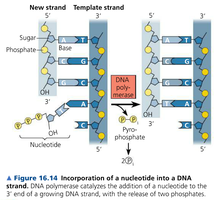
Try solving on your own before revealing the answer!
Final Answer:
Each DNA strand has a 5' end (phosphate group) and a 3' end (hydroxyl group), giving it directionality. DNA polymerase adds nucleotides to the 3' end, so synthesis always proceeds from 5' to 3'.
Q7. Why does DNA replication only happen in the 5’ → 3’ direction?
Background
Topic: DNA Synthesis Directionality
This question tests your understanding of enzyme specificity and the chemical mechanism of nucleotide addition during DNA replication.
Key Terms:
Dehydration synthesis: Chemical reaction forming covalent bonds by removing water.
DNA polymerase: Enzyme that catalyzes DNA synthesis.
5' to 3' direction: The only direction in which DNA polymerase can add nucleotides.
Step-by-Step Guidance
Recall that DNA polymerase catalyzes the addition of nucleotides to the 3' OH group.
Think about the chemical requirements for forming a phosphodiester bond.
Consider why the enzyme cannot add nucleotides to the 5' end.
Stop before fully explaining the mechanism.
Try solving on your own before revealing the answer!
Final Answer:
DNA replication only occurs in the 5' to 3' direction because DNA polymerase can only add nucleotides to the free 3' OH group, enabling the formation of a phosphodiester bond via dehydration synthesis.
Q8. What accounts for the difference between the higher initial “mistake” rate and the lower final mutation rate in DNA replication?
Background
Topic: DNA Replication Fidelity
This question tests your understanding of proofreading and repair mechanisms that ensure high fidelity in DNA replication.
Key Terms:
Proofreading: DNA polymerase checks and corrects errors during replication.
Mutation rate: Frequency of errors in DNA sequence.
Step-by-Step Guidance
Recall that DNA polymerase can make mistakes during nucleotide addition.
Think about the enzyme's ability to check and correct its work.
Consider how this proofreading reduces the final mutation rate.
Stop before describing all repair mechanisms.
Try solving on your own before revealing the answer!
Final Answer:
DNA polymerase III proofreads and corrects errors during replication, dramatically lowering the initial mistake rate to a much lower final mutation rate.
Q9. What roles do nucleases, polymerases, and ligases have in DNA repair?
Background
Topic: DNA Repair Mechanisms
This question tests your understanding of the enzymes involved in fixing errors or damage in DNA.
Key Terms:
Nuclease: Cuts damaged or incorrect DNA.
Polymerase: Adds new nucleotides to replace removed ones.
Ligase: Joins new DNA to existing DNA.
Step-by-Step Guidance
Recall that nucleases remove damaged or incorrect DNA segments.
Polymerases fill in the gap with correct nucleotides.
Ligases seal the new DNA into the existing strand.
Stop before describing the full repair process.
Try solving on your own before revealing the answer!
Final Answer:
Nucleases cut out damaged DNA, polymerases add new nucleotides, and ligases join the new DNA to the original strand, ensuring DNA integrity.
Q10. What is the main advantage of rare DNA mutations?
Background
Topic: Genetic Variation and Evolution
This question tests your understanding of how mutations contribute to genetic diversity and evolution.
Key Terms:
Mutation: Change in DNA sequence.
Phenotypic variation: Differences in traits among individuals.
Natural selection: Process by which advantageous traits become more common.
Step-by-Step Guidance
Recall that mutations create genetic diversity.
Think about how this diversity can lead to new traits.
Consider how some traits may be advantageous in certain environments.
Stop before fully explaining the evolutionary process.
Try solving on your own before revealing the answer!
Final Answer:
Rare mutations create genetic variation, which allows populations to adapt to changing environments through natural selection, improving survival and reproduction.
Q11. How does telomerase ensure that germ-line cells do not suffer from chromosome shortening?
Background
Topic: Telomeres and Telomerase Function
This question tests your understanding of chromosome maintenance in germ-line cells and the role of telomerase.
Key Terms:
Telomeres: Repetitive DNA sequences at chromosome ends.
Telomerase: Enzyme that adds telomere sequences.
Germ-line cells: Cells that give rise to gametes (sperm and egg).
Step-by-Step Guidance
Recall that telomeres protect chromosome ends from shortening during replication.
Think about how telomerase adds telomere sequences to germ-line cells.
Consider why this process is important for maintaining chromosome integrity in offspring.
Stop before fully describing the mechanism.
Try solving on your own before revealing the answer!
Final Answer:
Telomerase adds telomere sequences to chromosome ends in germ-line cells, preventing shortening and ensuring offspring inherit chromosomes with full-length telomeres.
Q12. Why do researchers believe telomerase may be a useful target for cancer therapy?
Background
Topic: Telomerase and Cancer
This question tests your understanding of the relationship between telomerase activity and cancer cell proliferation.
Key Terms:
Telomerase: Enzyme that extends telomeres.
Cancer: Disease characterized by uncontrolled cell division.
Cell cycle: Series of events leading to cell division.
Step-by-Step Guidance
Recall that normal cells stop dividing when telomeres become too short.
Think about how cancer cells often have active telomerase, allowing unlimited division.
Consider how inhibiting telomerase could limit cancer cell proliferation.
Stop before fully explaining therapeutic strategies.
Try solving on your own before revealing the answer!
Final Answer:
Telomerase enables cancer cells to keep dividing by maintaining telomere length. Targeting telomerase could limit cancer cell proliferation and slow disease progression.
