 Back
DNA Structure, Gene Expression, and Genetic Variation: Study Notes for General Biology
Study Guide - Smart Notes
 Tailored notes based on your materials, expanded with key definitions, examples, and context.
DNA, RNA, and Gene Function
Introduction to DNA and RNA
DNA (deoxyribonucleic acid) and RNA (ribonucleic acid) are the primary molecules responsible for storing and transmitting genetic information in living organisms. DNA serves as the blueprint for life, while RNA acts as the intermediary in gene expression, ultimately leading to protein synthesis.
DNA: Double-stranded molecule forming the genetic material of all living organisms.
RNA: Single-stranded molecule involved in protein synthesis.
Genes: Segments of DNA that encode instructions for building proteins.
Phenotype: Observable traits resulting from gene expression.
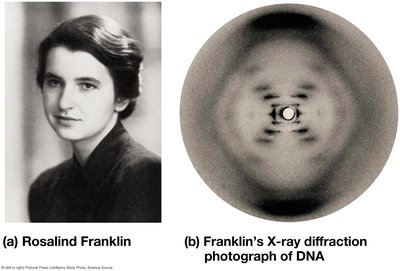
Structure of DNA
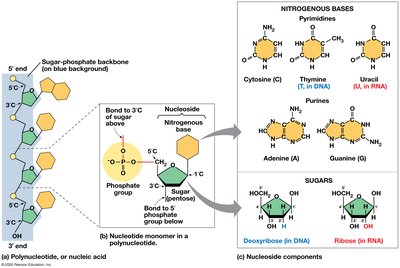
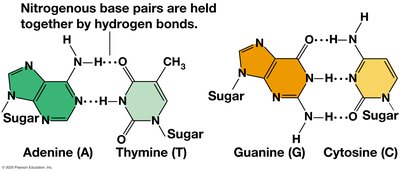
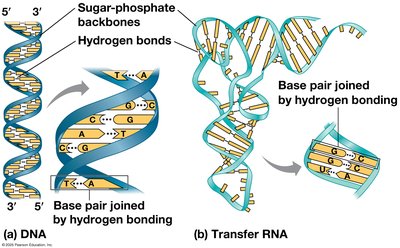
The structure of DNA is a double helix composed of two polynucleotide strands. Each strand consists of repeating units called nucleotides, which are joined by covalent bonds. The strands are held together by hydrogen bonds between complementary nitrogenous bases.
Nucleotides: Each nucleotide contains a nitrogenous base, a pentose sugar (deoxyribose in DNA), and a phosphate group.
Nitrogenous Bases: Adenine (A), Thymine (T), Guanine (G), Cytosine (C). Thymine is unique to DNA.
Base Pairing: A pairs with T, G pairs with C via hydrogen bonds.
Polynucleotide: DNA is a polymer of nucleotides.
Complementary DNA Strands
DNA strands are complementary, meaning each base on one strand pairs with its specific partner on the opposite strand. For example, the sequence 5'-TAGGCCT-3' pairs with 3'-ATCCGGA-5'.
Directionality: DNA strands have a 5' to 3' orientation.
Complementary Strand: The sequence is determined by base pairing rules.
Gene Expression: From Gene to Protein
Transcription and Translation
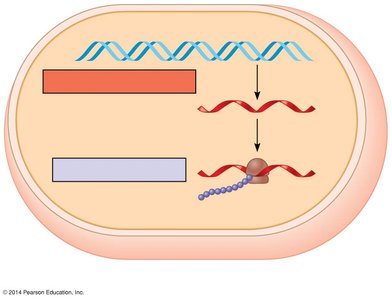
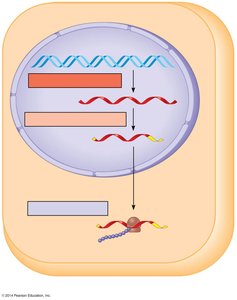
Gene expression is the process by which information from a gene is used to synthesize a functional gene product, typically a protein. This involves two main stages: transcription and translation.
Transcription: Synthesis of RNA from a DNA template. Produces messenger RNA (mRNA).
Translation: Synthesis of a polypeptide (protein) using information in mRNA. Occurs at ribosomes.
RNA: Contains ribose sugar and uracil (U) instead of thymine (T).
The Central Dogma of Biology
The central dogma describes the flow of genetic information within a biological system: DNA is transcribed into RNA, which is then translated into protein.
Primary Transcript: Initial RNA transcript before processing.
Cellular Chain of Command: DNA → RNA → Protein

Differences Between DNA and RNA
DNA and RNA differ in three major ways:
Sugar: DNA contains deoxyribose; RNA contains ribose.
Base: DNA has thymine (T); RNA has uracil (U).
Strands: DNA is double-stranded; RNA is usually single-stranded.
The Genetic Code
Codons and the Triplet Code
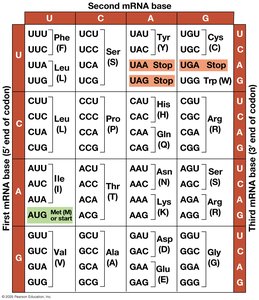
The genetic code is based on codons, which are sequences of three nucleotides in mRNA that specify particular amino acids. There are 64 possible codons, 61 of which code for amino acids and 3 are stop signals.
Triplet Code: Each amino acid is specified by a three-nucleotide codon.
Redundancy: Multiple codons can code for the same amino acid.
Non-ambiguity: Each codon codes for only one amino acid.
Transcription and Translation Process
During transcription, the template strand of DNA is used to synthesize a complementary RNA strand. During translation, ribosomes read the mRNA codons and assemble the corresponding amino acids into a polypeptide.
Template Strand: The DNA strand used for RNA synthesis.
Ribosomes: Sites of protein synthesis.

Genetic Variation and Mutations
Types of Mutations
Mutations are changes in the genetic material that can lead to variation in phenotype. They are the source of genetic diversity and drive evolution.
Point Mutations: Changes in a single nucleotide pair. Can be silent, missense, or nonsense.
Frameshift Mutations: Insertions or deletions that alter the reading frame.
Sickle-Cell Disease: A Case Study
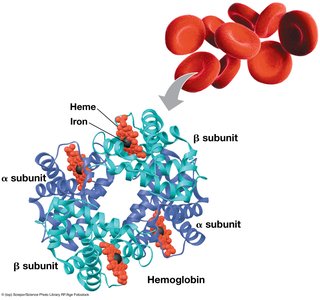
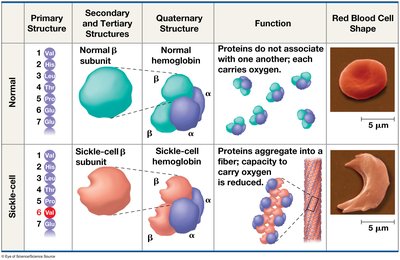
Sickle-cell disease is caused by a single amino acid substitution in the hemoglobin protein, resulting from a point mutation in the DNA. This change affects the protein's structure and function, leading to altered red blood cell shape and reduced oxygen-carrying capacity.
Primary Structure: Sequence of amino acids in a polypeptide.
Effect: A single nucleotide change leads to a valine instead of glutamic acid in hemoglobin.
Phenotype: Sickle-shaped red blood cells.
Summary and Recap
Key Concepts
DNA and RNA: Structure and function as genetic material.
Gene Expression: Transcription and translation as mechanisms for protein synthesis.
Genetic Variation: Mutations as drivers of phenotype variation and evolution.
Heritable phenotype variation is essential for evolution, as it provides the raw material for natural selection.
