 Back
BackDNA Structure, Replication, and Chromatin Organization
Study Guide - Smart Notes
 Tailored notes based on your materials, expanded with key definitions, examples, and context.
DNA Structure and Function
DNA as Genetic Material
Deoxyribonucleic acid (DNA) is the hereditary material in almost all living organisms, encoding the instructions for cellular structure and function. DNA is organized into genes, which are specific sequences that code for proteins or functional RNA molecules.
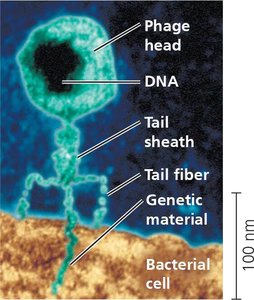
Virus: An infectious particle incapable of replicating outside a cell, consisting of an RNA or DNA genome surrounded by a protein coat, and sometimes a membrane envelope.
Bacteriophage (phage): A virus that infects bacteria.
DNA Structure
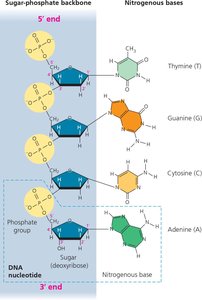
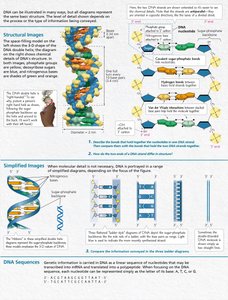
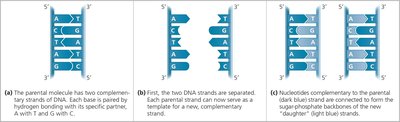
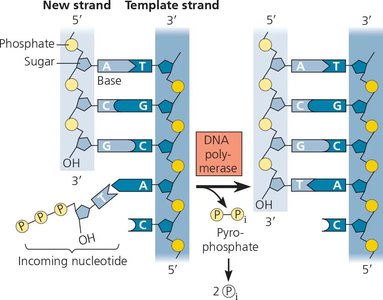
DNA is a double helix composed of two antiparallel strands of nucleotides. Each nucleotide consists of a phosphate group, a deoxyribose sugar, and a nitrogenous base (adenine, thymine, cytosine, or guanine).
Base pairing: Adenine (A) pairs with thymine (T), and guanine (G) pairs with cytosine (C) via hydrogen bonds.
Antiparallel orientation: One strand runs 5' to 3', the other 3' to 5'.
DNA Replication
Overview of DNA Replication
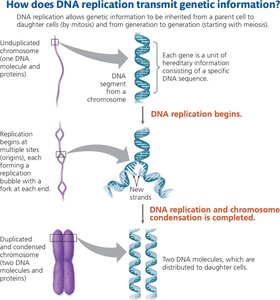
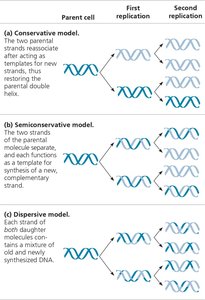
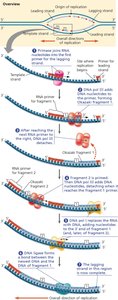
DNA replication is the process by which a cell copies its DNA before cell division, ensuring genetic information is transmitted to daughter cells. Replication is semiconservative, meaning each new DNA molecule consists of one parental and one newly synthesized strand.
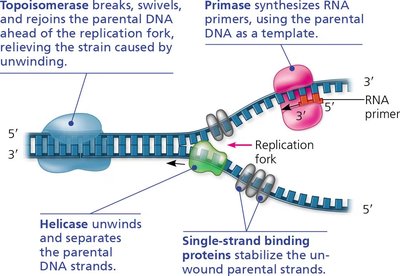
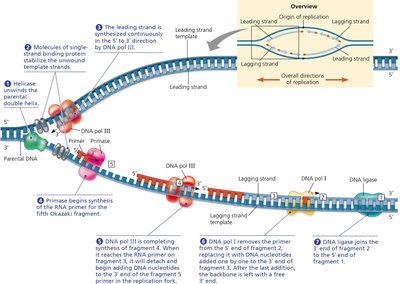
Replication fork: The Y-shaped region where the DNA is split into two template strands and new DNA is synthesized.
Leading strand: Synthesized continuously in the 5' to 3' direction toward the replication fork.
Lagging strand: Synthesized discontinuously away from the fork in short segments called Okazaki fragments.
Key Enzymes and Proteins in DNA Replication
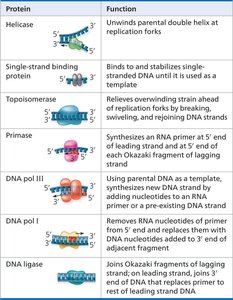
Helicase: Unwinds the DNA double helix at the replication fork.
Single-strand binding proteins: Stabilize unwound DNA strands, preventing them from re-annealing.
Topoisomerase: Relieves strain ahead of the replication fork by breaking, swiveling, and rejoining DNA strands.
Primase: Synthesizes short RNA primers needed to start DNA synthesis.
DNA polymerase III: Extends the new DNA strand by adding nucleotides to the 3' end.
DNA polymerase I: Removes RNA primers and replaces them with DNA nucleotides.
DNA ligase: Joins Okazaki fragments on the lagging strand, forming a continuous DNA strand.
Mechanism of DNA Synthesis
DNA polymerases add nucleotides to the free 3' end of a growing DNA strand, using the parental strand as a template. The energy for this process comes from the hydrolysis of nucleoside triphosphates.
Okazaki fragments: Short DNA segments synthesized on the lagging strand.
Directionality: DNA synthesis always proceeds in the 5' to 3' direction.
DNA Repair and Proofreading
Mismatch and Excision Repair
Cells possess mechanisms to correct errors that occur during DNA replication or as a result of DNA damage. These include mismatch repair and nucleotide excision repair.
Mismatch repair: Specific enzymes remove and replace incorrectly paired nucleotides.
Nuclease: Cuts out damaged or incorrect DNA segments.
DNA polymerase: Fills in the missing nucleotides using the undamaged strand as a template.
DNA ligase: Seals the repaired DNA strand.
Telomeres and Chromatin Structure
Telomeres
Telomeres are repetitive nucleotide sequences at the ends of eukaryotic chromosomes that protect the DNA from degradation during replication. They do not contain genes and become shorter with each cell division.
Chromatin Organization: Euchromatin and Heterochromatin
DNA in eukaryotic cells is packaged with proteins into chromatin, which can exist in two forms:
Euchromatin: Less condensed, transcriptionally active, and accessible for gene expression.
Heterochromatin: Highly condensed, generally not transcribed, and found in regions such as centromeres and telomeres.
Summary Table: Key Proteins in DNA Replication
Protein | Function |
|---|---|
Helicase | Unwinds parental double helix at replication forks |
Single-strand binding protein | Binds to and stabilizes single-stranded DNA until it is used as a template |
Topoisomerase | Relieves overwinding strain ahead of replication forks by breaking, swiveling, and rejoining DNA strands |
Primase | Synthesizes an RNA primer at 5' end of leading strand and at 5' end of each Okazaki fragment of lagging strand |
DNA polymerase III | Using parental DNA as template, synthesizes new DNA strand by covalently adding nucleotides to the 3' end of a pre-existing DNA strand or RNA primer |
DNA polymerase I | Removes RNA nucleotides of primer from 5' end and replaces them with DNA nucleotides added to 3' end of adjacent fragment |
DNA ligase | Joins Okazaki fragments of lagging strand; on leading strand, joins 3' end of DNA that replaces primer to rest of leading strand DNA |
Key Terms and Definitions
Semiconservative replication: Each new DNA molecule consists of one parental and one new strand.
Replication fork: The Y-shaped region where DNA is split and replicated.
Okazaki fragments: Short DNA segments synthesized on the lagging strand.
Telomeres: Repetitive DNA sequences at chromosome ends, protecting them from degradation.
Euchromatin: Loosely packed chromatin, transcriptionally active.
Heterochromatin: Densely packed chromatin, transcriptionally inactive.
Additional info:
DNA replication is essential for cell division and genetic inheritance.
Errors in replication or repair can lead to mutations, which may cause disease.
