 Back
DNA Structure, Replication, and Chromosome Organization
Study Guide - Smart Notes
 Tailored notes based on your materials, expanded with key definitions, examples, and context.
DNA: The Molecular Basis of Inheritance
DNA as the Genetic Material
The identification of DNA as the genetic material was a pivotal discovery in biology. Early experiments demonstrated that DNA, not protein, carries genetic information.
Frederick Griffith's Experiment: Showed that bacteria could be transformed by foreign DNA, indicating DNA's role in heredity.
Avery, McCarty, and MacLeod: Identified DNA as the transforming substance.
Hershey and Chase Experiment: Demonstrated that viral DNA, not protein, enters bacteria and directs viral reproduction.
Chargaff's Rules: The amount of adenine (A) equals thymine (T), and guanine (G) equals cytosine (C) in any species.
Structure of DNA
DNA is a polymer composed of nucleotides, each containing a nitrogenous base, a sugar (deoxyribose), and a phosphate group. The double-helical structure was elucidated by Watson and Crick, based on X-ray crystallography data from Rosalind Franklin.
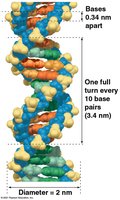
Double Helix: Two antiparallel strands form a helical structure.
Base Pairing: A pairs with T, G pairs with C, ensuring uniform width and stability.
Dimensions: Bases are 0.34 nm apart; one full turn every 10 base pairs (3.4 nm); diameter is 2 nm.
DNA Replication: Mechanisms and Enzymes
DNA replication is essential for cell division and inheritance. The process is semiconservative, meaning each new DNA molecule contains one old and one new strand.
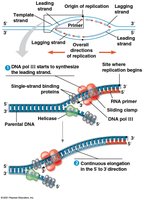
Origins of Replication: Specific sites where replication begins, forming replication bubbles.
Replication Fork: Y-shaped region where DNA is unwound.
Key Enzymes:
Helicase: Unwinds the DNA helix.
Single-strand binding proteins: Stabilize unwound DNA.
Topoisomerase: Relieves strain from unwinding.
Primase: Synthesizes RNA primers.
DNA Polymerase: Adds nucleotides to the 3' end of the primer.
DNA Ligase: Joins Okazaki fragments on the lagging strand.
Antiparallel Elongation: DNA polymerase synthesizes the leading strand continuously (5' → 3'), while the lagging strand is synthesized discontinuously as Okazaki fragments.
Proofreading and DNA Repair
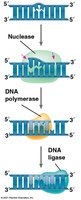
DNA polymerases proofread newly synthesized DNA, correcting errors. Additional repair mechanisms fix damage caused by environmental factors.
Mismatch Repair: Enzymes replace incorrectly paired nucleotides.
Nucleotide Excision Repair: Damaged DNA is removed and replaced by new nucleotides.
Telomeres and Replication of Chromosome Ends
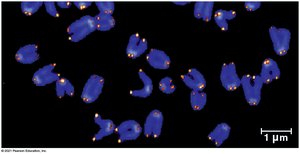
Linear chromosomes have special sequences called telomeres at their ends. These protect genes from erosion during replication. Telomerase extends telomeres in germ cells, and telomere shortening is associated with aging and cancer.
Telomeres: Repetitive DNA sequences at chromosome ends.
Telomerase: Enzyme that lengthens telomeres in germ cells.
Significance: Prevents loss of essential genes; telomerase activity is linked to cancer cell immortality.
Chromosome Structure and DNA Packing
Chromosomes consist of DNA tightly packed with proteins. In eukaryotes, DNA is organized into chromatin, which undergoes structural changes during the cell cycle.
Histones: Proteins responsible for DNA packing.
Nucleosomes: DNA wrapped around histone cores, forming "beads on a string" structure.
Chromatin Types:
Euchromatin: Loosely packed, transcriptionally active.
Heterochromatin: Highly condensed, transcriptionally inactive.
Chromatin Remodeling: Chemical modifications of histones affect gene expression.
Summary Table: DNA Replication Enzymes and Functions
Enzyme | Function |
|---|---|
Helicase | Unwinds DNA helix |
Single-strand binding protein | Stabilizes single-stranded DNA |
Topoisomerase | Relieves strain from unwinding |
Primase | Synthesizes RNA primer |
DNA Polymerase | Adds nucleotides to growing DNA strand |
DNA Ligase | Joins Okazaki fragments |
Key Equations and Concepts
Semiconservative Replication:
Base Pairing:
Antiparallel Strands: direction for synthesis
Additional info: The notes expand on the original content by providing definitions, examples, and a summary table for clarity. All included images directly reinforce the explanations of DNA structure, replication, repair, and telomere function.
