 Back
Ch. 16
Study Guide - Smart Notes
 Tailored notes based on your materials, expanded with key definitions, examples, and context.
DNA Structure and Its Role in Replication
Overview of DNA Structure
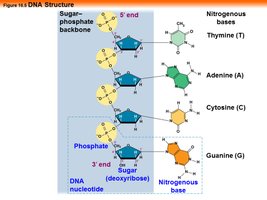
DNA is the hereditary material in all living organisms, composed of two strands forming a double helix. The structure of DNA is essential for its function in storing and transmitting genetic information.
DNA Nucleotide: Each nucleotide consists of a phosphate group, a deoxyribose sugar, and a nitrogenous base (adenine, thymine, cytosine, or guanine).
Backbone: The sugar-phosphate backbone forms the exterior of the molecule, while the nitrogenous bases are located on the interior.
Antiparallel Strands: The two DNA strands run in opposite directions (5' to 3' and 3' to 5').
Base Pairing: Adenine pairs with thymine (A-T), and guanine pairs with cytosine (G-C) via hydrogen bonds.
Chromosomes and Chromatin
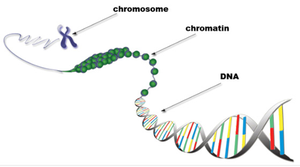
Chromosomes are structures within cells that contain DNA tightly packed with proteins, forming chromatin. This organization is crucial for gene regulation and inheritance.
Genes: Segments of DNA that code for proteins and traits.
Chromatin: DNA wrapped around histone proteins, forming a compact structure.
Historical Evidence for DNA as Genetic Material
Morgan’s Chromosome Theory
Early experiments by Morgan demonstrated that genes are located on chromosomes, which are composed of DNA and protein. This led to questions about which macromolecule was responsible for inheritance.
Viral Evidence: Bacteriophages
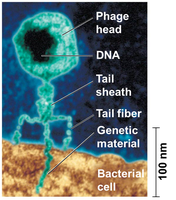
Viruses, especially bacteriophages, provided key evidence that DNA is the genetic material.
Bacteriophage: A virus that infects bacteria, consisting of DNA (or RNA) enclosed in a protein coat.
Replication: Viruses cannot replicate their genetic material without infecting a host cell.
Hershey-Chase Experiment
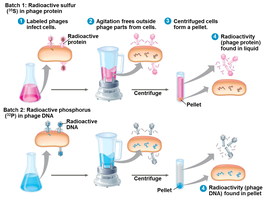
The Hershey-Chase experiment used radioactive labeling to show that DNA, not protein, is the hereditary material in viruses.
Batch 1: Radioactive sulfur labeled phage protein; after infection, radioactivity was found in the liquid, not the pellet.
Batch 2: Radioactive phosphorus labeled phage DNA; after infection, radioactivity was found in the pellet, indicating DNA entered the cell.
Chargaff’s Rules and DNA Composition
Chargaff’s Findings
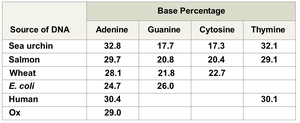
In 1950, Chargaff analyzed the base composition of DNA in various species, leading to two important rules:
Rule 1: The base composition of DNA varies between species.
Rule 2: The percentage of adenine equals thymine (%A = %T), and the percentage of guanine equals cytosine (%G = %C).
Base Percentage Table
Source of DNA | Adenine | Guanine | Cytosine | Thymine |
|---|---|---|---|---|
Sea urchin | 32.8 | 17.7 | 17.3 | 32.1 |
Salmon | 29.7 | 20.8 | 20.4 | 29.1 |
Wheat | 28.1 | 21.8 | 22.7 | 27.4 |
E. coli | 24.7 | 26.0 | 25.7 | 23.6 |
Human | 30.4 | 19.6 | 19.9 | 30.1 |
Ox | 29.0 | 22.0 | 22.0 | 29.0 |
Building the Structural Model of DNA
X-ray Crystallography and the Double Helix
Maurice Wilkins and Rosalind Franklin used X-ray crystallography to reveal the structure of DNA. Franklin’s images suggested DNA was composed of two strands with an outer sugar-phosphate backbone and an interior of nitrogenous bases.
Watson and Crick: Used Franklin’s data to deduce the double helix structure and the width of the helix.
Antiparallel Backbones: The two strands run in opposite directions.
Complementary Strands: Each strand can serve as a template for replication.
DNA Replication Mechanism
Overview of DNA Replication
DNA replication is the process by which a cell copies its DNA before cell division. The double helix structure allows each strand to serve as a template for a new strand.
Replication Origin: Replication begins at specific sites called origins of replication, forming a replication bubble.
Replication Fork: The Y-shaped region where the DNA is actively being unwound and replicated.
Proteins and Enzymes Involved
Several proteins and enzymes are essential for DNA replication:
Helicase: Unwinds the DNA double helix.
Single-Strand Binding Proteins: Stabilize the unwound DNA.
Topoisomerase: Relieves strain ahead of the replication fork.
Primase: Synthesizes a short RNA primer to initiate DNA synthesis.
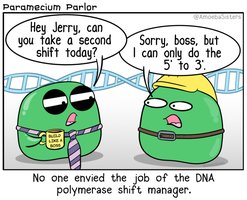
DNA Polymerase: Adds nucleotides to the growing DNA strand, only in the 5' to 3' direction.
DNA Ligase: Joins Okazaki fragments on the lagging strand.
Directionality and Strand Synthesis
The antiparallel nature of DNA affects replication:
Leading Strand: Synthesized continuously in the 5' to 3' direction toward the replication fork.
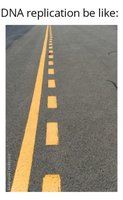
Lagging Strand: Synthesized discontinuously away from the fork in short segments called Okazaki fragments.

Okazaki Fragments
Okazaki fragments are short DNA segments synthesized on the lagging strand. DNA ligase joins these fragments to form a continuous strand.
Proofreading and DNA Repair
Proofreading by DNA Polymerase
DNA polymerases have proofreading ability, correcting errors during DNA synthesis.
Mismatch Repair: Repair enzymes correct errors in base pairing.
Nucleotide Excision Repair: A nuclease removes damaged DNA, and DNA polymerase fills the gap.
DNA Ligase: Seals the repaired DNA.
Environmental DNA Damage
DNA can be damaged by environmental factors such as X-rays, UV light, and chemical pollutants. Cells have mechanisms to repair such damage and maintain genetic integrity.
Replicating DNA Ends: Telomeres
Telomeres and Chromosome Protection
Eukaryotic chromosomes have linear DNA, which poses a problem for replication at the ends.
Telomeres: Special nucleotide sequences (e.g., TTAGGC) at chromosome ends that protect against DNA erosion.
Importance: Telomere shortening is associated with aging and cell senescence.
Prokaryotes: Do not face this problem due to their circular DNA.
Key Equations and Concepts
Base Pairing Equation
Directionality of DNA Synthesis
Okazaki Fragment Formation
Summary Table: DNA Replication Proteins
Protein/Enzyme | Function |
|---|---|
Helicase | Unwinds DNA |
Single-Strand Binding Protein | Stabilizes unwound DNA |
Topoisomerase | Relieves strain |
Primase | Synthesizes RNA primer |
DNA Polymerase | Adds nucleotides |
DNA Ligase | Joins fragments |
Conclusion
Understanding DNA structure, replication, and repair is fundamental to molecular biology. The double helix model, base pairing rules, and the mechanisms of replication and repair ensure the faithful transmission of genetic information from one generation to the next. Additional info: Some images included are memes or comics that humorously illustrate the concepts of DNA replication, Okazaki fragments, and DNA polymerase directionality, which can aid in student understanding.
