 Back
BackDNA Structure, Replication, and Telomere Maintenance
Study Guide - Smart Notes
 Tailored notes based on your materials, expanded with key definitions, examples, and context.
DNA Structure and Genetic Material
Nucleic Acid and DNA Structure
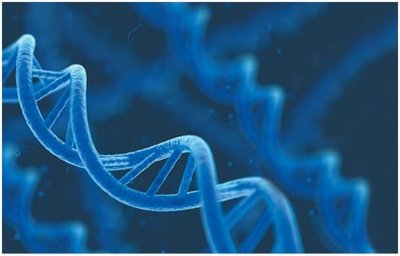
Deoxyribonucleic acid (DNA) is the hereditary material in almost all living organisms. DNA is a polymer composed of nucleotide monomers, each consisting of a deoxyribose sugar, a phosphate group, and a nitrogenous base (adenine, thymine, cytosine, or guanine). The structure of DNA is a double helix, with two antiparallel strands held together by hydrogen bonds between complementary bases.
Double Helix: The two strands twist around each other, forming a right-handed helix.
Base Pairing: Adenine pairs with thymine (A-T), and cytosine pairs with guanine (C-G).
Antiparallel Orientation: One strand runs 5' to 3', the other 3' to 5'.
Evidence that DNA is the Genetic Material
Experiments such as those by Avery, MacLeod, and McCarty, and the Hershey-Chase experiment, demonstrated that DNA, not protein, is the molecule responsible for heredity. These studies showed that DNA could transfer genetic information between organisms.
DNA Replication and the End-Replication Problem
DNA Replication
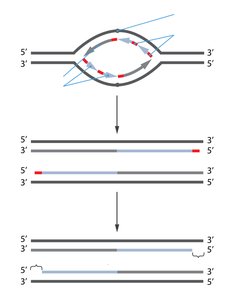
DNA replication is the process by which a cell copies its DNA before cell division. The enzyme DNA polymerase synthesizes new DNA strands using the original strands as templates. Replication is semi-conservative, meaning each new DNA molecule contains one old and one new strand.
Leading Strand: Synthesized continuously in the 5' to 3' direction.
Lagging Strand: Synthesized discontinuously as Okazaki fragments, later joined together.
Primase: Synthesizes short RNA primers to initiate DNA synthesis.
DNA Polymerase: Adds nucleotides to the 3' end of the primer or growing DNA strand.
The End-Replication Problem
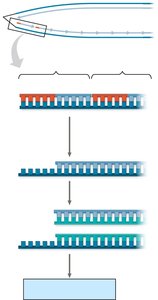
Linear chromosomes face a unique challenge during replication. DNA polymerase cannot fully replicate the 5' ends of the lagging strand, leading to progressive shortening of chromosomes with each cell division.
Limitation: DNA polymerase can only add nucleotides to an existing 3' end.
Result: After removal of the RNA primer at the end of the lagging strand, there is no upstream 3' end for DNA polymerase to extend, resulting in incomplete replication of chromosome ends.
Telomeres and Telomerase
Structure and Function of Telomeres
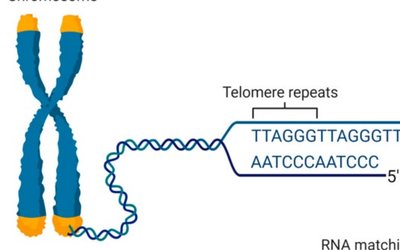
Telomeres are repetitive, non-coding DNA sequences found at the ends of linear chromosomes. In humans, the telomeric repeat sequence is TTAGGG, repeated thousands of times. Telomeres protect chromosome ends from degradation and prevent them from being recognized as DNA breaks.
Location: Ends of linear chromosomes.
Sequence: Highly repetitive, e.g., TTAGGG in humans.
Function: Prevent loss of important genetic information and maintain chromosome stability.
Telomere Shortening and Cellular Aging
With each round of DNA replication, telomeres become progressively shorter due to the end-replication problem. When telomeres reach a critically short length, cells enter senescence or undergo apoptosis, contributing to aging.
Somatic Cells: Most do not express telomerase, leading to gradual telomere shortening.
Germ Cells: Express telomerase, maintaining telomere length across generations.
Telomerase: The Telomere-Extending Enzyme
Telomerase is a ribonucleoprotein enzyme that extends telomeres by adding telomeric repeats to the 3' end of chromosomes. It carries its own RNA template, which it uses to synthesize DNA repeats.
Active In: Germ cells, stem cells, and most cancer cells.
Inactive In: Most normal somatic cells.
Mechanism: Telomerase binds to the 3' overhang and extends it, allowing lagging strand synthesis to complete the chromosome end.
Summary Table: Telomere and Telomerase Properties
Feature | Telomere | Telomerase |
|---|---|---|
Location | Chromosome ends | Nucleus (at telomeres) |
Sequence | TTAGGG (human) | RNA template for TTAGGG |
Function | Protects chromosome ends | Extends telomeres |
Activity | All cells | Germ cells, stem cells, cancer cells |
Flow of Genetic Information
Central Dogma of Molecular Biology
The flow of genetic information in cells follows the central dogma: DNA is transcribed into RNA, which is then translated into protein. This process ensures that genetic instructions are expressed as functional molecules.
Transcription: Synthesis of RNA from a DNA template.
Translation: Synthesis of protein from an mRNA template.
Additional Topics
Mutation
Mutations are changes in the DNA sequence that can affect gene function. They may occur spontaneously during DNA replication or be induced by environmental factors.
Bioinformatics
Bioinformatics involves the use of computational tools to analyze and interpret biological data, such as DNA sequences, to understand genetic information and its function.
Additional info: The notes above expand on the provided outline with academic context to ensure completeness and clarity for college-level biology students.
