 Back
BackDNA Structure, Replication, Gene Expression, and Mutations: Study Notes
Study Guide - Smart Notes
 Tailored notes based on your materials, expanded with key definitions, examples, and context.
DNA: The Molecule of Heredity
Discovery of DNA Structure
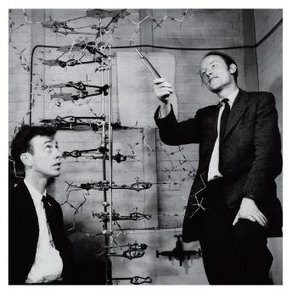
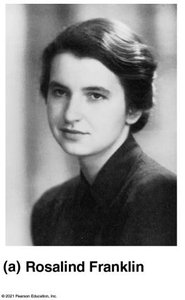
DNA (deoxyribonucleic acid) is the hereditary material in all living organisms. The structure of DNA was elucidated through the combined efforts of several scientists, including Watson, Crick, and Franklin. Their work revealed the double helix structure, which is essential for DNA's function in storing and transmitting genetic information.
Hershey & Chase Experiment
The Hershey & Chase experiment used bacteriophages (viruses that infect bacteria) to determine whether DNA or protein was the genetic material. They labeled DNA with radioactive phosphorus and protein with radioactive sulfur. After infection, only the radioactive DNA entered the bacterial cells, demonstrating that DNA is the molecule of heredity.
Conclusion: DNA, not protein, carries genetic information.
DNA Structure and Base Pairing
DNA Nucleotide Structure
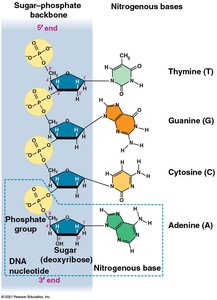
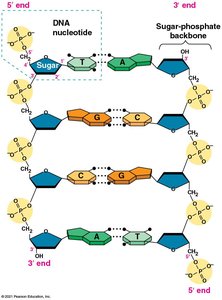
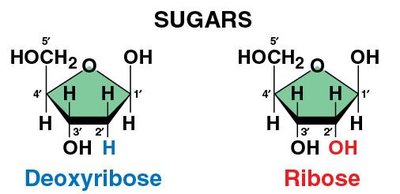
Each DNA nucleotide consists of a phosphate group, a deoxyribose sugar, and a nitrogenous base (adenine, thymine, cytosine, or guanine). The sugar-phosphate backbone forms the structural framework, while the bases pair in the interior.
Double Helix and Complementary Base Pairing
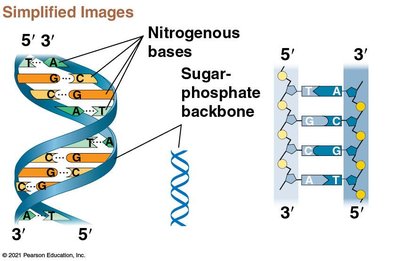
DNA is a double-stranded helix with antiparallel strands. The bases pair specifically: adenine (A) with thymine (T) via two hydrogen bonds, and guanine (G) with cytosine (C) via three hydrogen bonds. This complementary base pairing ensures accurate replication and transcription.
Base Pairing Rules: A pairs with T, G pairs with C.
Bond Type: Hydrogen bonds hold complementary bases together.
DNA Replication
Semi-Conservative Replication
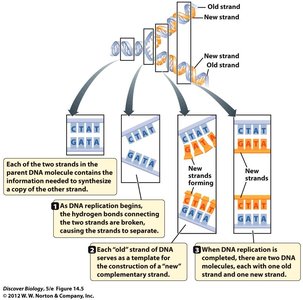
DNA replication is semi-conservative, meaning each new DNA molecule consists of one old (parental) strand and one newly synthesized strand. This process ensures genetic continuity between generations.
Key Enzymes: Helicase unwinds the DNA, DNA polymerase synthesizes new strands using the parental strands as templates.
Location: DNA replication occurs in the nucleus of eukaryotic cells.
The Central Dogma: Flow of Genetic Information
Overview
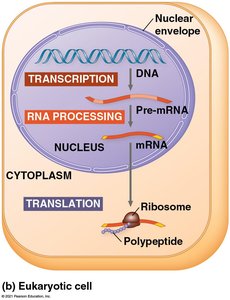
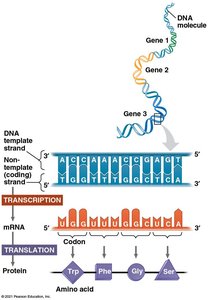
The central dogma of molecular biology describes the flow of genetic information from DNA to RNA to protein. This process involves two main steps: transcription and translation.

DNA vs. RNA
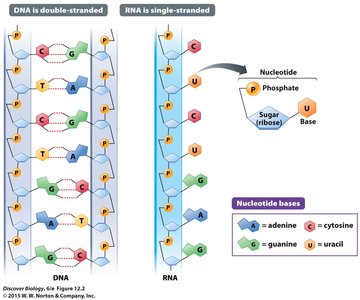
DNA and RNA differ in several key aspects:
Strands: DNA is double-stranded; RNA is single-stranded.
Sugar: DNA contains deoxyribose; RNA contains ribose.
Bases: DNA uses thymine (T); RNA uses uracil (U) instead of thymine.
Transcription: Making an RNA Copy of DNA
Stages of Transcription
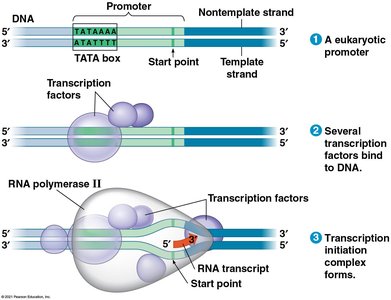
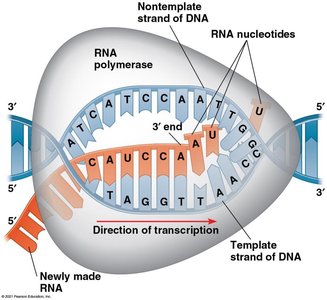
Transcription is the synthesis of RNA from a DNA template. It occurs in three main stages:
Initiation: RNA polymerase binds to the promoter region with the help of transcription factors, forming the transcription initiation complex.
Elongation: RNA polymerase moves along the DNA, synthesizing RNA in the 5' to 3' direction.
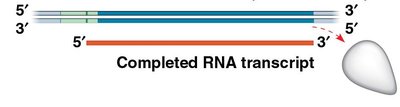
Termination: Transcription ends when RNA polymerase reaches a terminator sequence, releasing the completed RNA transcript.
RNA Processing in Eukaryotes
RNA Processing and Splicing
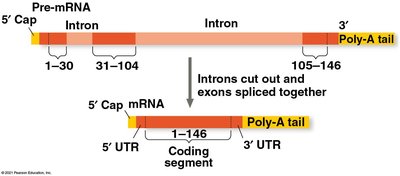
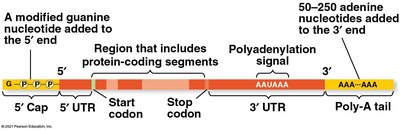
In eukaryotic cells, the primary RNA transcript (pre-mRNA) undergoes several modifications before becoming mature mRNA:
5' Capping: Addition of a modified guanine nucleotide to the 5' end.
Polyadenylation: Addition of a poly-A tail to the 3' end.
RNA Splicing: Removal of non-coding sequences (introns) and joining of coding sequences (exons).
Introns are non-coding regions removed during splicing, while exons are coding regions that remain in the mature mRNA.
Translation: Protein Synthesis
Genetic Code and Codons
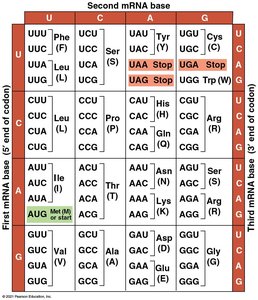
The genetic code is read in sets of three nucleotides called codons, each specifying an amino acid. The start codon (AUG) signals the beginning of translation, while stop codons (UAA, UAG, UGA) signal termination.
tRNA and Ribosomes
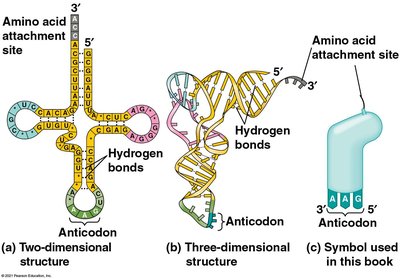
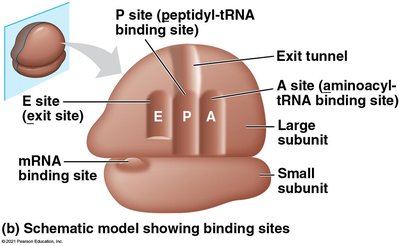
Transfer RNA (tRNA) molecules bring amino acids to the ribosome, matching their anticodon with codons on the mRNA. The ribosome has three binding sites for tRNA: A (aminoacyl), P (peptidyl), and E (exit).
Stages of Translation
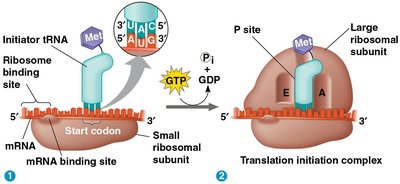
Initiation: The small ribosomal subunit binds to mRNA, and the initiator tRNA pairs with the start codon. The large subunit then assembles.
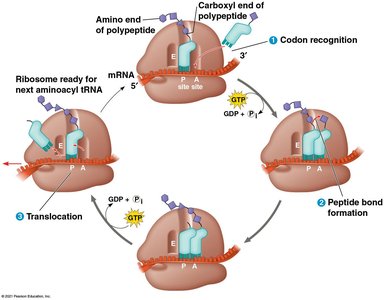
Elongation: Amino acids are added one by one as the ribosome moves along the mRNA, forming peptide bonds between them.
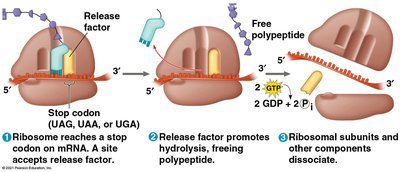
Termination: When a stop codon is reached, a release factor binds, causing the polypeptide to be released and the ribosome to dissociate.
Mutations: Changes in Genetic Information
Types of Mutations
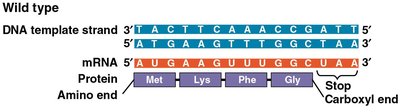
Mutations are changes in the DNA sequence that can affect gene function. They may occur spontaneously or be induced by environmental factors (mutagens).
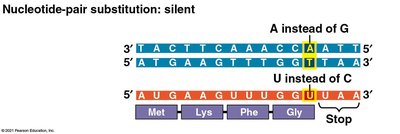
Silent Mutation: Alters a nucleotide but does not change the amino acid sequence.
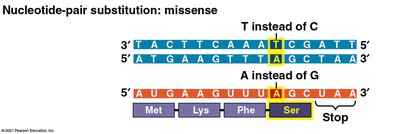
Missense Mutation: Changes one amino acid in the protein.
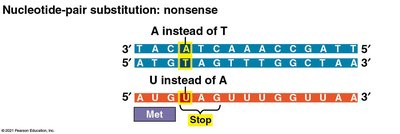
Nonsense Mutation: Converts a codon into a stop codon, truncating the protein.
Insertion/Deletion: Addition or loss of nucleotides, which may cause frameshift mutations, altering the reading frame.
Mutation Type | Effect |
|---|---|
Silent | No change in amino acid sequence |
Missense | One amino acid changed |
Nonsense | Premature stop codon |
Insertion/Deletion | Frameshift, possible extensive changes |
Example: Sickle-Cell Disease
Sickle-cell disease is caused by a missense mutation in the gene encoding the beta chain of hemoglobin. A single nucleotide change results in the substitution of valine for glutamic acid, altering the protein's primary structure and function.
Summary Table: Key Terms and Concepts
Term | Definition |
|---|---|
DNA | Molecule of heredity, double helix structure |
Gene | Segment of DNA encoding a functional product |
Transcription | Synthesis of RNA from DNA template |
Translation | Synthesis of protein from mRNA template |
Mutation | Change in DNA sequence |
Exon | Coding region of a gene |
Intron | Non-coding region removed during RNA processing |
Additional info: These notes cover core concepts from Chapters 16 and 17, including the molecular basis of inheritance and gene expression, as outlined in standard college biology curricula.
