 Back
DNA Structure, Replication, Transcription, Translation, and Mutations: Study Guide
Study Guide - Smart Notes
 Tailored notes based on your materials, expanded with key definitions, examples, and context.
DNA Structure and Function
DNA as the Molecule of Heredity
DNA is the fundamental molecule responsible for heredity in all living organisms. It stores genetic information and directs the synthesis of proteins, which determine cellular structure and function.
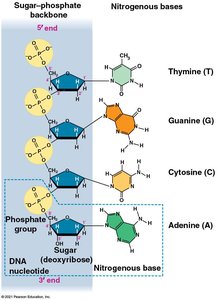
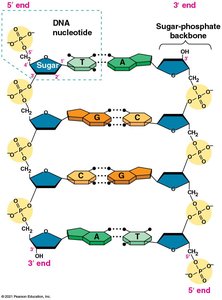
Key Point: DNA is composed of nucleotides, each containing a phosphate group, a deoxyribose sugar, and a nitrogenous base.
Key Point: The sequence of bases encodes genetic information.
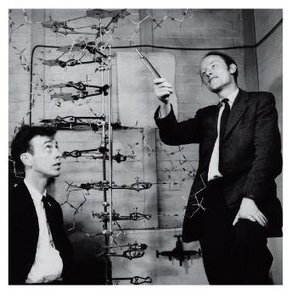
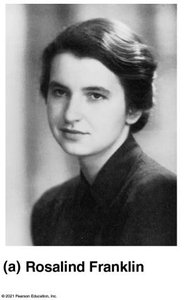
Example: The discovery of DNA's structure by Watson, Crick, and Franklin was pivotal in understanding heredity.
DNA Base Pairing
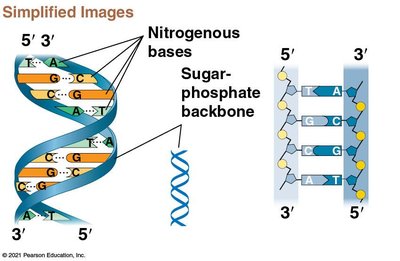
The nitrogenous bases in DNA pair in a complementary manner, ensuring accurate replication and transcription.
Key Point: Adenine (A) pairs with Thymine (T), and Guanine (G) pairs with Cytosine (C).
Key Point: Base pairs are held together by hydrogen bonds: A-T pairs have 2 hydrogen bonds, G-C pairs have 3.
Key Point: The number of base pairs shown in a DNA segment depends on the length of the sequence.
Example: Complementary base pairing is essential for the fidelity of DNA replication.
DNA Replication
Semi-Conservative Replication
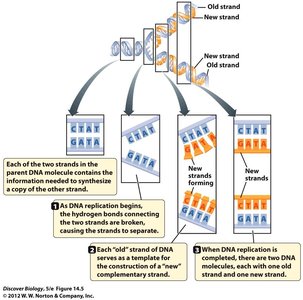
DNA replication is the process by which a cell copies its DNA before cell division. It is described as semi-conservative because each new DNA molecule contains one old strand and one newly synthesized strand.
Key Point: The parental DNA strands serve as templates for the synthesis of new strands.
Key Point: Enzymes involved include helicase (unwinds DNA), DNA polymerase (synthesizes new DNA), and others.
Key Point: Replication occurs in the nucleus of eukaryotic cells.
Example: The semi-conservative model was confirmed by the Meselson-Stahl experiment.
The Central Dogma: Flow of Genetic Information
Overview of Genetic Information Flow
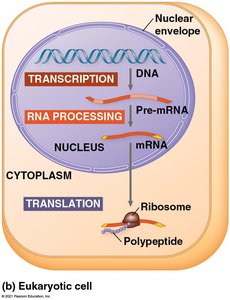
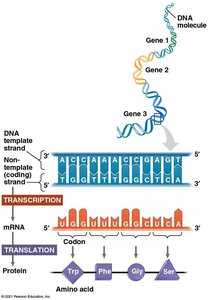
The central dogma describes the directional flow of genetic information: DNA is transcribed into RNA, which is then translated into protein.
Key Point: Transcription occurs in the nucleus, translation occurs in the cytoplasm.
Key Point: Proteins are the functional products of gene expression.
Example: The central dogma is summarized as DNA → RNA → Protein.

Differences Between DNA and RNA
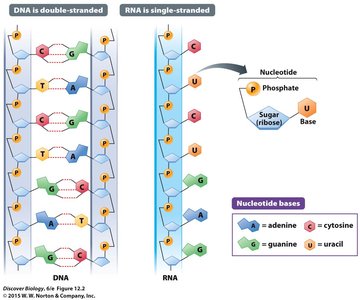
DNA and RNA differ in structure and function, which is crucial for their roles in gene expression.
Key Point: DNA is double-stranded; RNA is single-stranded.
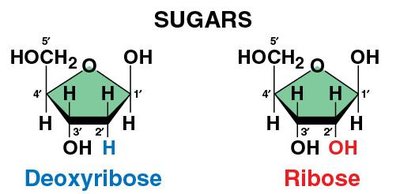
Key Point: DNA contains deoxyribose sugar; RNA contains ribose sugar.
Key Point: DNA uses thymine (T); RNA uses uracil (U).
Example: These differences allow RNA to be more versatile in cellular processes.
Transcription: Making an RNA Copy of DNA
Initiation, Elongation, and Termination
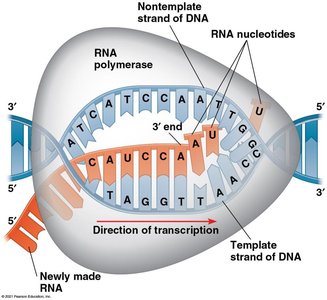
Transcription is the process by which RNA is synthesized from a DNA template.
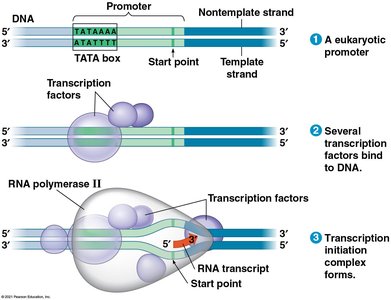
Key Point: Initiation: RNA polymerase binds to the promoter region, aided by transcription factors.
Key Point: Elongation: RNA polymerase synthesizes RNA by adding nucleotides complementary to the DNA template.
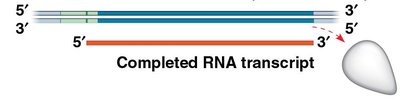
Key Point: Termination: Transcription ends when RNA polymerase reaches a termination sequence.
Example: The TATA box is a common promoter element in eukaryotes.
RNA Processing in Eukaryotes
RNA Modification and Splicing
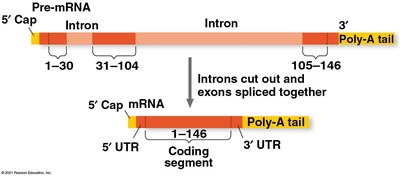
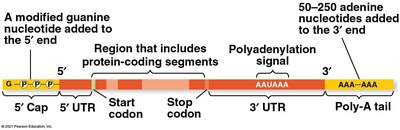
Eukaryotic mRNAs are modified after transcription to become mature mRNAs ready for translation.
Key Point: Modifications include addition of a 5' cap and a poly-A tail.
Key Point: RNA splicing removes introns (non-coding regions) and joins exons (coding regions).
Key Point: Introns are intervening sequences; exons are expressed sequences.
Example: Alternative splicing allows a single gene to code for multiple proteins.
Translation: Protein Synthesis
mRNA, tRNA, and Ribosome Function
Translation is the process by which the genetic code in mRNA is used to synthesize proteins.
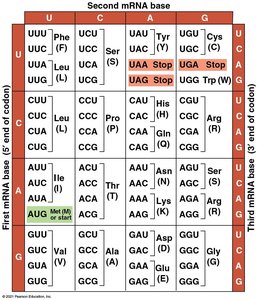
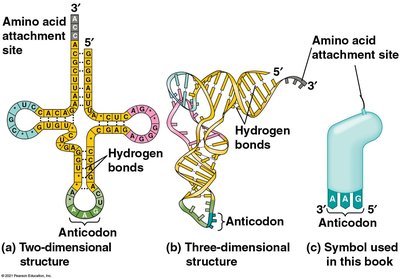
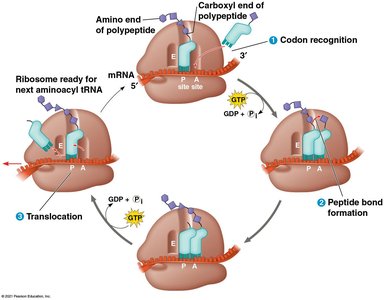
Key Point: mRNA carries codons, tRNA brings amino acids, and the ribosome facilitates peptide bond formation.
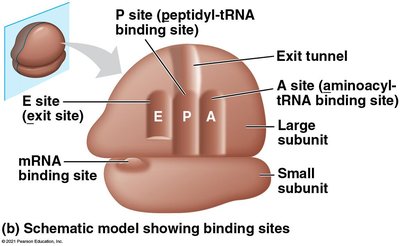
Key Point: The ribosome has three sites: E (exit), P (peptidyl), and A (aminoacyl).
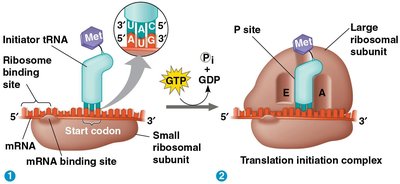
Key Point: Translation occurs in three stages: initiation, elongation, and termination.
Example: The start codon (AUG) signals the beginning of translation; stop codons (UAA, UAG, UGA) signal its end.
Mutations and Their Effects
Types of Mutations
Mutations are changes in the DNA sequence that can affect gene expression and protein function.
Key Point: Silent mutations do not change the amino acid sequence.
Key Point: Missense mutations change one amino acid to another.
Key Point: Nonsense mutations introduce a premature stop codon.
Key Point: Insertions and deletions can cause frameshift mutations, altering the reading frame.
Example: Sickle-cell disease is caused by a missense mutation in the hemoglobin gene.
Mutation Type | Effect |
|---|---|
Silent | No change in protein |
Missense | One amino acid changed |
Nonsense | Protein truncated |
Insertion/Deletion | Frameshift, major changes |
Summary Table: Key Terms and Concepts
Term | Definition |
|---|---|
DNA | Molecule of heredity, double-stranded |
RNA | Single-stranded, involved in protein synthesis |
Transcription | Process of making RNA from DNA |
Translation | Process of making protein from mRNA |
Mutation | Change in DNA sequence |
Codon | Three-base sequence in mRNA |
tRNA | Transfers amino acids to ribosome |
Ribosome | Site of protein synthesis |
Additional info:
DNA replication occurs during the S phase of the cell cycle.
RNA polymerase is the enzyme responsible for transcription.
Mutations can be caused by errors in replication, environmental factors, or chemical agents.
