 Back
DNA Synthesis and Repair: Structure, Replication, and Maintenance
Study Guide - Smart Notes
 Tailored notes based on your materials, expanded with key definitions, examples, and context.
DNA Structure and Components
Nucleotides: The Building Blocks of DNA
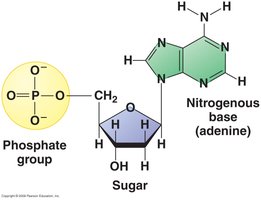
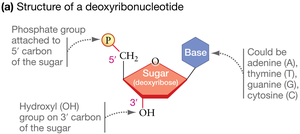
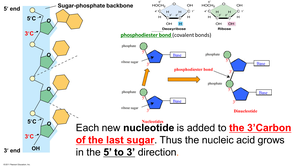
DNA is composed of nucleotides, which are the monomers of nucleic acids. Each nucleotide consists of three main components: a phosphate group, a five-carbon sugar (deoxyribose in DNA), and a nitrogenous base (adenine, thymine, guanine, or cytosine). The sequence of these nucleotides encodes genetic information.
Phosphate group: Provides structural support and links nucleotides together.
Sugar (deoxyribose): Forms the backbone of the DNA strand.
Nitrogenous base: Determines the genetic code; bases pair via hydrogen bonds (A with T, G with C).
Nucleoside: A nucleotide without the phosphate group.
Polynucleotides and DNA Double Helix
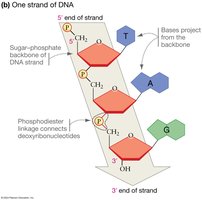
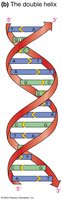
Nucleotides are joined together by phosphodiester bonds to form polynucleotide chains. Two polynucleotide strands run antiparallel and twist to form the double helix structure of DNA.
Phosphodiester linkage: Connects the 5' phosphate of one nucleotide to the 3' hydroxyl of the next.
Antiparallel orientation: One strand runs 5' to 3', the other 3' to 5'.
Double helix: Stabilized by hydrogen bonds between complementary bases.
DNA Replication: Mechanism and Enzymes
Origins of Replication and Replication Forks
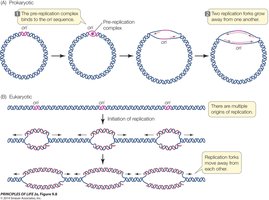
DNA replication begins at specific sites called origins of replication. In eukaryotes, chromosomes have multiple origins, allowing replication to proceed rapidly. Replication proceeds bidirectionally from each origin, forming replication forks where the DNA is actively unwound and copied.
Replication fork: The Y-shaped region where new DNA strands are synthesized.
Bidirectional replication: Both directions from the origin, increasing efficiency.
Initiation: Unwinding the DNA
Several enzymes and proteins are involved in the initiation of DNA replication:
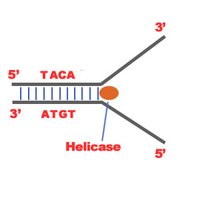
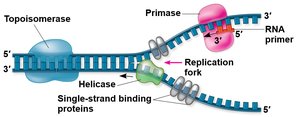
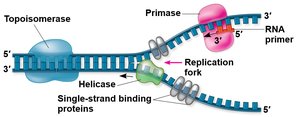
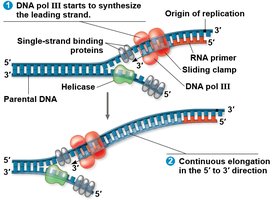
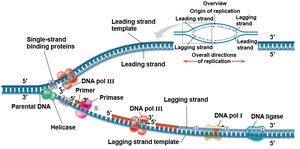
DNA helicase: Unwinds the parental double helix by breaking hydrogen bonds.
Single-strand binding proteins: Stabilize separated strands and prevent re-pairing.
Topoisomerase: Relieves strain ahead of the replication fork by cutting and rejoining DNA.
Synthesizing New DNA Strands
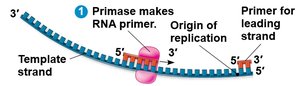
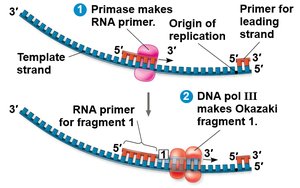
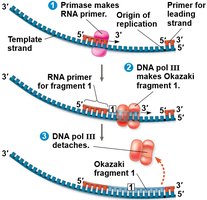
DNA polymerases synthesize new DNA strands by adding nucleotides to a pre-existing primer. The primer is a short RNA segment synthesized by primase. DNA polymerase III extends the primer, building the new strand in the 5' to 3' direction.
Primer: Short RNA sequence required for DNA polymerase to start synthesis.
DNA polymerase III: Main enzyme for DNA synthesis.
Primase: Synthesizes the RNA primer.
Antiparallel Elongation and Strand Synthesis
DNA polymerase can only add nucleotides to the 3' end of the primer or growing DNA strand, resulting in two distinct modes of synthesis:
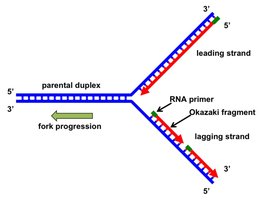
Leading strand: Synthesized continuously toward the replication fork; requires only one primer.
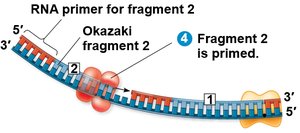
Lagging strand: Synthesized discontinuously away from the fork in short segments called Okazaki fragments; requires multiple primers.
Okazaki Fragments and Lagging Strand Completion
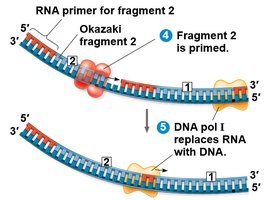
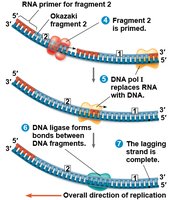
The lagging strand is synthesized in fragments. Primase makes new RNA primers, DNA polymerase III extends them, and DNA polymerase I replaces RNA with DNA. DNA ligase joins the fragments, completing the strand.
Okazaki fragments: Short DNA segments on the lagging strand.
DNA polymerase I: Removes RNA primers and replaces them with DNA.
DNA ligase: Seals nicks between fragments.
Summary of DNA Replication
DNA replication is a highly coordinated process involving multiple enzymes and proteins. The leading strand is synthesized continuously, while the lagging strand is synthesized in fragments. The process ensures accurate duplication of genetic material.
Bacterial DNA Replication Proteins and Their Functions
The following table summarizes the main proteins involved in bacterial DNA replication and their functions:
Protein | Function |
|---|---|
Helicase | Unwinds parental double helix at replication forks |
Single-strand binding proteins | Binds to and stabilizes single-stranded DNA until it is used as a template |
Topoisomerase | Relieves overwinding strain ahead of replication forks by breaking, swiveling, and rejoining DNA strands |
Primase | Synthesizes an RNA primer at 5' end of leading strand and at 5' end of each Okazaki fragment of lagging strand |
DNA polymerase III | Using parental DNA as a template, synthesizes new DNA strand by adding nucleotides to an RNA primer or a pre-existing DNA strand |
DNA polymerase I | Removes RNA nucleotides of primer from 5' end and replaces them with DNA nucleotides added to 3' end of adjacent fragment |
DNA ligase | Joins Okazaki fragments of lagging strand; on leading strand, joins 3' end of DNA that replaces primer to rest of leading strand DNA |
Termination and Telomeres
Termination of DNA Replication
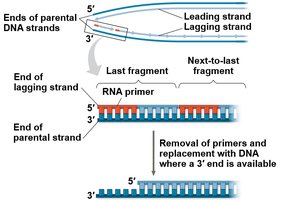
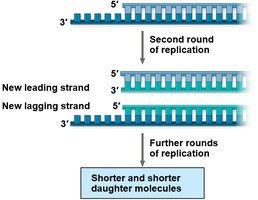
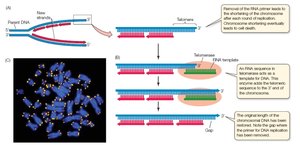
In eukaryotes, the end of the lagging strand presents a problem: after removal of the final RNA primer, there is no 3' end available for DNA polymerase to fill the gap, resulting in progressive shortening of chromosomes with each cell division.
Telomeres and Telomerase
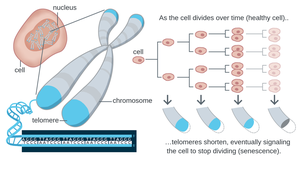
Telomeres are repetitive, non-coding sequences at the ends of chromosomes that protect genes from erosion. With each cell division, telomeres shorten, eventually leading to cellular senescence. Telomerase is an enzyme that extends telomeres, active in certain cells (e.g., embryonic stem cells). Mutations affecting telomerase can contribute to cancer development.
Telomere sequence in humans: TTAGGG, repeated 100–1000 times.
Function: Postpones gene erosion, but does not prevent DNA shortening.
Proofreading and Repairing DNA
Proofreading by DNA Polymerases
DNA polymerases have proofreading ability, correcting errors during DNA synthesis by removing and replacing incorrect nucleotides.
Mismatch repair: Specialized enzymes correct errors in base pairing after replication.
DNA Damage and Repair Mechanisms
DNA can be damaged by environmental factors (e.g., chemicals, radiation) or spontaneous changes. Specific repair enzymes recognize and excise damaged DNA, replacing it with correct sequences.
Excision repair: Damaged DNA is cut out and replaced.
Importance: Maintains genetic integrity and prevents mutations.
Chromatin Packing in Eukaryotic Chromosomes
Chromatin Structure
DNA is tightly packed in eukaryotic chromosomes through multiple levels of organization, from nucleosomes to higher-order structures. This packing regulates gene expression and protects DNA.
Nucleosome: DNA wrapped around histone proteins.
Higher-order packing: Further compacts DNA for efficient storage.
Learning Objectives
Describe the chemical components and structure of DNA.
Explain semiconservative DNA replication.
Identify and explain key components of a replication bubble.
Describe functions of major enzymes in DNA replication.
Explain DNA damage detection and repair mechanisms.
Additional info: Academic context was added to clarify enzyme functions, DNA structure, and the significance of telomeres and repair mechanisms.
