 Back
BackDNA Technology and Biotechnology: Methods, Applications, and Ethical Considerations
Study Guide - Smart Notes
 Tailored notes based on your materials, expanded with key definitions, examples, and context.
DNA Technology: Overview and Key Concepts
Introduction to DNA Technology
DNA technology encompasses the sequencing, manipulation, and application of DNA for research and practical purposes. It is widely used in agriculture, criminal law, and medical research. The double-stranded nature of DNA and complementary base pairing enable nucleic acid hybridization, which is foundational for many biotechnological methods.
Double-stranded DNA: Provides stability and allows for replication and repair.
Complementary base pairing: Enables precise hybridization and is exploited in sequencing and cloning.
The Human Genome Project (HGP)
The Human Genome Project, completed in 2003, was a large international effort to map and understand all human genes. It identified approximately 20,500 genes and 3 billion base pairs, providing a foundation for modern genomics and biotechnology.
DNA Sequencing Technologies
Sanger Sequencing (Chain Termination Method)
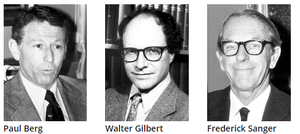
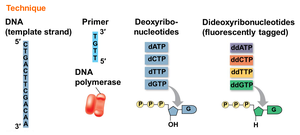
Sanger sequencing, developed by Frederick Sanger and colleagues, was the first widely used DNA sequencing method. It uses dideoxynucleotides to terminate DNA synthesis at specific bases, generating fragments that can be separated and read to determine the DNA sequence.
Dideoxynucleotides (ddNTPs): Lack a 3' OH group, causing chain termination.
DNA polymerase: Synthesizes new DNA strands until a ddNTP is incorporated.
Gel electrophoresis: Separates DNA fragments by size for sequence determination.
Next-Generation and High-Throughput Sequencing
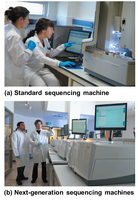
Next-generation sequencing (NGS) technologies allow for the parallel sequencing of thousands to millions of DNA fragments, greatly increasing speed and reducing cost. These methods have enabled the sequencing of thousands of species and hundreds of thousands of human genomes.
High-throughput sequencing: Involves fragmenting DNA, amplifying fragments, and sequencing in parallel.
Bioinformatics: Computational analysis is essential for managing and interpreting large datasets.
Third-Generation Sequencing
Third-generation sequencing technologies, such as nanopore sequencing, read single DNA molecules directly and are even faster and cheaper, though not yet fully established.
DNA Cloning and Recombinant DNA
Gene Cloning Using Plasmids
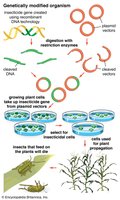
Gene cloning involves making multiple identical copies of a gene of interest (GOI). Plasmids, small circular DNA molecules in bacteria, are commonly used as cloning vectors. Recombinant DNA is created by inserting foreign DNA into plasmids, which are then introduced into bacteria for replication.
Cloning vector: A plasmid used to carry foreign DNA into a host cell.
Recombinant DNA: DNA molecule formed by combining DNA from different sources.
Restriction Enzymes and DNA Ligation
Restriction enzymes cut DNA at specific sequences, producing fragments with 'sticky ends' that can be joined with complementary sequences. DNA ligase seals the bonds, creating stable recombinant DNA molecules.
Gel Electrophoresis
Gel electrophoresis separates DNA fragments by size, charge, or other properties, allowing verification of successful cloning or analysis of DNA samples.
Polymerase Chain Reaction (PCR)
PCR is a technique to amplify specific DNA sequences exponentially using cycles of denaturation, annealing, and extension. It requires heat-stable DNA polymerase (e.g., Taq polymerase), primers, and free nucleotides.
Denaturation: DNA strands are separated by heating.
Annealing: Primers bind to target sequences.
Extension: DNA polymerase synthesizes new DNA strands.
Limitations: PCR can introduce errors and requires careful primer design.
Gene Expression and Functional Analysis
Expressing Cloned Genes
Cloned genes can be expressed in bacterial or eukaryotic cells to produce proteins for research or therapeutic use. Expression vectors with strong promoters are used to drive gene expression in bacteria, but eukaryotic genes may require eukaryotic hosts due to differences in gene structure and regulation.
Assessing Gene Expression
Gene expression can be measured by detecting mRNA levels using reverse transcriptase PCR (RT-PCR) or nucleic acid hybridization with labeled probes. In situ hybridization allows visualization of gene expression in tissues.
High-Throughput Gene Expression Analysis
DNA microarrays and RNA-seq enable the simultaneous measurement of thousands of genes, providing comprehensive gene expression profiles under various conditions.
Gene Silencing and Editing
Gene function can be studied by silencing gene expression using RNA interference (RNAi) or by introducing mutations via in vitro mutagenesis. The CRISPR-Cas9 system allows precise gene editing in living cells, using a guide RNA to direct the Cas9 protein to the target sequence for cutting and modification.
Applications of DNA Technology
Organismal Cloning and Stem Cells
Organismal cloning produces genetically identical organisms. Stem cells are undifferentiated cells capable of giving rise to various cell types. They are categorized by potency:
Totipotent: Can generate a complete organism.
Pluripotent: Can become many cell types.
Induced pluripotent stem (iPS) cells: Differentiated cells reprogrammed to act like pluripotent cells.
Cloning in Plants and Animals
Plant cells are totipotent and can be cloned for agricultural use. Animal cloning typically involves nuclear transplantation, where the nucleus of a differentiated cell is transferred into an enucleated egg. Cloned animals often face developmental challenges due to incomplete reprogramming of the donor nucleus.
Medical and Agricultural Biotechnology
Biotechnology is used to diagnose and treat diseases, produce pharmaceuticals, and improve crops and livestock. Examples include gene therapy, production of human proteins in bacteria, and creation of transgenic animals and plants.
Genetically Modified Organisms (GMOs)
GMOs are organisms whose genomes have been altered using recombinant DNA technology. They are widely used in agriculture to enhance traits such as pest resistance and yield. However, their use raises ethical, environmental, and health concerns.
Potential Benefits | Potential Risks |
|---|---|
Increased crop yield | Loss of genetic diversity |
Improved nutritional content | Unintended ecological effects |
Reduced pesticide use | Potential health concerns |
Ethical Issues in Biotechnology
Stem Cell Research
Embryonic stem cells are valuable for research but raise ethical questions regarding the status of human embryos. Adult stem cells and iPS cells offer alternatives with fewer ethical concerns.
Genetic Engineering and GMOs
The use of genetic engineering in food and medicine requires careful consideration of potential risks and benefits. Issues include regulation, labeling, and long-term effects on health and the environment.
Summary Table: Key Methods in DNA Technology
Method | Main Purpose | Key Features |
|---|---|---|
Sanger Sequencing | DNA sequencing | Chain termination, ddNTPs, gel electrophoresis |
Next-Gen Sequencing | High-throughput sequencing | Parallel sequencing, bioinformatics |
PCR | DNA amplification | Denaturation, annealing, extension |
CRISPR-Cas9 | Gene editing | Guide RNA, Cas9 protein, targeted cuts |
RNAi | Gene silencing | Double-stranded RNA, mRNA degradation |
Conclusion
DNA technology and biotechnology have revolutionized biology, medicine, and agriculture. While offering significant benefits, they also present technical, ethical, and societal challenges that require ongoing research and thoughtful regulation.
