Back
BackDNA Technology and Genomics: Study Notes
Study Guide - Smart Notes
 Tailored notes based on your materials, expanded with key definitions, examples, and context.
DNA Technology and Genomics
Introduction to DNA Technology
DNA technology refers to the set of modern laboratory techniques used to study and manipulate genetic material. It has revolutionized agriculture, medicine, and biological research. Genetically modified organisms (GMOs) and gene cloning are central applications of this technology.
Biotechnology: The manipulation of organisms or their components to make useful products.
Genetic engineering: The direct manipulation of genes for practical purposes.
Applications include the production of disease-resistant crops, medical therapies, and forensic science.

Gene Cloning
Cloning Genes in Recombinant Plasmids
Gene cloning is the process of making multiple, identical copies of a gene or DNA segment. This is often achieved using recombinant DNA technology, where DNA from different sources is combined.
Recombinant DNA: DNA formed by joining nucleotide sequences from two different sources, often different species.
Vector: A DNA molecule used to carry foreign genetic material into another cell; plasmids are common vectors.
Plasmids: Small, circular DNA molecules in bacteria that replicate independently of the bacterial chromosome.
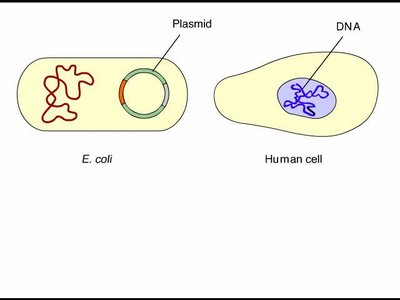
Steps in Gene Cloning
Isolate plasmid DNA and DNA containing the gene of interest.
Cut both DNA samples with the same restriction enzyme.
Mix the DNAs; fragments with matching ends pair up.
Use DNA ligase to join the fragments, forming recombinant plasmids.
Introduce recombinant plasmids into bacteria (transformation).
Bacteria reproduce, forming a clone of cells with the gene of interest.
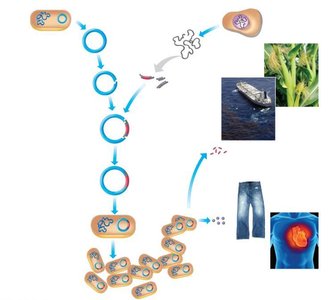
Applications of Gene Cloning
Production of pest-resistant plants
Bioremediation (cleaning up toxic waste)
Industrial enzyme production (e.g., for stone-washed jeans)
Medical therapies (e.g., proteins to dissolve blood clots)



Restriction Enzymes and DNA Ligation
Restriction Enzymes
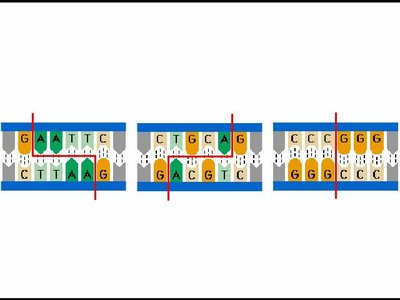
Restriction enzymes are proteins that recognize specific DNA sequences (restriction sites) and cut both DNA strands at these sites, producing fragments with 'sticky ends' that can be joined with other DNA fragments cut by the same enzyme.
Restriction site: A specific sequence recognized and cut by a restriction enzyme.
Sticky ends: Single-stranded overhangs left after restriction enzyme cuts, facilitating the joining of DNA fragments.
DNA ligase: Enzyme that forms covalent bonds between DNA fragments, sealing the backbone.
Genomic Libraries and cDNA
Genomic Libraries
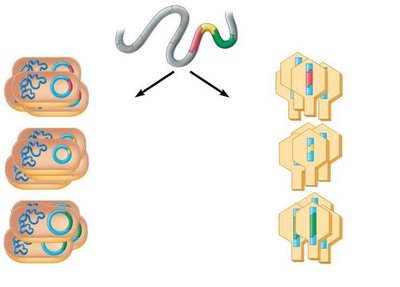
A genomic library is a collection of cloned DNA fragments representing an organism's entire genome. These libraries can be constructed using plasmids or bacteriophage vectors.
Plasmid library: Genomic DNA fragments cloned into plasmids.
Phage library: Genomic DNA fragments cloned into bacteriophage DNA.
cDNA and Reverse Transcriptase
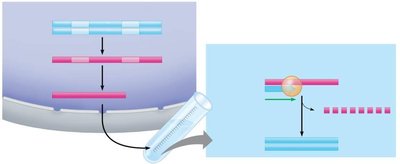
Complementary DNA (cDNA) is synthesized from mRNA using the enzyme reverse transcriptase. cDNA libraries represent only the expressed genes in a cell, lacking introns.
cDNA is useful for studying gene expression and for cloning eukaryotic genes in prokaryotes.
Advantages: Smaller size, no introns, easier to handle.
Identifying Clones with Nucleic Acid Probes
Nucleic Acid Probes
Nucleic acid probes are labeled, single-stranded DNA or RNA sequences that bind specifically to complementary sequences in a DNA sample, allowing identification of clones carrying a gene of interest.
Probes are often labeled with radioactive or fluorescent tags for detection.
Genetically Modified Organisms (GMOs)
Production and Applications of GMOs
GMOs are organisms whose genomes have been altered by the introduction of foreign genes. Transgenic organisms contain genes from other species. GMOs are widely used in agriculture, medicine, and industry.
Common vector for plant transformation: Ti plasmid from Agrobacterium tumefaciens.
Applications: Pest resistance, improved nutrition, pharmaceutical production.
Examples of GMO Applications
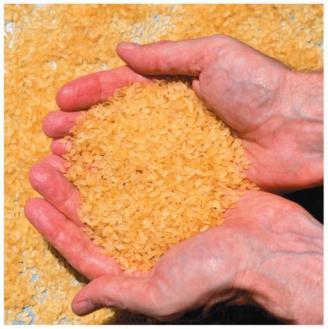
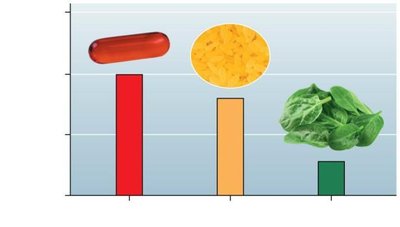
Golden Rice: Engineered to produce beta-carotene, a precursor of vitamin A.
Transgenic animals: Modified for improved nutritional content or faster growth.
Health and Environmental Concerns
There is ongoing debate about the safety of GMOs for human health and the environment. Scientific studies have not found significant health risks, but long-term effects are still being studied. Environmental concerns include gene flow to wild relatives and ecosystem disruption.
Gene Therapy
Principles and Applications
Gene therapy involves altering an individual's genes to treat or prevent disease. This is typically done by inserting a healthy gene into a patient's cells using a viral vector.
Applications: Treatment of genetic disorders such as SCID and LCA.
Ethical concerns: Potential for eugenics and unintended consequences.
DNA Profiling
DNA Profiling and Forensics
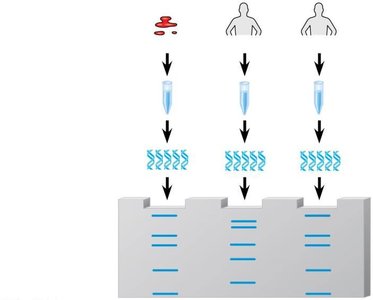
DNA profiling is the analysis of DNA samples to determine identity or relationships. It is widely used in criminal investigations, paternity testing, and historical research.
Steps: DNA isolation, amplification of markers, comparison of DNA fragments.
Polymerase Chain Reaction (PCR)
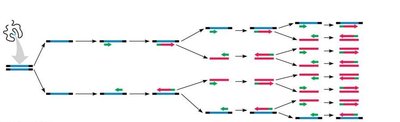
PCR is a technique used to amplify specific DNA sequences rapidly and efficiently from small samples.
Steps: Denaturation (heating), annealing (primer binding), extension (DNA synthesis).
Applications: Forensics, ancient DNA analysis, medical diagnostics.
Gel Electrophoresis
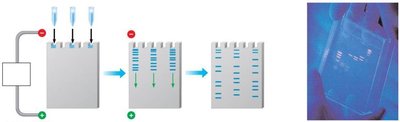
Gel electrophoresis separates DNA fragments by size using an electric field. Shorter fragments move faster and farther through the gel.
Used to visualize DNA profiles as bands.
Short Tandem Repeat (STR) Analysis
STR analysis compares the number of short, repeated DNA sequences at specific loci in the genome. It is the standard method for DNA profiling in forensic science.
Typically analyzes 13 STR sites for high specificity.
Restriction Fragment Length Polymorphism (RFLP)
RFLP analysis detects variations in DNA sequences by using restriction enzymes to cut DNA at specific sites. Differences in fragment lengths indicate genetic variation.
Genomics and Proteomics
Genomics
Genomics is the study of whole genomes, including the sequencing, mapping, and analysis of all genes and their interactions. The Human Genome Project (HGP) was a landmark effort to sequence the entire human genome.
Humans have about 21,000 genes in 3 billion base pairs.
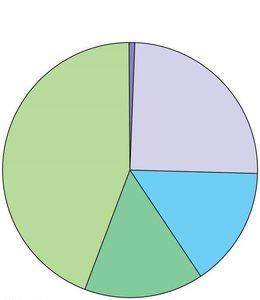
Only 1.5% of human DNA codes for proteins; the rest is noncoding, including introns and repetitive DNA.
Proteomics
Proteomics is the study of the full set of proteins encoded by a genome, including their functions and interactions. The human proteome consists of about 100,000 proteins.
Proteomics and genomics together provide a holistic view of biological systems.
Table: Some Protein Products of Recombinant DNA Technology
Product | Made by | Use |
|---|---|---|
Human insulin | E. coli | Treatment for diabetes |
Human growth hormone (HGH) | E. coli | Treatment for growth defects |
Interleukin-2 (IL-2) | E. coli | Possible treatment for cancer |
Bovine growth hormone (BGH) | E. coli | Improving weight gain in cattle |
Factor VIII | Mammalian cells | Treatment for hemophilia |
Tissue plasminogen activator (TPA) | Mammalian cells | Treatment for heart attacks and some strokes |
Additional info: Table includes other products such as vaccines, interferons, and enzymes for industrial use. |
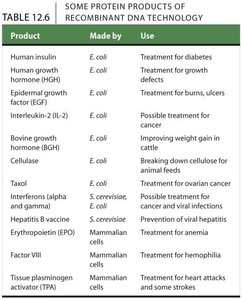
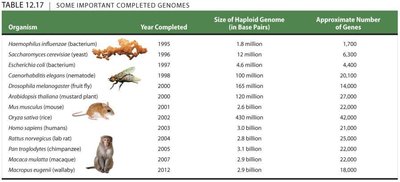
Table: Some Important Completed Genomes
Organism | Year Completed | Genome Size (Base Pairs) | Number of Genes |
|---|---|---|---|
Haemophilus influenzae (bacterium) | 1995 | 1.8 million | 1,700 |
Saccharomyces cerevisiae (yeast) | 1996 | 12.1 million | 6,300 |
Escherichia coli (bacterium) | 1997 | 4.6 million | 4,300 |
Homo sapiens (human) | 2003 | 3.2 billion | 21,000 |
Additional info: Table includes other model organisms such as mouse, fruit fly, and chimpanzee. |