 Back
DNA: The Genetic Material, Structure, and Replication
Study Guide - Smart Notes
 Tailored notes based on your materials, expanded with key definitions, examples, and context.
DNA: The Genetic Material
Discovery of DNA as the Heritable Material
The identification of DNA as the molecule responsible for heredity was established through a series of classic experiments. These studies demonstrated that DNA, not protein, carries genetic information in living organisms.
Griffith's Transformation Experiment (1928): Showed that a 'transforming principle' from dead virulent bacteria could convert non-virulent bacteria into a virulent form.
Avery, MacLeod, and McCarty (1944): Identified DNA as the 'transforming principle' by showing that only DNAase (not protease) treatment prevented transformation.
Hershey-Chase Experiment (1952): Used radioactive labeling to confirm that DNA, not protein, is the genetic material transferred by viruses into bacteria.
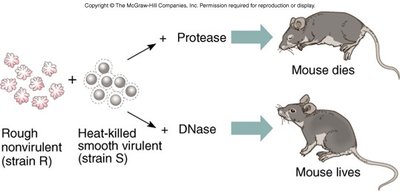
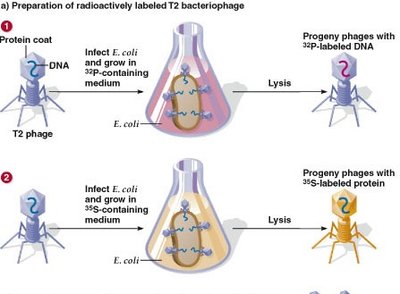
Conclusion: DNA is the molecule responsible for heredity in all living organisms.
Structure of DNA
DNA Composition and Nucleotide Structure
DNA (deoxyribonucleic acid) is a polymer composed of repeating units called nucleotides. Each nucleotide consists of three components:
Phosphate group
Deoxyribose sugar
Nitrogenous base: Adenine (A), Thymine (T), Guanine (G), or Cytosine (C)
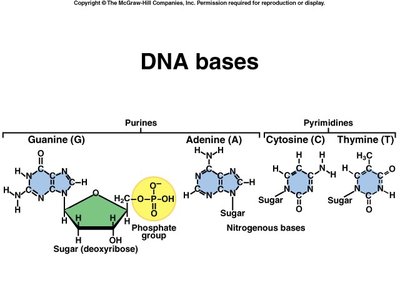
Purines: Adenine and Guanine Pyrimidines: Cytosine and Thymine
Base Pairing and Chargaff's Rules
Erwin Chargaff discovered that the amount of adenine equals thymine, and the amount of guanine equals cytosine in DNA. This led to the base-pairing rules:
A pairs with T via two hydrogen bonds
G pairs with C via three hydrogen bonds
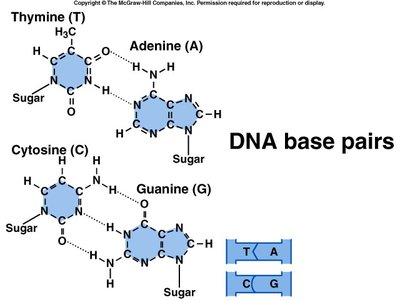
Example: If a DNA sample contains 30% adenine, it must also contain 30% thymine, and the remaining 40% is split equally between guanine and cytosine (20% each).
DNA Double Helix and Directionality
DNA exists as a double-stranded helix with antiparallel strands. The sugar-phosphate backbone gives DNA its directionality, with one end designated 5' (five prime) and the other 3' (three prime).
Antiparallel orientation: One strand runs 5' to 3', the other 3' to 5'.
Hydrogen bonds: Hold the two strands together between complementary bases.
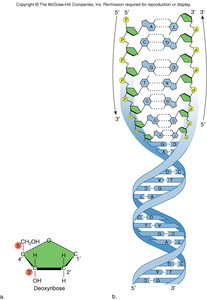
Discovery: X-ray diffraction by Rosalind Franklin and Maurice Wilkins revealed the helical structure, which was modeled by Watson and Crick.
DNA Packaging: Chromatin and Chromosomes
In eukaryotic cells, DNA is tightly packed with proteins called histones to form chromatin. During cell division, chromatin further condenses to form chromosomes.
Nucleosome: DNA wrapped around histone proteins
Chromatin: Complex of DNA and proteins
Chromosome: Highly condensed chromatin visible during mitosis
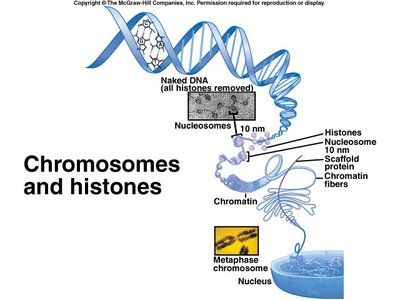
Importance: DNA packaging regulates gene expression and ensures accurate segregation during cell division.
Genes and Genetic Information
A gene is a segment of DNA that encodes the instructions for making a functional product, typically a protein or functional RNA. The sequence of nucleotides in a gene determines the sequence of amino acids in a protein, which in turn influences phenotype.
Central Dogma: DNA → RNA → Protein
DNA Replication
Models of DNA Replication
Three models were proposed for DNA replication:
Semiconservative: Each new DNA molecule consists of one old (parental) strand and one newly synthesized strand.
Conservative: The parental molecule remains intact, and an entirely new molecule is synthesized.
Dispersive: Each strand of both daughter molecules contains a mixture of old and new DNA.
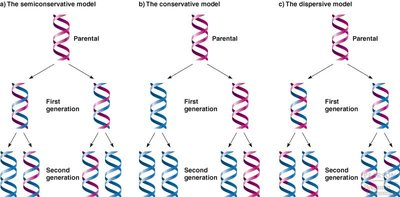
Correct Model: The semiconservative model was confirmed by the Meselson-Stahl experiment.
Mechanism of DNA Replication
DNA replication is the process by which a cell copies its DNA before cell division. It involves several steps and enzymes:
Initiation: DNA unwinds at origins of replication, forming replication forks.
Elongation: New nucleotides are added to the growing DNA strand by DNA polymerase.
Leading Strand: Synthesized continuously in the 5' to 3' direction.
Lagging Strand: Synthesized discontinuously as Okazaki fragments, later joined by DNA ligase.
Proofreading: DNA polymerase checks and corrects errors during replication.
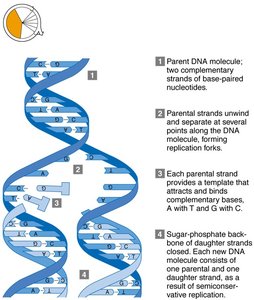
Key Enzymes in DNA Replication
Helicase: Unwinds the DNA double helix.
Single-Strand Binding Proteins: Stabilize unwound DNA strands.
Primase: Synthesizes short RNA primers to initiate DNA synthesis.
DNA Polymerase: Adds nucleotides to the growing DNA strand and proofreads.
Exonuclease (DNA Pol I): Removes RNA primers and replaces them with DNA.
Ligase: Joins Okazaki fragments and seals nicks in the sugar-phosphate backbone.
Directionality: DNA synthesis always proceeds in the 5' to 3' direction.
Summary Table: Models of DNA Replication
Model | Description | Resulting DNA Molecules |
|---|---|---|
Semiconservative | Each daughter molecule has one old and one new strand | Hybrid DNA (one parental, one new strand) |
Conservative | Parental molecule conserved; new molecule is entirely new | One all-old, one all-new DNA |
Dispersive | Each strand is a mix of old and new DNA | Mixed segments in both strands |
Additional info: DNA replication is essential for cell division and the transmission of genetic information from one generation to the next. Errors in replication can lead to mutations, which may affect phenotype and contribute to evolution or disease.
