 Back
DNA: The Molecular Basis of Inheritance – Structure, Replication, and Chromatin Organization
Study Guide - Smart Notes
 Tailored notes based on your materials, expanded with key definitions, examples, and context.
DNA as the Genetic Material
Historical Evidence and Discovery
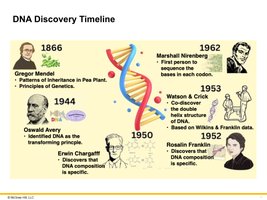
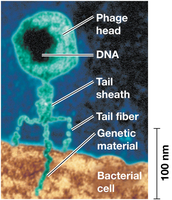
DNA is the hereditary material found in the nucleus of cells, encoding all information necessary for organismal development and function. Early researchers believed proteins, due to their complexity, were the genetic material, but experiments with bacteria and viruses revealed DNA's central role.
Key Point 1: Experiments with bacteriophages (viruses that infect bacteria) demonstrated that DNA, not protein, is responsible for heredity.
Key Point 2: The timeline of discoveries includes contributions from Mendel, Avery, Chargaff, Franklin, Watson, and Crick.
Example: The Hershey-Chase experiment showed that viral DNA, not protein, enters bacterial cells and directs viral reproduction.
Structure of DNA
DNA Composition and Double Helix
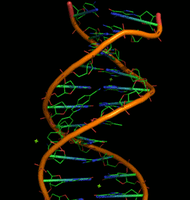
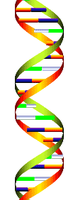
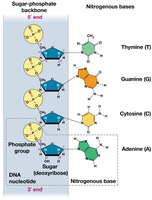
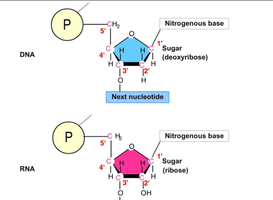
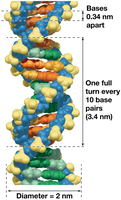
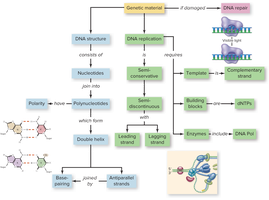
DNA is a polymer composed of nucleotides, each containing a nitrogenous base (adenine, thymine, guanine, cytosine), a deoxyribose sugar, and a phosphate group. The double helix structure, elucidated by Watson and Crick, consists of two antiparallel strands held together by complementary base pairing.
Key Point 1: Chargaff’s rules state that in any species, the amount of adenine equals thymine, and guanine equals cytosine.
Key Point 2: The double helix is stabilized by hydrogen bonds between base pairs: A-T and G-C.
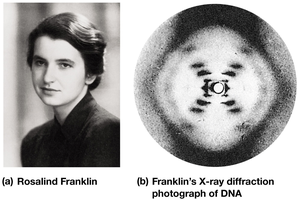
Example: X-ray crystallography images by Rosalind Franklin provided critical evidence for the helical structure of DNA.
DNA Replication
Mechanism and Enzymes Involved
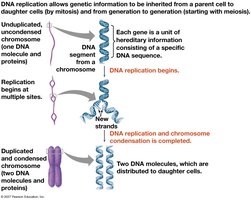
DNA replication is the process by which genetic information is accurately copied for cell division. The semiconservative model, supported by Meselson and Stahl, states that each new DNA molecule contains one old strand and one new strand.
Key Point 1: Replication begins at origins of replication, forming replication bubbles and forks.
Key Point 2: Enzymes involved include helicase (unwinds DNA), primase (synthesizes RNA primer), DNA polymerase (adds nucleotides), ligase (joins Okazaki fragments), topoisomerase (relieves strain), and single-strand binding proteins (stabilize unwound DNA).
Key Point 3: DNA polymerase can only add nucleotides to the 3' end, resulting in continuous synthesis on the leading strand and discontinuous synthesis (Okazaki fragments) on the lagging strand.
Example: The energy for DNA polymerization comes from the hydrolysis of nucleoside triphosphates, releasing pyrophosphate.
Proofreading and DNA Repair
Ensuring Fidelity of Genetic Information
DNA polymerases possess proofreading abilities, correcting errors during replication. Additional repair mechanisms include mismatch repair and nucleotide excision repair, which fix errors and damage caused by environmental factors.
Key Point 1: Mismatch repair enzymes replace incorrectly paired nucleotides.
Key Point 2: Nucleases remove damaged DNA, which is then replaced by DNA polymerase and ligase.
Example: Mutations that escape repair can lead to genetic variation and are the basis for evolution.
Telomeres and Telomerase
Replicating Chromosome Ends
Eukaryotic chromosomes have telomeres, repetitive sequences at their ends that protect genes from erosion during replication. Telomerase extends telomeres in germ cells and is active in many cancer cells, allowing unlimited division.
Key Point 1: Telomeres postpone gene loss but do not prevent chromosome shortening.
Key Point 2: Telomerase activity is linked to cellular immortality in cancer.
Chromatin Structure and Chromosome Organization
Levels of DNA Packing
In eukaryotes, DNA is packaged with proteins into chromatin, which undergoes various levels of condensation.
Key Point 1: The basic unit of chromatin is the nucleosome, consisting of DNA wrapped around histone proteins.
Key Point 2: Chromatin can be loosely packed (euchromatin) or highly condensed (heterochromatin), affecting gene expression.
Key Point 3: Chromatin packing changes during the cell cycle, condensing into chromosomes for mitosis.
Example: Chemical modifications of histones regulate chromatin structure and gene expression.
Comparison of Bacterial and Eukaryotic Chromosomes
Structural Differences
Bacterial chromosomes are circular and associated with fewer proteins, while eukaryotic chromosomes are linear and highly protein-associated.
Key Point 1: Bacterial DNA is supercoiled and located in the nucleoid region.
Key Point 2: Eukaryotic chromosomes undergo complex packing and occupy specific regions in the nucleus.
Summary Table: Key Proteins in DNA Replication
Bacterial DNA Replication Proteins and Functions
Protein | Function |
|---|---|
Helicase | Unwinds DNA at replication forks |
Single-strand binding protein | Stabilizes single-stranded DNA |
Topoisomerase | Relieves strain ahead of replication fork |
Primase | Synthesizes RNA primer |
DNA polymerase | Adds nucleotides to growing DNA strand |
DNA ligase | Joins Okazaki fragments |
Key Equations
DNA Polymerization Reaction
Equation:
Chargaff's Rule
Equation:
Additional info:
DNA replication is semiconservative, ensuring genetic continuity.
Mutations arising from replication errors are a source of genetic diversity.
Chromatin structure is dynamic and influences gene expression and cellular function.
