 Back
DNA to Proteins: Transcription, RNA Processing, and Translation
Study Guide - Smart Notes
 Tailored notes based on your materials, expanded with key definitions, examples, and context.
Central Dogma of Molecular Biology
Overview
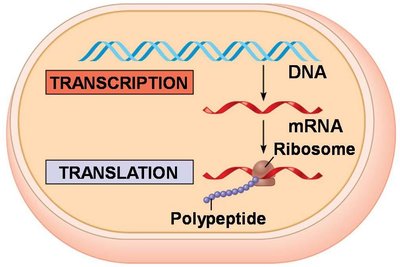
The central dogma describes the flow of genetic information in cells: DNA is transcribed into RNA, which is then translated into protein. This process is fundamental to all living organisms and explains how genes direct the synthesis of proteins.
Transcription: The process of making RNA from a DNA template.
Translation: The synthesis of a polypeptide (protein) using information in the mRNA.
Messenger RNA (mRNA): The RNA type that carries genetic information from DNA to the ribosome for protein synthesis.
Gene Expression in Eukaryotes vs. Prokaryotes
Comparative Analysis
Eukaryotic and prokaryotic cells differ in the number of protein-producing genes and the diversity of proteins produced.
Eukaryotic cells: ~20,000-25,000 protein-producing genes, up to 100,000 different proteins.
Prokaryotic cells: ~3,000 protein-producing genes, ~3,000 different proteins.
DNA ultimately encodes polypeptides, and a single mRNA strand can produce one or multiple proteins.
Transcription and Translation Locations
Eukaryotic Cell Compartmentalization
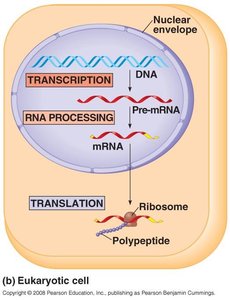
In eukaryotic cells, transcription occurs in the nucleus, while translation takes place at ribosomes in the cytoplasm or rough ER. Before mRNA leaves the nucleus, it undergoes RNA processing.
Transcription: Nucleus
Translation: Ribosomes (cytoplasm or rough ER)
RNA Processing: Modifies pre-mRNA before export
Stages of Transcription
Initiation, Elongation, Termination
Transcription is divided into three main stages:
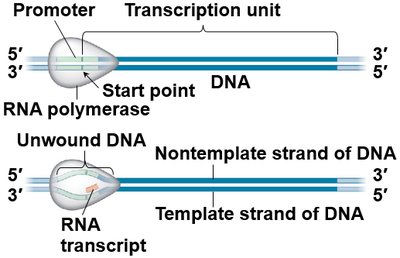
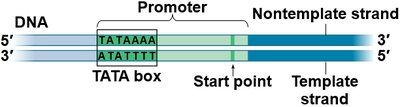
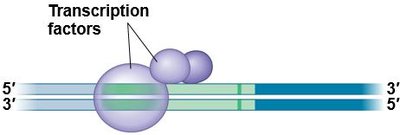
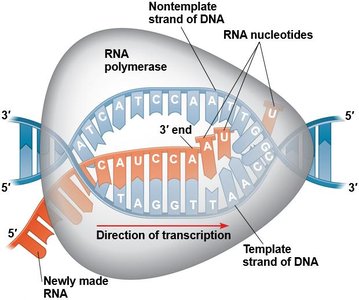
Initiation: Proteins bind to the promoter region of DNA to start transcription. The template strand is used to make RNA, and RNA polymerase is the enzyme responsible.
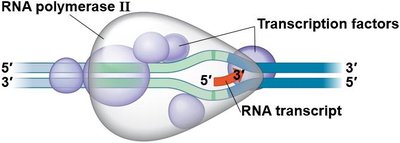
Elongation: RNA polymerase II (RNAPII) reads the template DNA strand in the 3'→5' direction, synthesizing mRNA in the 5'→3' direction. RNAPII also unwinds DNA.
Termination: RNAPII transcribes until it reaches the polyadenylation signal sequence (AAUAAA), after which the RNA transcript is released.
Eukaryotic RNA Processing
Modification of pre-mRNA
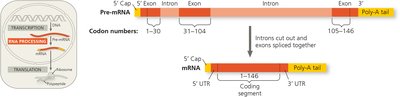
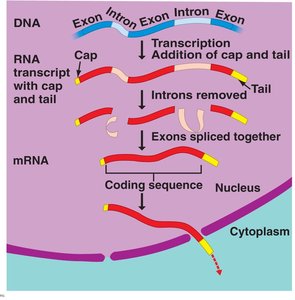
Pre-mRNA must be processed before it becomes mature mRNA. This includes modifications at both ends and splicing of internal regions.
5' Cap: Addition of a modified guanine nucleotide to the 5' end.
Poly-A Tail: Addition of a string of adenine nucleotides to the 3' end.
These modifications aid in mRNA export, stability, and ribosome attachment.
RNA Splicing
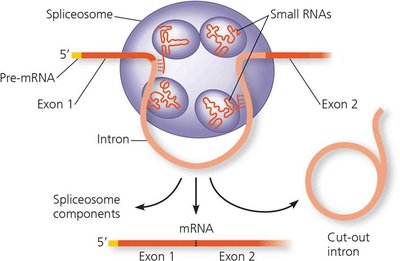
Most mRNA transcripts contain noncoding regions called introns, which are removed during RNA processing. Coding regions, called exons, are joined together.
Introns: Noncoding stretches removed from pre-mRNA.
Exons: Coding regions retained in mature mRNA.
Spliceosome: A protein/RNA complex that removes introns and joins exons.
Transcriptional Output and Alternative Splicing
Multiple Transcripts and Protein Diversity
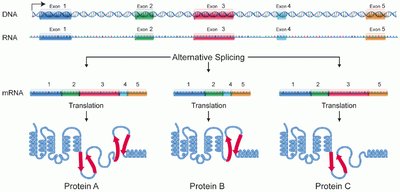
One DNA gene can produce multiple mRNA transcripts simultaneously.
Alternative Splicing: Different combinations of exons can be spliced together, allowing a single gene to encode multiple proteins.
This increases the diversity of proteins beyond the number of genes.
Exons and Protein Domains
Functional Organization
Exons often correspond to distinct domains within a protein, each with specific functions.
Example: One exon may code for an ATP-binding domain, another for substrate binding.
Summary Table: Transcription and RNA Processing
Key Steps and Features
Step | Description |
|---|---|
Initiation | Promoter region (TATA box) and transcription factors recruit RNA polymerase II |
Elongation | RNA polymerase II synthesizes mRNA in 5'→3' direction, unwinding DNA |
Termination | Polyadenylation signal sequence (AAUAAA) triggers release of RNA transcript |
RNA Processing | 5' cap and poly-A tail added; introns removed, exons spliced together |
Alternative Splicing | Different exon combinations produce multiple proteins from one gene |
Key Terms and Concepts
Central Dogma: DNA → RNA → Protein
Transcription: DNA to RNA
Translation: RNA to Protein
Promoter: DNA sequence where transcription begins
TATA Box: Eukaryotic promoter region
RNA Polymerase II: Enzyme for mRNA synthesis
Introns/Exons: Noncoding/coding regions of mRNA
Spliceosome: Complex for RNA splicing
Alternative Splicing: Mechanism for protein diversity
