 Back
DNA Tools and Biotechnology: PCR, Genetic Fingerprinting, and Gel Electrophoresis
Study Guide - Smart Notes
 Tailored notes based on your materials, expanded with key definitions, examples, and context.
DNA Tools and Biotechnology
Polymerase Chain Reaction (PCR)
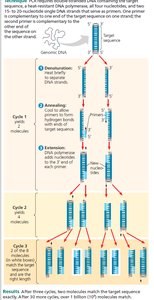
The Polymerase Chain Reaction (PCR) is a revolutionary molecular biology technique used to amplify specific DNA sequences, generating millions to billions of copies from a small initial sample. Invented by Kary Mullis (Nobel Prize, 1993), PCR is essential for DNA cloning, genetic analysis, and diagnostics.
Definition: PCR is a method for rapid and precise amplification of a targeted DNA segment.
Purpose: Enables the study and manipulation of genes by producing large quantities of DNA from minimal starting material.
Applications: Used in cloning, sequencing, forensics, paternity testing, medical diagnostics, and evolutionary biology.
Essential Reagents for PCR
Thermocycler: Automated device that cycles through temperature changes required for PCR.
Template DNA: The DNA sample containing the target sequence to be amplified.
Primers: Short single-stranded DNA (15–20 nucleotides) complementary to the 3' ends of the target sequence on each DNA strand.
dNTPs: Four deoxynucleotides (A, T, C, G) as building blocks for new DNA synthesis.
Taq DNA Polymerase: Heat-tolerant enzyme from Thermus aquaticus that synthesizes new DNA strands.
Buffer: Maintains optimal conditions for enzyme activity.

Steps in PCR
Denaturation (95°C): Double-stranded DNA is heated to separate into single strands.
Annealing (≈60°C): Temperature is lowered to allow primers to bind (anneal) to complementary sequences on the template DNA.
Extension (72°C): Taq polymerase adds dNTPs to the 3' end of each primer, synthesizing new DNA strands in the 5'→3' direction.
Amplification: Each cycle doubles the amount of target DNA; after n cycles, copies are produced (e.g., 30 cycles yield over 1 billion molecules).
Applications of PCR
Genetics/Research: Cloning, sequencing, and gene analysis.
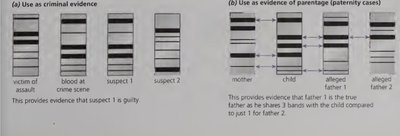
Forensics: Genetic fingerprinting for crime scene investigation.
Paternity Testing: Determining biological relationships.
Medical Diagnostics: Detecting pathogens and genetic disorders.
Evolutionary Biology: Species identification and phylogenetic studies.
Genetic Fingerprinting
Principles and Applications
Genetic fingerprinting is a laboratory technique used to identify individuals by analyzing unique patterns in specific regions of their DNA. Developed by Alec Jeffreys in 1984, it is based on the high variability of non-coding DNA regions among individuals.
Polymorphisms: Variations in DNA sequences, especially in non-coding regions, serve as individual identifiers.
Key Analogy: Like a barcode scanner reading an individual's unique genetic pattern.
Applications: Forensics, paternity testing, missing persons identification, genealogy, and historical investigations.
The Target: Short Tandem Repeats (STRs)
STRs: Short DNA sequences (2–5 base pairs) repeated in tandem; the number of repeats varies greatly among individuals.
Example: A sequence like "GATA-GATA-GATA-GATA" contains four repeats of the tetramer 'GATA'.
Analysis: DNA is cut with restriction enzymes, amplified by PCR, and multiple STR loci are analyzed for individual specificity.
Probability: The chance of two unrelated people having the same STR profile at multiple loci is less than 1 in a trillion.
CODIS: The FBI uses 13 core STR loci stored in the Combined DNA Index System for national database comparisons.

Applications of Genetic Fingerprinting
Forensic Science: Linking suspects to crime scenes, identifying human remains, and analyzing trace evidence.
Paternity Testing: Determining biological parentage by comparing STR profiles; a child's profile contains half the alleles from each parent.
Missing Persons: Identifying remains by comparing DNA to relatives.
Genealogy/History: Tracing ancestral lineages using Y-chromosome (paternal) or mitochondrial DNA (maternal).
Gel Electrophoresis
Principle and Materials
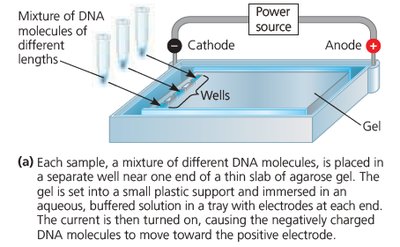
Gel electrophoresis is a laboratory technique used to separate mixtures of DNA, RNA, or proteins based on size and charge. It is fundamental for analyzing PCR products, restriction digests, and genetic fingerprints.
Principle: Charged molecules migrate through a gel matrix when an electric current is applied. Negatively charged DNA moves toward the positive electrode (anode).
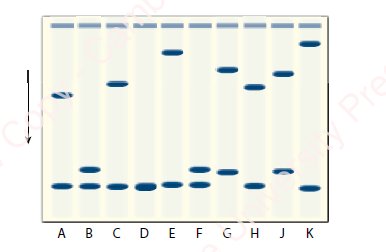
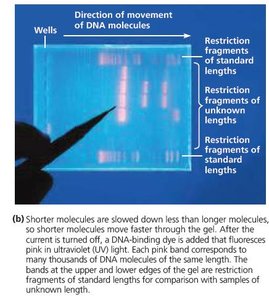
Separation: Smaller molecules travel faster and farther through the gel pores than larger ones.
Materials Required
Agarose gel
Buffer solution
DNA sample and loading dye
Gel casting tray and comb (to create wells)
Power supply and electrophoresis chamber
Staining dye (for visualization under UV light)
Procedure of Gel Electrophoresis
Prepare agarose gel and pour into casting tray; insert comb to form wells and allow to solidify.
Load DNA samples mixed with loading dye into wells.
Apply electric current; DNA migrates toward the positive electrode.
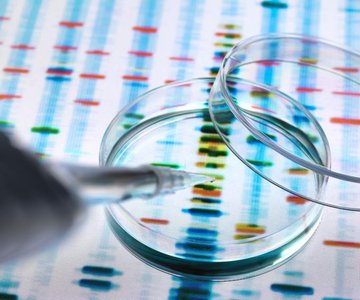
Stain the gel to visualize DNA bands under UV light.
Compare bands to a molecular weight marker (ladder) for size estimation.
Visualization of DNA Bands
Ladder: Contains DNA fragments of known sizes for comparison.
Smallest fragments: Migrate farthest toward the anode (+).
Largest fragments: Remain closer to the cathode (–).
Applications of Gel Electrophoresis
DNA fingerprinting and forensic analysis
Checking PCR or restriction enzyme digestion results
Genetic engineering and cloning experiments
RNA and protein analysis
