 Back
DNA Transcription & Translation Study Guide – Step-by-Step Guidance
Study Guide - Smart Notes
 Tailored notes based on your materials, expanded with key definitions, examples, and context.
Q1. What is a “codon”?
Background
Topic: Genetic Code
This question tests your understanding of the basic unit of genetic information used during transcription and translation.
Key Terms:
Codon: A sequence of three nucleotides in DNA or RNA that codes for a specific amino acid.
Nucleotide: The building block of DNA and RNA, consisting of a sugar, phosphate, and a nitrogenous base.
Step-by-Step Guidance
Recall that DNA and RNA are composed of sequences of nucleotides.
Understand that during transcription, DNA is converted into mRNA, which is then read in sets of three nucleotides.
Each set of three nucleotides forms a codon, which specifies an amino acid during translation.
Try solving on your own before revealing the answer!
Final Answer:
A codon is a sequence of three nucleotides in DNA or mRNA that codes for a specific amino acid.
Q2. Does each amino acid have only one codon that codes for it?
Background
Topic: Genetic Code Redundancy
This question tests your understanding of the redundancy in the genetic code.
Key Terms:
Redundancy: Multiple codons can code for the same amino acid.
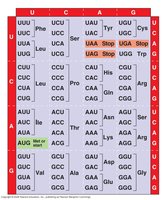
Codon Table: A chart showing which codons correspond to which amino acids.
Step-by-Step Guidance
Examine the codon table to see how many codons code for each amino acid.
Notice that some amino acids are specified by more than one codon.
Think about why this redundancy might be beneficial for the cell.
Try solving on your own before revealing the answer!
Final Answer:
No, some amino acids are coded for by multiple codons. This is called redundancy in the genetic code.
Q3. Does each codon correspond to only one, or more than one amino acid?
Background
Topic: Genetic Code Specificity
This question tests your understanding of the specificity of codons for amino acids.
Key Terms:
Ambiguity: When a codon could code for more than one amino acid (which does not occur in the genetic code).
Specificity: Each codon codes for only one amino acid.
Step-by-Step Guidance
Look at the codon table and observe that each codon specifies a single amino acid.
Consider the importance of this specificity for accurate protein synthesis.
Try solving on your own before revealing the answer!
Final Answer:
Each codon specifies just one amino acid. There is no ambiguity in the genetic code.
Q4. What is meant by the phrase “The genetic code has redundancy but not ambiguity”?
Background
Topic: Genetic Code Properties
This question tests your understanding of how the genetic code is organized and interpreted.
Key Terms:
Redundancy: Multiple codons can code for the same amino acid.
Ambiguity: A codon could code for more than one amino acid (which does not happen).
Step-by-Step Guidance
Review the codon table and note that some amino acids are coded by several codons.
Observe that each codon codes for only one amino acid, so there is no ambiguity.
Think about how this ensures accurate translation of genetic information.
Try solving on your own before revealing the answer!
Final Answer:
Redundancy means multiple codons can specify the same amino acid, but not ambiguity means each codon specifies only one amino acid.
Q5. What is meant by a “reading frame” in a DNA or mRNA sequence? What determines the reading frame?
Background
Topic: Reading Frames and Mutations
This question tests your understanding of how sequences are parsed into codons and the impact of mutations.
Key Terms:
Reading Frame: The way nucleotides are grouped into codons.
Start Codon: The codon that sets the reading frame for translation (usually AUG).
Frame-shift Mutation: A mutation that changes the reading frame by inserting or deleting nucleotides.
Step-by-Step Guidance
Understand that the reading frame is established by the start codon during translation.
Consider how the sequence is divided into codons based on this frame.
Think about how insertions or deletions can shift the reading frame, affecting all downstream codons.
Try solving on your own before revealing the answer!
Final Answer:
A reading frame is the way nucleotides are grouped into codons. The start codon determines the reading frame, and mutations can shift it.
Q6. a. In which direction is mRNA synthesized?
Background
Topic: Directionality of Transcription
This question tests your understanding of the direction in which RNA is synthesized from DNA.
Key Terms:
5’ to 3’ Direction: The direction in which nucleic acids are synthesized.
Antiparallel: The template strand is read in the opposite direction.
Step-by-Step Guidance
Recall that both DNA and RNA are synthesized in the 5’ to 3’ direction.
Understand that the template strand is read in the 3’ to 5’ direction by RNA polymerase.
Try solving on your own before revealing the answer!
Final Answer:
mRNA is synthesized in the 5’ to 3’ direction.
Q6. b. What is the difference between the “template strand” and the “coding strand” of DNA?
Background
Topic: DNA Strands in Transcription
This question tests your understanding of which DNA strand is used during transcription and how they relate to each other.
Key Terms:
Template Strand: The DNA strand read by RNA polymerase.
Coding Strand: The DNA strand with the same sequence as the mRNA (except T for U).
Step-by-Step Guidance
Identify which strand is being read by RNA polymerase (template strand).
Recognize that the coding strand is the opposite strand and matches the mRNA sequence (with T instead of U).
Try solving on your own before revealing the answer!
Final Answer:
The template strand is read by RNA polymerase; the coding strand has the same sequence as the mRNA (except T for U).
Q6. c. In which direction is the DNA template strand read by RNA polymerase?
Background
Topic: Directionality of Transcription
This question tests your understanding of how RNA polymerase reads the DNA template strand.
Key Terms:
Antiparallel: The template strand is read in the opposite direction to mRNA synthesis.
Step-by-Step Guidance
Recall that mRNA is synthesized in the 5’ to 3’ direction.
Understand that the template strand is read in the 3’ to 5’ direction.
Try solving on your own before revealing the answer!
Final Answer:
The DNA template strand is read in the 3’ to 5’ direction by RNA polymerase.
Q7. Determine which strand shown above is the template strand and which is the coding strand.
Background
Topic: Identifying DNA Strands
This question tests your ability to identify the template and coding strands based on directionality and promoter location.
Key Terms:
Promoter: Region upstream of the gene where transcription starts.
Template Strand: Read in the 3’ to 5’ direction.
Coding Strand: Matches mRNA sequence.
Step-by-Step Guidance
Locate the promoter region to determine the direction of transcription.
Identify which strand is read in the 3’ to 5’ direction (template strand).
The opposite strand is the coding strand.
Try solving on your own before revealing the answer!
Final Answer:
The bottom strand is the template strand; the top strand is the coding strand.
Q8. Transcribe the coding strand into RNA (just a straight translation into RNA, no complimentary base pairing)
Background
Topic: Transcription
This question tests your ability to convert a DNA coding strand into an RNA sequence.
Key Terms:
Transcription: The process of making RNA from DNA.
RNA: Uses uracil (U) instead of thymine (T).
Step-by-Step Guidance
Write out the coding strand sequence.
Replace every T with U to convert DNA to RNA.
Keep the sequence in the 5’ to 3’ direction.
Try solving on your own before revealing the answer!
Final Answer:
5’ CACCAUGGUGCAUCUGACUCCUGAGGAGAAGUCUGCCUAG 3’
Q9. In the RNA sequence you just wrote, find and underline the start codon (use the codon chart below).
Background
Topic: Start Codon Identification
This question tests your ability to identify the start codon in an RNA sequence.
Key Terms:
Start Codon: Usually AUG, codes for methionine (Met).
Step-by-Step Guidance
Scan the RNA sequence for the AUG codon.
Underline or mark the first occurrence of AUG.
Try solving on your own before revealing the answer!
Final Answer:
The start codon is AUG, which should be underlined in the RNA sequence.
Q10. Beginning with the start codon, use small vertical lines to section your RNA into codons.
Background
Topic: Codon Segmentation
This question tests your ability to divide an RNA sequence into codons starting from the start codon.
Key Terms:
Codon: Three-nucleotide sequence.
Step-by-Step Guidance
Start at the AUG start codon.
Divide the sequence into groups of three nucleotides (codons).
Mark each codon with a vertical line.
Try solving on your own before revealing the answer!
Final Answer:
The RNA sequence should be divided into codons: CAC|CAU|GUG|CAU|CUG|ACU|CCU|GAG|GAG|AAG|UCU|GCC|UAG
Q11. Use the genetic code provided below to translate the RNA into a sequence of amino acids.
Background
Topic: Translation
This question tests your ability to use the codon chart to translate RNA into amino acids.
Key Terms:
Translation: The process of converting mRNA codons into amino acids.
Codon Chart: Used to match codons to amino acids.
Step-by-Step Guidance
Start with the first codon (AUG) and use the codon chart to find the corresponding amino acid.
Continue translating each codon in sequence.
Stop translation when you reach a stop codon.
Try solving on your own before revealing the answer!
Final Answer:
The amino acid sequence is: MET; Val; His; Leu; Thr; Pro; Glu; Glu; Lys; Ser; Ala; STOP
Q12. Which macromolecule provides the information in transcription?
Background
Topic: Transcription Information Source
This question tests your understanding of which molecule serves as the template for transcription.
Key Terms:
DNA: The molecule that provides the information for transcription.
Step-by-Step Guidance
Recall that transcription is the process of making RNA from DNA.
Identify the macromolecule that serves as the template.
Try solving on your own before revealing the answer!
Final Answer:
DNA provides the information in transcription.
Q13. What macromolecule is synthesized in transcription?
Background
Topic: Transcription Product
This question tests your understanding of what is produced during transcription.
Key Terms:
RNA: The product of transcription.
Step-by-Step Guidance
Recall that transcription is the process of making RNA from DNA.
Identify the macromolecule synthesized.
Try solving on your own before revealing the answer!
Final Answer:
RNA is synthesized in transcription.
Q14. Which enzyme is primarily involved in transcription?
Background
Topic: Enzymes in Transcription
This question tests your understanding of the enzyme responsible for synthesizing RNA from DNA.
Key Terms:
RNA Polymerase: The enzyme that synthesizes RNA from a DNA template.
Step-by-Step Guidance
Recall the enzyme responsible for reading DNA and synthesizing RNA.
Identify the name of this enzyme.
Try solving on your own before revealing the answer!
Final Answer:
RNA polymerase is the enzyme primarily involved in transcription.
Q15. What macromolecule provides the information in translation?
Background
Topic: Translation Information Source
This question tests your understanding of which molecule serves as the template for translation.
Key Terms:
mRNA: The molecule that provides the information for translation.
Step-by-Step Guidance
Recall that translation is the process of making a polypeptide from mRNA.
Identify the macromolecule that serves as the template.
Try solving on your own before revealing the answer!
Final Answer:
mRNA provides the information in translation.
Q16. What macromolecule is synthesized in translation?
Background
Topic: Translation Product
This question tests your understanding of what is produced during translation.
Key Terms:
Polypeptide: The product of translation, which folds into a protein.
Step-by-Step Guidance
Recall that translation is the process of making a polypeptide from mRNA.
Identify the macromolecule synthesized.
Try solving on your own before revealing the answer!
Final Answer:
A polypeptide is synthesized in translation, which folds into a protein.
Q17. Which enzyme is primarily involved in translation?
Background
Topic: Enzymes in Translation
This question tests your understanding of the enzyme responsible for synthesizing polypeptides from mRNA.
Key Terms:
Ribosome: The molecular machine that synthesizes polypeptides from mRNA.
Step-by-Step Guidance
Recall the enzyme responsible for reading mRNA and synthesizing polypeptides.
Identify the name of this enzyme.
Try solving on your own before revealing the answer!
Final Answer:
The ribosome is the enzyme primarily involved in translation.
Q18. Where did the monomers for building these macromolecules come from?
Background
Topic: Monomer Sources
This question tests your understanding of the origin of monomers used in protein synthesis.
Key Terms:
Amino Acids: Monomers for polypeptides.
Essential Amino Acids: Must be obtained from food.
Step-by-Step Guidance
Recall that amino acids are the monomers for polypeptides.
Some amino acids are synthesized by the body; others must be obtained from food.
Try solving on your own before revealing the answer!
Final Answer:
The monomers (amino acids) come from both synthesis in the body and from food.
Q19. In eukaryotes, where in the cell do transcription and translation happen? What about in prokaryotes?
Background
Topic: Cellular Locations of Transcription and Translation
This question tests your understanding of where these processes occur in different cell types.
Key Terms:
Nucleus: Site of transcription in eukaryotes.
Cytoplasm: Site of translation in eukaryotes.
Nucleoid: Site of both processes in prokaryotes.
Step-by-Step Guidance
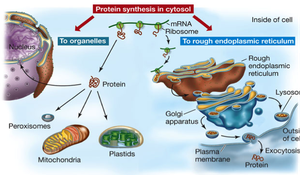
Recall that eukaryotes have a nucleus, where transcription occurs.
Translation occurs in the cytoplasm or on the rough ER in eukaryotes.
In prokaryotes, both processes occur in the nucleoid region.
Try solving on your own before revealing the answer!
Final Answer:
In eukaryotes, transcription occurs in the nucleus and translation in the cytoplasm. In prokaryotes, both occur in the nucleoid region.
Q20. What is the result of a mutation in the DNA that results in an RNA codon “UAU instead of UAC”?
Background
Topic: Mutation Effects
This question tests your understanding of how mutations affect protein synthesis.
Key Terms:
Silent Mutation: A mutation that does not change the amino acid.
Codon Table: Used to determine the effect of the mutation.
Step-by-Step Guidance
Use the codon chart to check what amino acid UAU and UAC code for.
Determine if the mutation changes the amino acid.
Try solving on your own before revealing the answer!
Final Answer:
Both UAC and UAU code for tyrosine, so the mutation is silent and does not affect the protein.
Q21. What is the result of a mutation in the DNA that results in an RNA codon “UAA instead of UAC”?
Background
Topic: Mutation Effects
This question tests your understanding of how mutations can introduce stop codons.
Key Terms:
Stop Codon: UAA signals termination of translation.
Nonsense Mutation: Mutation that introduces a stop codon.
Step-by-Step Guidance
Use the codon chart to check what amino acid UAA codes for.
Determine the effect of introducing a stop codon.
Try solving on your own before revealing the answer!
Final Answer:
UAA is a stop codon, so translation would terminate early, resulting in a truncated protein.
Q22. What is the result of a mutation in the DNA that adds three extra nucleotides?
Background
Topic: Mutation Effects
This question tests your understanding of how insertions affect protein structure.
Key Terms:
Insertion Mutation: Addition of nucleotides.
Frame-shift: Only occurs if the number added is not a multiple of three.
Step-by-Step Guidance
Consider how adding three nucleotides affects the reading frame.
Determine if the protein will be longer or if the reading frame will change.
Try solving on your own before revealing the answer!
Final Answer:
There would be an extra amino acid in the protein, but no frame shift. The protein would be one amino acid longer.
Q23. What is the result of a mutation in the DNA that adds four extra nucleotides?
Background
Topic: Mutation Effects
This question tests your understanding of how insertions not in multiples of three affect protein structure.
Key Terms:
Frame-shift Mutation: Changes the reading frame, affecting all downstream codons.
Step-by-Step Guidance
Consider how adding four nucleotides affects the reading frame.
Determine the impact on the protein sequence downstream of the mutation.
Try solving on your own before revealing the answer!
Final Answer:
Adding four nucleotides causes a frame shift, changing all downstream codons and resulting in a protein with altered sequence and function.
Q1. What cellular structure facilitates all protein synthesis (translation)?
Background
Topic: Protein Synthesis Machinery
This question tests your understanding of the cellular structure responsible for translation.
Key Terms:
Ribosome: The cellular structure that facilitates translation.
Step-by-Step Guidance
Recall the main structure involved in translation.
Identify its role in protein synthesis.
Try solving on your own before revealing the answer!
Final Answer:
The ribosome facilitates all protein synthesis (translation).
Q2. What’s the difference between free ribosomes and bound ribosomes?
Background
Topic: Ribosome Types
This question tests your understanding of the location and function of different ribosome types.
Key Terms:
Free Ribosomes: Located in the cytoplasm.
Bound Ribosomes: Attached to the rough ER.
Step-by-Step Guidance
Recall the locations of free and bound ribosomes.
Consider the types of proteins synthesized by each.
Try solving on your own before revealing the answer!
Final Answer:
Free ribosomes are in the cytoplasm; bound ribosomes are on the rough ER.
Q3. What is “ER signal peptide”? How does it serve as a molecular address?
Background
Topic: Protein Targeting
This question tests your understanding of how proteins are directed to the ER.
Key Terms:
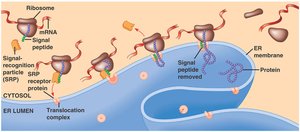
ER Signal Peptide: A sequence in the protein that directs it to the ER.
Signal Recognition Particle (SRP): Recognizes the signal peptide.
Step-by-Step Guidance
Recall that the ER signal peptide is part of the protein being synthesized.
Understand that it acts as a molecular address, directing the protein to the ER.
Try solving on your own before revealing the answer!
Final Answer:
The ER signal peptide is a sequence in the protein that directs it to the ER, serving as a molecular address.
Q4. The ER signal peptide is which? (A) part of the ribosome; (B) part of a protein being made; (C) part of a separate enzyme system in the cytosol; (D) a protein that recognizes mRNA sequences
Background
Topic: Protein Targeting
This question tests your understanding of the nature of the ER signal peptide.
Key Terms:
Peptide: A short chain of amino acids.
Step-by-Step Guidance
Recall that the signal peptide is part of the protein being synthesized.
Eliminate the other options based on the definition of peptide.
Try solving on your own before revealing the answer!
Final Answer:
The ER signal peptide is part of the protein being made (option B).
Q5. What does the “signal recognition particle” do?
Background
Topic: Protein Targeting
This question tests your understanding of the role of the signal recognition particle (SRP).
Key Terms:
SRP: Recognizes the ER signal sequence and directs the ribosome to the ER.
Step-by-Step Guidance
Recall the function of the SRP in recognizing the signal peptide.
Understand how it moves the ribosome and mRNA to the ER.
Try solving on your own before revealing the answer!
Final Answer:
The SRP recognizes the ER signal sequence and moves the ribosome and mRNA to the rough ER.
Q6. Proteins that contain the “ER signal peptide” begin their synthesis (A) at bound ribosomes; or (B) at free ribosomes.
Background
Topic: Protein Synthesis Location
This question tests your understanding of where protein synthesis begins for proteins with an ER signal peptide.
Key Terms:
Free Ribosomes: Where all protein synthesis begins.
Step-by-Step Guidance
Recall that all proteins begin synthesis at free ribosomes.
Understand that the signal peptide directs the ribosome to the ER after synthesis begins.
Try solving on your own before revealing the answer!
Final Answer:
Every protein begins its synthesis at free ribosomes.
Q7. What causes the “rough ER” to be rough?
Background
Topic: Rough ER Structure
This question tests your understanding of the structural features of the rough ER.
Key Terms:
Ribosomes: Cause the rough appearance of the ER.
Step-by-Step Guidance
Recall the features of the rough ER.
Identify what gives it a rough appearance.
Try solving on your own before revealing the answer!
Final Answer:
Ribosomes on its surface cause the rough ER to be rough.
Q8. For proteins made at the rough ER, which organelle will they visit next?
Background
Topic: Protein Secretion Pathway
This question tests your understanding of the pathway proteins follow after synthesis at the rough ER.
Key Terms:
Golgi Apparatus: The next organelle in the protein secretion pathway.
Step-by-Step Guidance
Recall the pathway proteins follow after synthesis at the rough ER.
Identify the next organelle in the pathway.
Try solving on your own before revealing the answer!
Final Answer:
Proteins made at the rough ER visit the Golgi apparatus next.
Q9. Outline how the presence of a “signal peptide” facilitates synthesis of a protein into the ER lumen.
Background
Topic: Protein Targeting to ER
This question tests your understanding of the steps involved in targeting a protein to the ER lumen.
Key Terms:
Signal Peptide: Directs the protein to the ER.
SRP: Recognizes the signal peptide.
Translocation Complex: Facilitates entry into the ER lumen.
Step-by-Step Guidance
Protein synthesis begins at a free ribosome.
The signal peptide emerges and is recognized by the SRP.
The SRP directs the ribosome to the ER membrane.
The ribosome docks at the translocation complex, and the protein is synthesized into the ER lumen.
Try solving on your own before revealing the answer!
Final Answer:
The signal peptide is recognized by the SRP, which directs the ribosome to the ER, where the protein is synthesized into the ER lumen.
Q10. How does a transmembrane receptor protein get into the membrane it will ultimately be a part of? List the general steps from DNA stage to final job site.
Background
Topic: Protein Targeting and Processing
This question tests your understanding of the steps involved in synthesizing and targeting a transmembrane protein.
Key Terms:
Transmembrane Protein: A protein that spans a membrane.
Signal Peptide: Directs the protein to the ER.
Golgi Apparatus: Processes and sorts proteins.
Plasma Membrane: Final destination for many transmembrane proteins.
Step-by-Step Guidance
Transcription of the gene occurs in the nucleus.
Translation begins at a free ribosome.
The signal peptide directs the ribosome to the ER.
The protein is synthesized into the ER membrane.
The protein is processed in the Golgi apparatus.
The protein is transported to its final destination (e.g., plasma membrane).
Try solving on your own before revealing the answer!
Final Answer:
The steps are: transcription in the nucleus, translation at free ribosomes, targeting to the ER, insertion into the ER membrane, processing in the Golgi, and delivery to the plasma membrane.
