 Back
BackDNA Translation and Mutations: Mechanisms and Biological Implications
Study Guide - Smart Notes
 Tailored notes based on your materials, expanded with key definitions, examples, and context.
DNA Translation and Mutations
Overview of Gene Expression
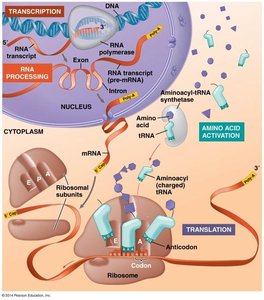
Gene expression is the process by which genetic information encoded in DNA is used to synthesize functional gene products, primarily proteins. This process involves two main stages: transcription (DNA to RNA) and translation (RNA to protein). Translation is the RNA-directed synthesis of a polypeptide, which occurs in the cytoplasm or on the rough endoplasmic reticulum (ER).
Translation: The RNA-Directed Synthesis of Proteins
Translation is the process by which the sequence of an mRNA molecule is used to direct the synthesis of a polypeptide. This process occurs in three main stages: initiation, elongation, and termination. The main molecules involved are mRNA, tRNA, ribosomes, and various protein factors.
mRNA (messenger RNA): Carries the genetic code from DNA to the ribosome.
tRNA (transfer RNA): Adapter molecules that match mRNA codons with their corresponding amino acids.
Ribosomes: Complexes of rRNA and proteins that facilitate the coupling of tRNA anticodons with mRNA codons during protein synthesis.
tRNA: Adapter Molecules in Translation
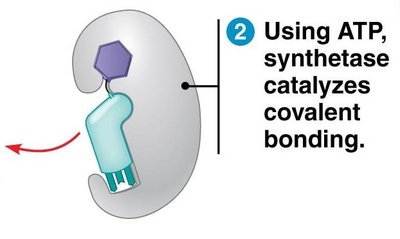
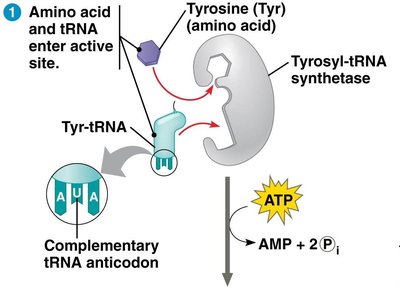
tRNA molecules are single-stranded RNA that fold into a characteristic cloverleaf structure. Each tRNA has a specific anticodon that pairs with a complementary mRNA codon and an amino acid attachment site at the 3' end. The enzyme aminoacyl-tRNA synthetase catalyzes the attachment of the correct amino acid to its corresponding tRNA, a process that requires ATP.
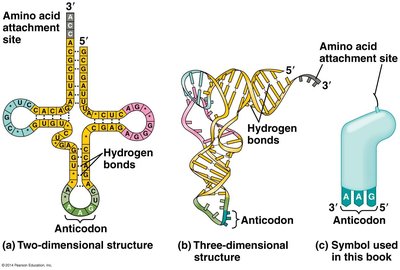
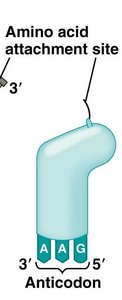
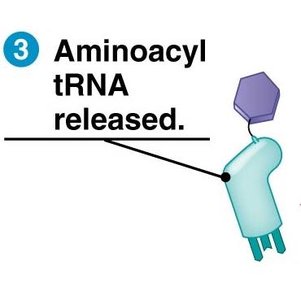
Aminoacyl-tRNA: A tRNA molecule with its attached amino acid (also called 'charged' tRNA).
Aminoacyl-tRNA synthetase: Enzyme that joins each amino acid to the appropriate tRNA.
Codons and the Genetic Code
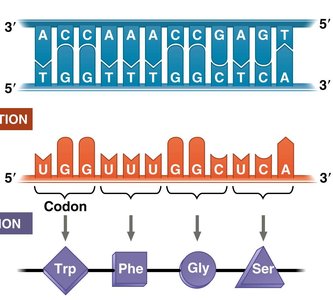
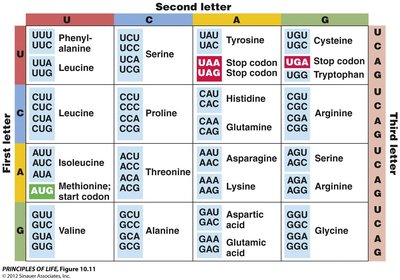
The genetic code is read in triplets called codons, each specifying a particular amino acid. The start codon (AUG) signals the beginning of translation, while stop codons (UAA, UAG, UGA) signal termination. The code is nearly universal and redundant, meaning multiple codons can code for the same amino acid.
Stages of Translation
Initiation
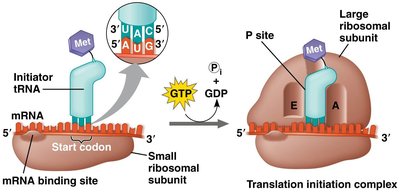
During initiation, the small ribosomal subunit binds to the mRNA near the 5' end. The initiator tRNA carrying methionine (anticodon UAC) pairs with the start codon (AUG). The large ribosomal subunit then assembles to form the complete initiation complex.
Elongation
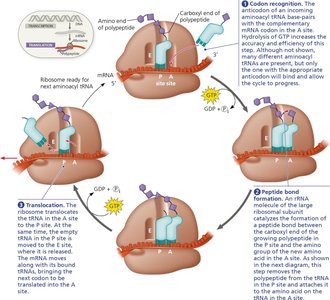
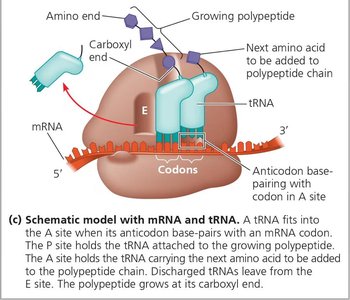
Elongation involves the sequential addition of amino acids to the growing polypeptide chain. tRNAs enter the ribosome at the A site, the polypeptide is transferred to the new amino acid at the P site, and discharged tRNAs exit via the E site. GTP hydrolysis provides energy for these steps.
Termination
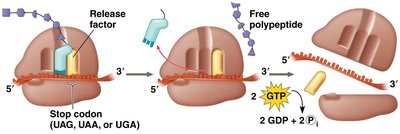
Termination occurs when a stop codon is reached. A release factor binds to the stop codon, causing the polypeptide to be released from the tRNA and the ribosomal subunits to dissociate.
Ribosome Structure and Function
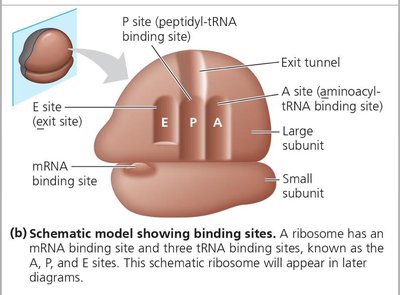
Ribosomes have three binding sites for tRNA:
A site (Aminoacyl-tRNA site): Holds the tRNA carrying the next amino acid to be added.
P site (Peptidyl-tRNA site): Holds the tRNA with the growing polypeptide chain.
E site (Exit site): Where discharged tRNAs leave the ribosome.
Free vs. Bound Ribosomes
Ribosomes can be free in the cytosol or bound to the rough ER. Free ribosomes synthesize proteins that function in the cytosol, while bound ribosomes make proteins for the endomembrane system or secretion. Translation always begins on free ribosomes; signal peptides direct ribosomes to the ER if needed.
Polyribosomes (Polysomes)
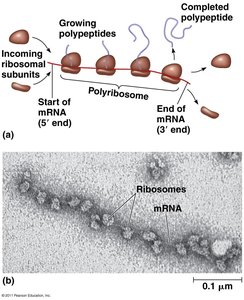
Multiple ribosomes can simultaneously translate a single mRNA molecule, forming a structure called a polyribosome or polysome. This increases the efficiency of protein synthesis.
Translation in Prokaryotes
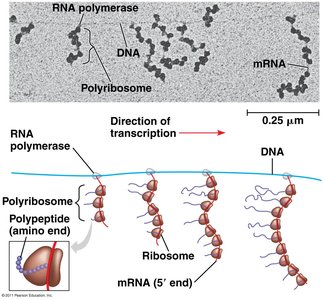
In prokaryotes, transcription and translation are coupled because there is no nuclear envelope. Translation can begin on an mRNA molecule before transcription is complete.
DNA Mutations
Types of Mutations
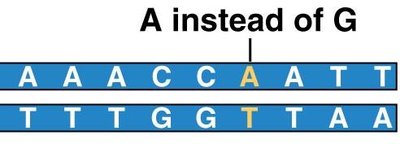
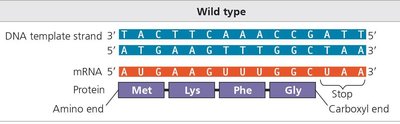
A mutation is a change in the DNA nucleotide sequence. Mutations can be spontaneous or induced by mutagens (e.g., UV light, chemicals). The main types of point mutations are:
Silent mutations: Change in nucleotide sequence that does not alter the amino acid sequence due to redundancy in the genetic code.
Missense mutations: Change in nucleotide sequence that results in a different amino acid being incorporated into the protein. Effects can be minimal or severe depending on the location and nature of the change.
Nonsense mutations: Change in nucleotide sequence that introduces a premature stop codon, leading to a truncated, usually nonfunctional protein.
Frameshift mutations: Insertions or deletions of nucleotides not in multiples of three, altering the reading frame and resulting in extensive missense and often premature termination.
Effects of Mutations on Phenotype
Silent mutations: No change in phenotype.
Missense mutations: May have positive, negative, or neutral effects on phenotype.
Nonsense mutations: Usually result in loss of function.
Frameshift mutations: Typically cause severe disruption of protein function.
Gene Editing: CRISPR-Cas9 System
The CRISPR-Cas9 system is a revolutionary gene-editing tool that allows scientists to make precise changes in the DNA sequence. The Cas9 protein acts as a nuclease, cutting DNA at a location specified by a guide RNA. This technology is being explored for correcting genetic defects and treating diseases.
Key Terminologies
tRNA (transfer RNA): Adapter molecule in translation.
Codon, anticodon: Triplet nucleotide sequences on mRNA and tRNA, respectively.
Aminoacyl-tRNA synthetases: Enzymes that attach amino acids to tRNAs.
A, P, E sites: Ribosomal binding sites for tRNA.
Initiation, elongation, termination: Stages of translation.
Release factor: Protein that recognizes stop codons and terminates translation.
Signal peptide: Sequence that directs ribosomes to the ER.
Polyribosomes: Multiple ribosomes translating a single mRNA.
Silent, missense, nonsense, frameshift mutations: Types of point mutations.
CRISPR-Cas9 System: Gene-editing technology.
Summary Table: Types of Point Mutations
Mutation Type | DNA Change | Protein Effect | Phenotypic Effect |
|---|---|---|---|
Silent | Single nucleotide change | No change in amino acid | None |
Missense | Single nucleotide change | Different amino acid | Variable (positive, negative, or neutral) |
Nonsense | Single nucleotide change | Premature stop codon | Usually loss of function |
Frameshift | Insertion/deletion (not multiple of 3) | Altered reading frame, extensive missense, premature stop | Severe disruption |
Additional info: This guide covers material relevant to the following textbook chapters: Ch. 17 (Gene Expression: From Gene to Protein), Ch. 18 (Regulation of Gene Expression), Ch. 16 (The Molecular Basis of Inheritance), and Ch. 20 (DNA Tools and Biotechnology).
