 Back
Early Embryogenesis and Maternal Recognition of Pregnancy in Mammals
Study Guide - Smart Notes
 Tailored notes based on your materials, expanded with key definitions, examples, and context.
Early Embryonic Development
Terminology and Stages
Embryogenesis in mammals involves a series of well-defined stages, each characterized by specific cellular and morphological changes. Understanding these stages is essential for grasping the fundamentals of developmental biology.
Fertilized oocyte (ootid): The cell formed immediately after fertilization, before the fusion of male and female pronuclei.
Syngamy: The fusion of the male pronucleus (MPN) and female pronucleus (FPN), resulting in a diploid zygote.
Zygote: The cell formed after syngamy, containing a single diploid (2n) nucleus.
Embryo: The organism in early development, not yet recognizable as a specific species.
Fetus: The organism in the uterus, now identifiable as a member of its species.
Key cellular features:
Both polar bodies (PB) and pronuclei (PN) are visible in early stages.
Mitosis begins within the zona pellucida (ZP), leading to cleavage divisions.
Cells produced by cleavage are called blastomeres.
Blastomeres from embryos with 8 cells or fewer are totipotent, meaning they can give rise to a complete individual (e.g., twins).
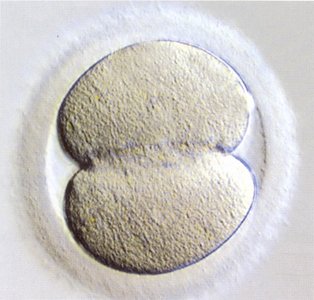
Morula and Blastocyst Formation
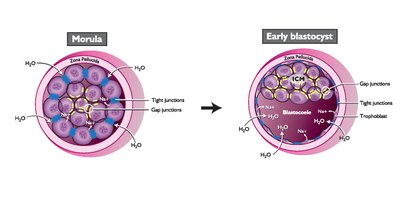
After several rounds of cleavage, the embryo transitions from a ball of cells (morula) to a blastocyst, a structure with distinct cell populations and a fluid-filled cavity.
Morula: A solid ball of cells (16+ cells) formed after the 8-cell stage. Outer cells begin to compact more than inner cells, forming two groups: inner and outer cells.
Blastocyst: The morula develops a cavity (blastocoele) as Na+ is pumped into intercellular spaces, causing water to follow and fluid to accumulate. The outer cells flatten and differentiate into the trophoblast, while the inner cells form the inner cell mass (ICM).
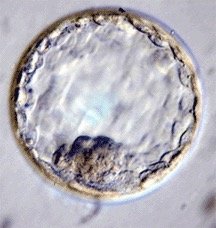
Blastocyst Hatching
As fluid continues to accumulate, trophoblast cells produce enzymes that break down the zona pellucida (ZP). The weakened ZP allows the blastocyst to "hatch" and exit, preparing for implantation.
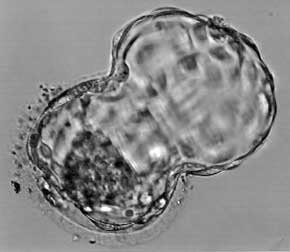
Timeline of Embryogenesis in the Female
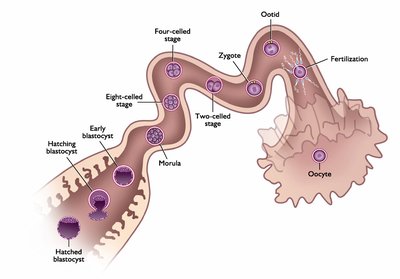
Embryogenesis typically occurs over 3-7 days, with the embryo progressing through several stages as it travels through the female reproductive tract.
Stages include: Oocyte, fertilization, ootid, zygote, two-celled stage, four-celled stage, eight-celled stage, morula, early blastocyst, hatching blastocyst.
Maternal Recognition of Pregnancy (MRP)
Concept and Mechanisms
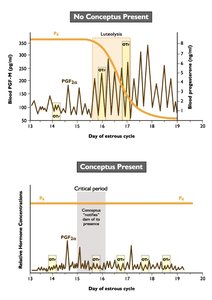
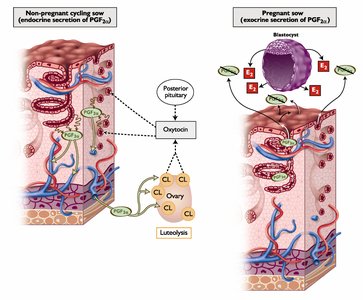
Maternal recognition of pregnancy (MRP) is the process by which the embryo signals its presence to the mother, preventing luteolysis and ensuring continued progesterone production for pregnancy maintenance. The mechanisms vary among species.
Cow and Ewe: The blastocyst (specifically trophoblast cells) produces interferon tau (IFN-𝞃), which binds to the endometrium and inhibits oxytocin receptor synthesis, preventing PGF2α-induced luteolysis. It also stimulates uterine gland protein synthesis for embryo survival.
Sow: Estradiol is the signal for MRP, rerouting PGF2α to the uterine lumen where it is rendered inactive.
Mare: Physical migration of the embryo throughout the uterus (horns) is required, occurring 12–14 times per day during days 12–14 of pregnancy.
Timing and Factors of Pregnancy Recognition
The timing and factors involved in MRP differ among animal species. The following table summarizes key details:
Animal | Pregnancy Recognition Factors | Critical Period for Recognition (days after ovulation) | Time of Attachment (days after ovulation) |
|---|---|---|---|
Cow | bIFN - τ | 15 – 16 | 18 – 22 |
Ewe | oIFN - τ | 13 – 14 | 15 – 18 |
Sow | Estradiol | 11 – 12 | 14 – 18 |
Mare | ??? | 12 – 14 | 36 – 38 |
Queen | None | None | 12 – 14 |
Bitch | None | None | 18 – 20 |
Hen | None | None | None |
Summary of Key Terms
Blastomere: A cell produced by cleavage of the zygote.
Totipotent: Ability of a cell to give rise to a complete organism.
Morula: Early stage embryo consisting of a solid ball of cells.
Blastocyst: Embryo with a fluid-filled cavity and differentiated cell populations.
Trophoblast: Outer cell layer of the blastocyst, contributes to placenta formation.
Inner Cell Mass (ICM): Group of cells inside the blastocyst that will form the embryo proper.
Zona Pellucida (ZP): Glycoprotein layer surrounding the oocyte and early embryo.
Maternal Recognition of Pregnancy (MRP): Process by which the embryo signals its presence to prevent luteolysis.
Additional info:
Embryogenesis and MRP are critical for successful reproduction and are foundational concepts in developmental biology and reproductive physiology.
Species-specific differences in MRP highlight evolutionary adaptations in reproductive strategies.
