 Back
Early Life and the Diversification of Prokaryotes: Study Notes
Study Guide - Smart Notes
 Tailored notes based on your materials, expanded with key definitions, examples, and context.
Early Life and the Diversification of Prokaryotes
Major Events in the History of Life
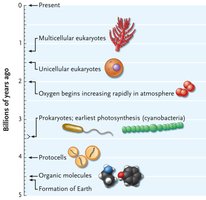
The history of life on Earth spans approximately 3.8 billion years, marked by significant geological and biological events. Understanding these events provides context for the origin and evolution of prokaryotes, the earliest forms of life.
Formation of Earth: Earth formed about 4.6 billion years ago.
Origin of Life: Life began with the formation of simple organic molecules, followed by the emergence of protocells and self-replicating molecules.
Prokaryotes: The oldest fossil organisms are prokaryotes, dating back to 3.5 billion years ago.
Photosynthesis and Oxygen: Cyanobacteria began photosynthesizing, releasing oxygen and transforming Earth's atmosphere.
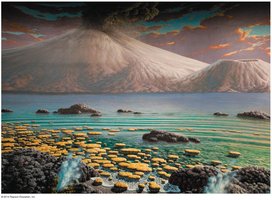
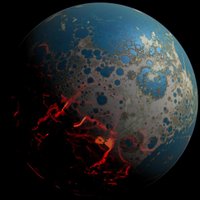
Concept 24.1: Conditions on Early Earth Made the Origin of Life Possible
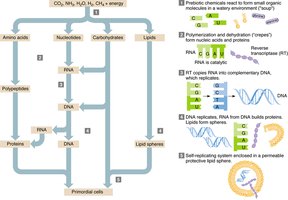
Early Earth provided the chemical and physical conditions necessary for the origin of life. The process likely occurred in several stages, including the abiotic synthesis of organic molecules, formation of macromolecules, packaging into protocells, and the emergence of self-replicating molecules.
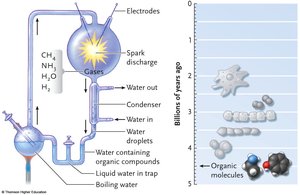
Abiotic Synthesis: Organic molecules formed from inorganic precursors in Earth's early atmosphere, which contained water vapor, nitrogen, carbon dioxide, methane, ammonia, and hydrogen.
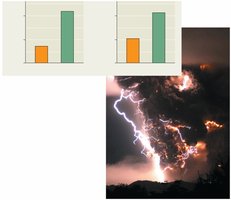
Miller-Urey Experiment: Demonstrated that organic molecules could be synthesized in a laboratory simulating early Earth conditions.
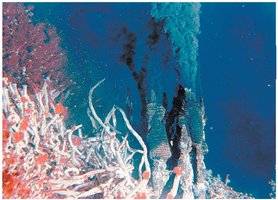
Alternative Origins: Organic compounds may have originated near volcanoes, deep-sea vents, or arrived via meteorites.
Fossil Evidence of Early Life
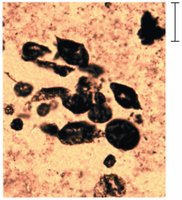
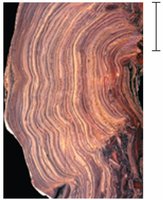
Fossils provide direct evidence of early life. Stromatolites, layered rocks formed by prokaryotes, are among the oldest known fossils. Ancient prokaryotic cells have also been discovered, offering insight into early biological diversity.
Stromatolites: Formed by cyanobacteria, these structures date back to 3.5 billion years ago.
Prokaryotic Fossils: Fossils of individual prokaryotic cells have been found, some as old as 3 billion years.
Concept 24.2: Structural and Metabolic Adaptations in Prokaryotes
Prokaryotes are unicellular organisms with diverse structural and metabolic adaptations, enabling them to thrive in extreme environments. Their cell walls, shapes, and metabolic pathways are key features distinguishing them from eukaryotes.
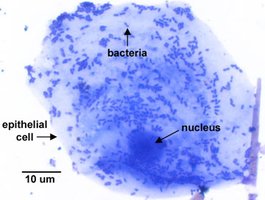
Cell Size: Prokaryotes are typically 0.5–5 µm in diameter, smaller than most eukaryotic cells.
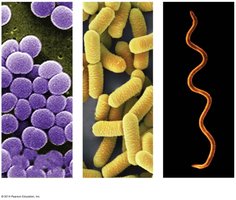
Shapes: Common shapes include spherical (cocci), rod-shaped (bacilli), and spiral (spirilla).
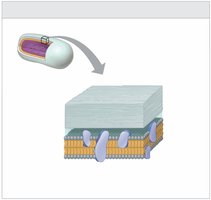
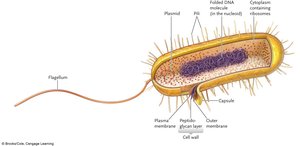
Cell Wall: Bacterial cell walls contain peptidoglycan; archaeal cell walls lack peptidoglycan.
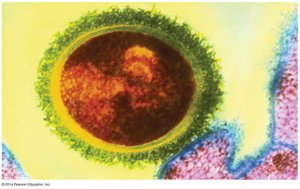
Capsule and Endospores: Some prokaryotes have a protective capsule or form resistant endospores.
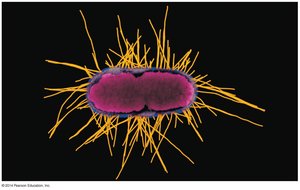
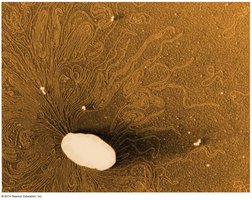
Fimbriae: Hair-like appendages for attachment.
Motility: Many prokaryotes move using flagella and exhibit chemotaxis.
Genetic Material: Most have a circular chromosome in the nucleoid region; plasmids are small rings of DNA.
Metabolic Diversity in Prokaryotes
Prokaryotes exhibit remarkable metabolic diversity, allowing them to utilize a wide range of energy and carbon sources. Their metabolic pathways are classified based on their relationship with oxygen and their nutritional modes.
Oxygen Requirements:
Obligate aerobes: Require O2 for cellular respiration.
Obligate anaerobes: Poisoned by O2; use fermentation or anaerobic respiration.
Facultative anaerobes: Can survive with or without O2.
Nitrogen Metabolism: Some prokaryotes fix atmospheric nitrogen (N2) into ammonia (NH3).
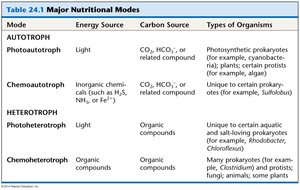
Nutritional Modes: Prokaryotes can be autotrophs or heterotrophs, using light, inorganic, or organic compounds as energy and carbon sources.
Mode | Energy Source | Carbon Source | Types of Organisms |
|---|---|---|---|
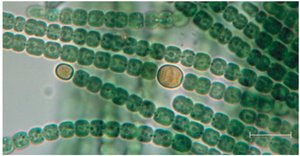
Photoautotroph | Light | CO2, HCO3−, or related compounds | Photosynthetic prokaryotes (e.g., cyanobacteria), plants, certain protists |
Chemoautotroph | Inorganic chemicals (e.g., H2S, NH3, Fe2+) | CO2, HCO3−, or related compounds | Unique to certain prokaryotes (e.g., Sulfolobus) |
Photoheterotroph | Light | Organic compounds | Unique to certain aquatic and salt-loving prokaryotes (e.g., Rhodobacter, Chlorobacter) |
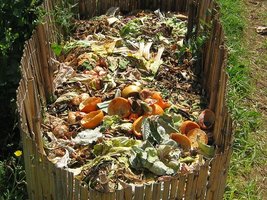
Chemoheterotroph | Organic compounds | Organic compounds | Many prokaryotes (e.g., Clostridium), protists, fungi, animals, some plants |
Concept 24.3: Genetic Diversity and Adaptation in Prokaryotes
Prokaryotes display extraordinary genetic variation due to rapid reproduction, mutation, and genetic recombination. These mechanisms drive adaptation and diversification.
Binary Fission: Prokaryotes reproduce quickly, accumulating mutations rapidly.
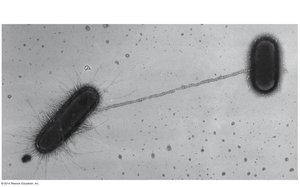
Genetic Recombination: DNA from different sources is combined through transformation, transduction, and conjugation.
Horizontal Gene Transfer: Genes move between individuals of different species, increasing genetic diversity.
Concept 24.4: Prokaryotic Lineages and Diversity
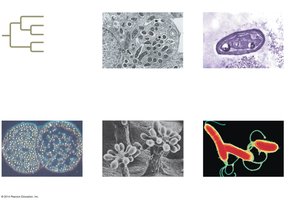
Prokaryotes have radiated into a diverse set of lineages, inhabiting every environment that supports life. Molecular systematics has revealed the evolutionary relationships among Bacteria, Archaea, and Eukarya.
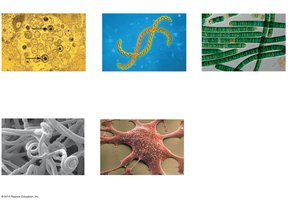
Bacteria: Include the vast majority of prokaryotes, with diverse structural and metabolic traits.
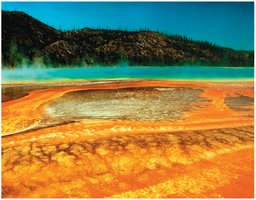
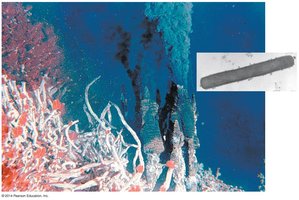
Archaea: Share traits with both bacteria and eukaryotes; many are extremophiles.
Eukarya: Eukaryotes evolved from prokaryotic ancestors.
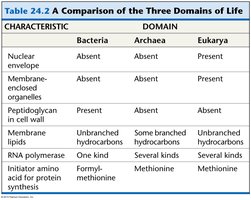
Characteristic | Bacteria | Archaea | Eukarya |
|---|---|---|---|
Nuclear envelope | Absent | Absent | Present |
Membrane-enclosed organelles | Absent | Absent | Present |
Peptidoglycan in cell wall | Present | Absent | Absent |
Membrane lipids | Unbranched hydrocarbons | Some branched hydrocarbons | Unbranched hydrocarbons |
RNA polymerase | One kind | Several kinds | Several kinds |
Initiator amino acid for protein synthesis | Formyl-methionine | Methionine | Methionine |
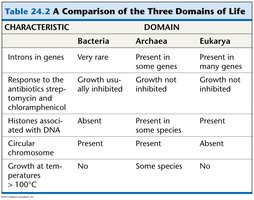
Characteristic | Bacteria | Archaea | Eukarya |
|---|---|---|---|
Introns in genes | Very rare | Present in some genes | Present in many genes |
Response to antibiotics | Growth usually inhibited | Growth not inhibited | Growth not inhibited |
Histones associated with DNA | Absent | Present in some species | Present |
Circular chromosome | Present | Present | Absent |
Growth at temperatures >100°C | No | Some species | No |
Summary
Conditions on early Earth made the origin of life possible.
Diverse structural and metabolic adaptations have evolved in prokaryotes.
Rapid reproduction, mutation, and genetic recombination promote genetic diversity in prokaryotes.
Prokaryotes have radiated into a diverse set of lineages and play a crucial role in the biosphere.
