 Back
Early Life and the Diversification of Prokaryotes: Study Notes
Study Guide - Smart Notes
 Tailored notes based on your materials, expanded with key definitions, examples, and context.
Early Life and the Diversification of Prokaryotes
Origins of Life on Earth
The origin of life on Earth is a fundamental topic in biology, involving the transition from non-living chemical systems to living cells. Understanding these processes provides insight into the evolution and diversity of life.
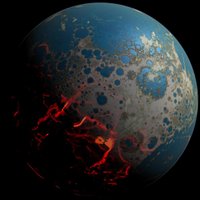
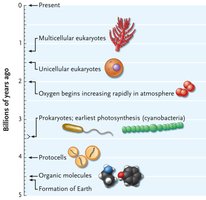
Major Events: Formation of Earth (~4.6 billion years ago), synthesis of organic molecules, formation of protocells, and the emergence of self-replicating molecules.
Abiotic Synthesis: Early Earth's atmosphere contained water vapor and gases from volcanic eruptions (e.g., nitrogen, carbon dioxide, methane, ammonia, hydrogen).
Protocells: Membrane-bound droplets capable of maintaining internal chemistry, considered precursors to true cells.
Self-Replicating Molecules: The origin of molecules capable of replication (such as RNA) was crucial for the development of life.
Example: The Miller-Urey experiment demonstrated that organic molecules could form under early Earth conditions.
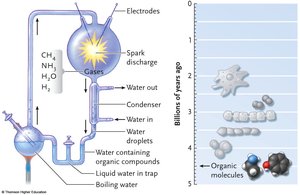
Major Events in the History of Life
Life on Earth has evolved through a series of major events, each contributing to the diversity observed today.
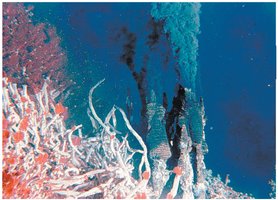
Formation of Organic Molecules: Occurred in the primordial environment, possibly in oceans or near hydrothermal vents.
Protocells: Aggregates of organic molecules capable of basic metabolic functions.
Prokaryotes: The first true cells, appearing about 3.5 billion years ago.
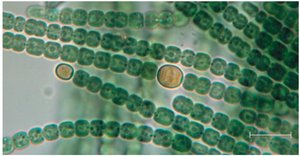
Photosynthesis: Cyanobacteria began photosynthesizing, releasing oxygen into the atmosphere.
Oxygen Revolution: Increased atmospheric oxygen led to new evolutionary pathways.
Fossil Evidence of Early Life
Fossils provide direct evidence of early life forms and their activities.
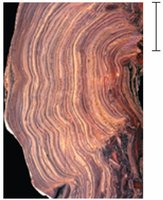
Stromatolites: Layered rocks formed by prokaryotic activity, dating back to 3.5 billion years ago.
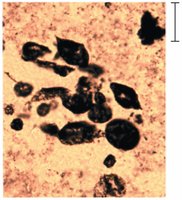
Ancient Prokaryotes: Fossils of individual prokaryotic cells have been discovered, confirming their early presence.
Cyanobacteria: Responsible for the release of oxygen through photosynthesis.
Diversification of Prokaryotes
Key Characteristics of Prokaryotes
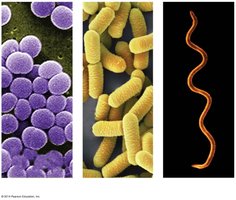
Prokaryotes are single-celled organisms classified into the domains Bacteria and Archaea. They exhibit remarkable structural and metabolic diversity.
Cell Structure: Most prokaryotes are unicellular, with diameters of 0.5–5 µm.
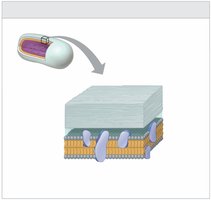
Cell Wall: Bacterial cell walls contain peptidoglycan; archaeal cell walls lack peptidoglycan.
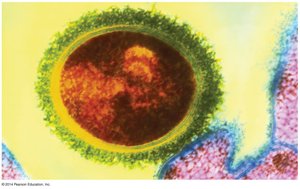
Capsule: Some prokaryotes have a polysaccharide or protein layer outside the cell wall.
Endospores: Resistant cells formed by some prokaryotes to survive harsh conditions.
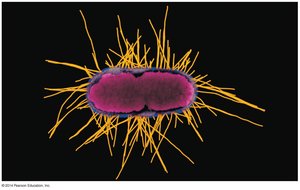
Fimbriae: Hair-like appendages for attachment.
Motility and Chemotaxis
Many prokaryotes are motile, moving toward or away from chemical stimuli (chemotaxis). Flagella are common structures for locomotion.
Flagella: Allow for effective movement in liquid environments.
Chemotaxis: Movement in response to chemical gradients.
Genetic Material
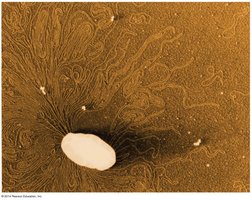
Prokaryotic genomes are typically composed of a single circular chromosome located in the nucleoid region. Some species possess plasmids, which are small rings of DNA.
Chromosome: Contains most genetic information.
Plasmids: Carry additional genes, often for antibiotic resistance.
Metabolic Diversity
Prokaryotes exhibit a wide range of metabolic adaptations, allowing them to thrive in diverse environments.
Oxygen Requirements: Obligate aerobes require O2, obligate anaerobes are poisoned by O2, and facultative anaerobes can survive with or without O2.
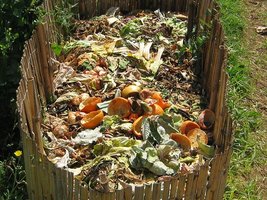
Nitrogen Metabolism: Some prokaryotes fix atmospheric nitrogen (N2) into ammonia (NH3).
Genetic Diversity and Adaptation
Rapid Reproduction and Mutation
Prokaryotes reproduce rapidly by binary fission, leading to quick accumulation of mutations and genetic diversity.
Binary Fission: Simple cell division process.
Mutation: Although rates are low, rapid reproduction allows mutations to accumulate quickly.
Genetic Recombination
Genetic recombination increases diversity through the exchange of DNA between individuals.
Transformation: Uptake of foreign DNA from the environment.
Transduction: DNA transfer via bacteriophages.
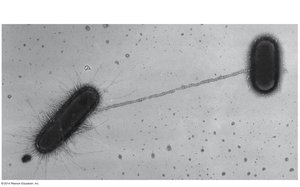
Conjugation: Direct transfer of DNA between cells via a sex pilus.
Horizontal Gene Transfer: Movement of genes between different species.
Prokaryotic Diversity and Classification
Radiation into Diverse Lineages
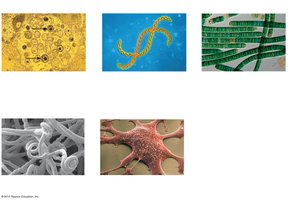
Prokaryotes have radiated into a wide variety of lineages, inhabiting every environment capable of supporting life.
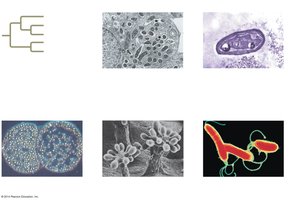
Bacteria: Includes the vast majority of prokaryotes.
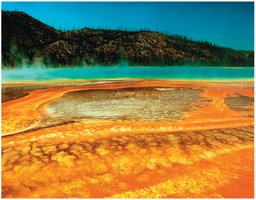
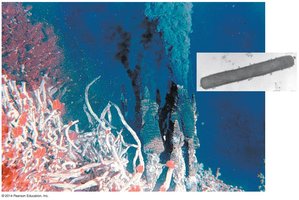
Archaea: Shares traits with both bacteria and eukaryotes; includes extremophiles such as halophiles, thermophiles, and methanogens.
Molecular Systematics: Has led to the splitting of prokaryotes into bacteria and archaea.
Comparison of the Three Domains of Life
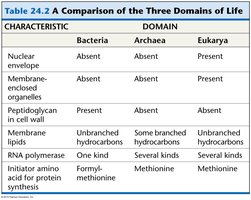
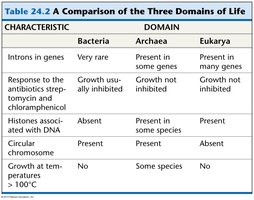
The three domains of life—Bacteria, Archaea, and Eukarya—are distinguished by several key characteristics.
Characteristic | Bacteria | Archaea | Eukarya |
|---|---|---|---|
Nuclear envelope | Absent | Absent | Present |
Membrane-enclosed organelles | Absent | Absent | Present |
Peptidoglycan in cell wall | Present | Absent | Absent |
Membrane lipids | Unbranched hydrocarbons | Some branched hydrocarbons | Unbranched hydrocarbons |
RNA polymerase | One kind | Several kinds | Several kinds |
Initiator amino acid for protein synthesis | Formyl-methionine | Methionine | Methionine |
Characteristic | Bacteria | Archaea | Eukarya |
|---|---|---|---|
Introns in genes | Very rare | Present in some genes | Present in many genes |
Response to antibiotics | Growth usually inhibited | Growth not inhibited | Growth not inhibited |
Histones associated with DNA | Absent | Present in some species | Present |
Circular chromosome | Present | Present | Absent |
Growth at temperatures >100°C | No | Some species | No |
Phylogenetic Relationships
Molecular evidence supports the division of life into three domains, with prokaryotes split into Bacteria and Archaea. Eukaryotes share ancestry with Archaea.

Summary
Conditions on early Earth made the origin of life possible. Prokaryotes evolved diverse structural and metabolic adaptations, and rapid reproduction, mutation, and genetic recombination promote their genetic diversity. Prokaryotes have radiated into a diverse set of lineages and play a crucial role in the biosphere.
