 Back
BackEarth Processes and Plate Tectonics: Evidence and Mechanisms
Study Guide - Smart Notes
 Tailored notes based on your materials, expanded with key definitions, examples, and context.
Earth Processes and Plate Tectonics
Introduction to Plate Tectonics
Plate tectonics is the scientific theory explaining the movement of Earth's lithospheric plates and the processes that result from their interactions. This theory provides a unifying framework for understanding the formation of continents, ocean basins, mountains, earthquakes, and volcanoes.
The Continental Drift Hypothesis
Wegener's Proposal
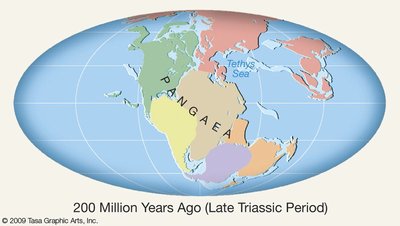
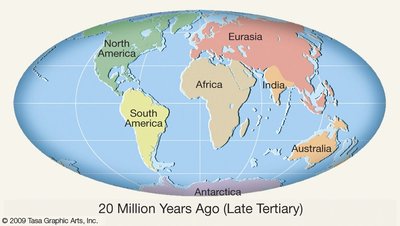
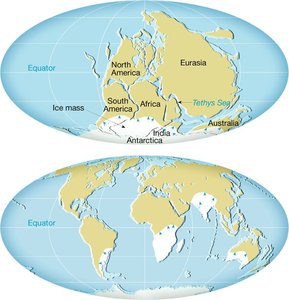
In 1915, German scientist Alfred Wegener proposed the hypothesis of continental drift, suggesting that continents move slowly over Earth's surface. He theorized that all continents were once joined in a single supercontinent called Pangaea, which later broke apart into the continents we see today.
Pangaea: Greek for "all land," the name given to the supercontinent.
Laurasia and Gondwanaland: The two large landmasses formed after Pangaea split.
Evidence Supporting Continental Drift
Wegener collected multiple lines of evidence to support his hypothesis:
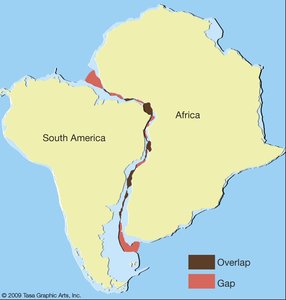
Fit of the Continents: The coastlines of continents such as South America and Africa appear to fit together like puzzle pieces.
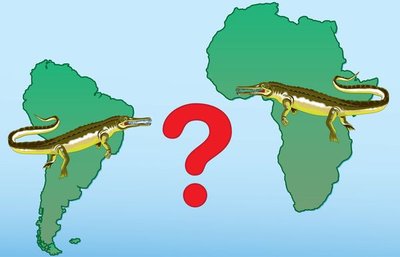
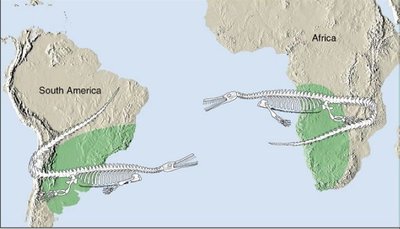
Matching Fossils: Identical fossils of extinct species, such as Mesosaurus, were found on continents now separated by oceans, indicating these continents were once joined.
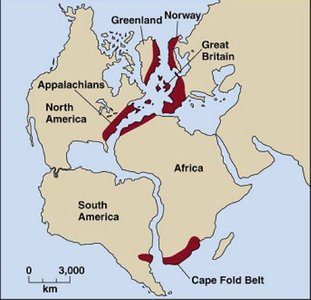
Matching Rock Types and Structures: Similar rock formations and mountain ranges are found on continents now separated by oceans, such as the Appalachian Mountains in North America and similar ranges in Britain and Scandinavia.
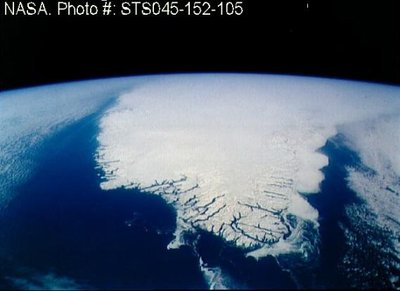
Ancient Climates: Evidence of past glaciations and coal deposits in now-tropical regions suggests continents have shifted positions over time.
Development of Plate Tectonics Theory
Mechanism for Continental Movement
Wegener's hypothesis was initially criticized due to the lack of a mechanism for continental movement. The discovery of seafloor spreading provided the missing explanation, showing that new oceanic crust forms at mid-ocean ridges and moves outward, pushing continents apart.
Structure of the Earth
Lithosphere: The rigid outer layer of Earth, composed of the crust and uppermost mantle.
Asthenosphere: The semi-fluid layer beneath the lithosphere, allowing for plate movement.
Mantle Convection: The process by which heat from Earth's interior causes material in the mantle to circulate, driving plate movement.
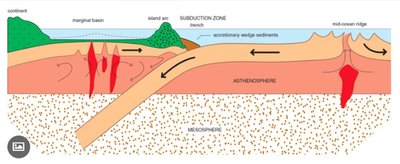
Types of Plate Boundaries
Divergent Boundaries
At divergent boundaries, two plates move apart, and new crust forms from upwelling magma. These boundaries are typically found at mid-ocean ridges.
Example: Mid-Atlantic Ridge
Convergent Boundaries
At convergent boundaries, two plates move toward each other. This can result in subduction (one plate sinking beneath another) or continental collision (mountain building).
Oceanic-Continental: Oceanic plate subducts beneath a continental plate, forming volcanic arcs (e.g., Andes Mountains).
Oceanic-Oceanic: One oceanic plate subducts beneath another, forming volcanic island arcs (e.g., Japan, Aleutian Islands).
Continental-Continental: Two continental plates collide, forming large mountain ranges (e.g., Himalayas).
Transform Boundaries
At transform boundaries, two plates slide past each other horizontally, causing earthquakes but not creating or destroying crust.
Example: San Andreas Fault
Evidence from Paleomagnetism
Magnetic Striping and Seafloor Spreading
As magma at mid-ocean ridges cools, iron-rich minerals align with Earth's magnetic field. Periodic reversals of the magnetic field are recorded as symmetrical stripes on either side of the ridge, providing strong evidence for seafloor spreading and plate movement.
Summary Table: Evidence for Continental Drift
Evidence Type | Description | Example |
|---|---|---|
Fit of Continents | Continents appear to fit together like puzzle pieces | South America and Africa |
Fossil Evidence | Identical fossils found on now-separated continents | Mesosaurus in South America and Africa |
Rock Types & Structures | Similar rocks and mountain ranges on different continents | Appalachians and Caledonian Mountains |
Ancient Climates | Evidence of glaciation and coal in unexpected regions | Glacial deposits in Africa, coal in Arctic |
Paleomagnetism | Magnetic striping on ocean floor records reversals | Mid-Atlantic Ridge |
Conclusion
The theory of plate tectonics, built upon Wegener's continental drift hypothesis, is supported by multiple lines of evidence from geology, paleontology, and geophysics. It explains the dynamic nature of Earth's surface and the processes that shape our planet over geological time.
