 Back
BackLec 23
Study Guide - Smart Notes
 Tailored notes based on your materials, expanded with key definitions, examples, and context.
Ecological Opportunity and Adaptive Radiation
Introduction to Adaptive Radiation
Adaptive radiation is an evolutionary process in which organisms rapidly diversify from an ancestral species into a multitude of new forms, particularly when a change in the environment makes new resources available, creates new challenges, or opens new environmental niches. This process is often triggered by events such as mass extinctions, colonization of new habitats, or the evolution of novel traits (key innovations).
Definition: Adaptive radiation is the rapid evolution of diversely adapted species from a common ancestor.
Key Features: High rates of speciation, phenotypic divergence, and ecological differentiation among closely related species.
Ecological Opportunity: The availability of unexploited resources or niches that can be evolutionarily utilized by organisms.
Key Innovation: The evolution of a trait that enables a lineage to interact with the environment in a novel way, facilitating access to new resources or habitats.
Example: The diversification of mammals after the extinction of non-avian dinosaurs at the end of the Mesozoic Era is a classic example of adaptive radiation.
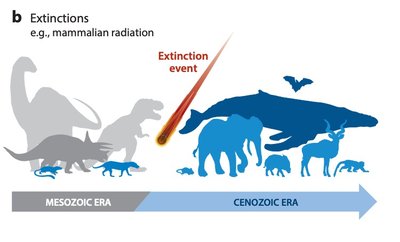
Ecological Opportunity as a Driver of Adaptive Radiation
Ecological opportunity arises when new habitats or resources become available, often following extinction events, environmental changes, or colonization of new areas. This opportunity allows for rapid diversification as species adapt to fill available niches.
Extinction Events: Mass extinctions can eliminate dominant groups, freeing up ecological space for surviving lineages to diversify.
Colonization: When species colonize new geographic areas with few competitors, they can diversify to exploit different resources.
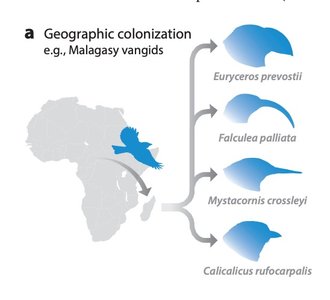
Island Biogeography and Adaptive Radiation
Islands as Natural Laboratories
Islands provide unique opportunities to study adaptive radiation due to their isolation, limited initial diversity, and clear boundaries. Adaptive radiations are often most evident on islands, where colonizing species diversify to fill available niches.
Dispersal and Colonization: Species that reach islands are often immediately isolated from their ancestral populations, leading to founder effect speciation.
Endemism: The proportion of endemic species (those found nowhere else) increases with distance from the mainland.
Example: Hawaiian Drosophilid flies and silversword plants are classic examples of adaptive radiation on islands.
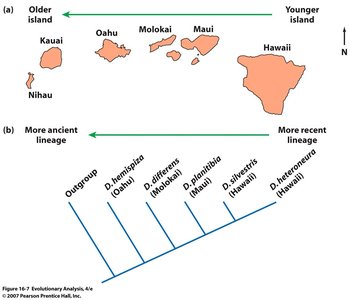
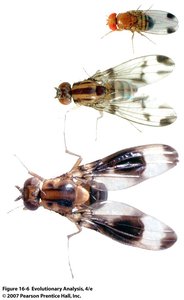
Case Study: Hawaiian Drosophilid Flies
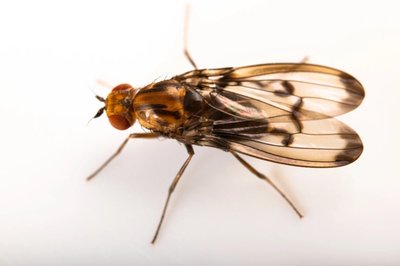
The Hawaiian islands are home to over 1,000 species of fruit flies (Drosophilidae), all of which are endemic. These flies have radiated to fill a wide variety of ecological niches, often associated with different host plants and habitats.
Founder Effect Speciation: Small populations that colonize new islands become isolated, leading to rapid speciation.
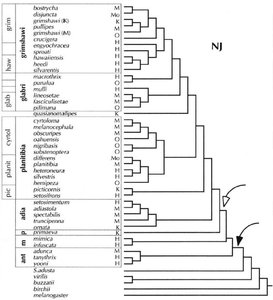
Phylogenetic Patterns: Closely related species are found on adjacent islands, and phylogenies often show an old-to-young pattern corresponding to island age.
Adaptive Traits: Evidence for positive selection on genes involved in olfaction suggests adaptation to different host plants.
Case Study: Hawaiian Silverswords
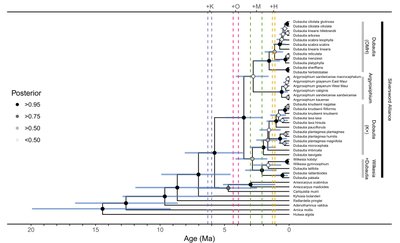
The Hawaiian silversword alliance is a group of plants that have undergone remarkable adaptive radiation, resulting in a wide variety of forms adapted to different ecological conditions across the Hawaiian islands.
Phylogenetic Evidence: Molecular data show that silverswords are monophyletic and diversified after colonizing the islands.
Ecological Diversification: Silverswords have adapted to diverse habitats, from alpine deserts to wet forests.

Adaptive Radiation in Anolis Lizards
Patterns of Diversification
Anolis lizards are a textbook example of adaptive radiation, especially in the Caribbean islands. Over 300 species exist globally, with about 150 species inhabiting Caribbean islands. These lizards have diversified into distinct ecological forms, or ecomorphs, each adapted to specific microhabitats.
Ecomorphs: Distinct morphological types that occupy different ecological niches (e.g., trunk-crown, twig, grass-bush).
Convergent Evolution: Similar ecomorphs have evolved independently on different islands.
Trait Evolution: Hind limb length correlates with perch diameter, reflecting adaptation to different substrates.
Experimental Evidence
Experimental introductions of Anolis lizards to new islands have demonstrated rapid evolutionary changes in morphology, supporting the role of ecological opportunity in driving adaptive radiation.
Example: Losos et al. introduced Anolis lizards to small islands and observed evolutionary changes in limb length over a decade, corresponding to the available vegetation structure.
Adaptive Radiation in Cichlid Fishes
East African Rift Lakes
Cichlid fishes in the African Rift lakes (e.g., Lake Victoria, Lake Malawi, Lake Tanganyika) represent one of the most spectacular examples of adaptive radiation. Each lake contains hundreds of endemic cichlid species that have diversified in a relatively short period of time.
Monophyly: Phylogenetic analyses show that cichlids within each lake are monophyletic, indicating a single colonization event followed by rapid radiation.
Key Innovations: Adaptations such as specialized jaws have enabled cichlids to exploit a wide range of food resources.
Sexual Selection: Diversification of male color patterns has contributed to reproductive isolation and speciation.
Summary Table: Key Concepts in Adaptive Radiation
Concept | Definition | Example |
|---|---|---|
Ecological Opportunity | Availability of unexploited resources or niches | Post-extinction environments, newly formed islands |
Adaptive Radiation | Rapid diversification of a lineage into multiple forms | Darwin's finches, Hawaiian Drosophila, cichlid fishes |
Key Innovation | Trait enabling exploitation of new resources | Cichlid pharyngeal jaws, bird beak shapes |
Founder Effect Speciation | Speciation following colonization by a small population | Hawaiian Drosophila, island Anolis lizards |
Conclusion
Adaptive radiation is a fundamental process in evolutionary biology, illustrating how ecological opportunity, isolation, and key innovations can drive the rapid diversification of life. Case studies from islands and lakes around the world provide compelling evidence for the mechanisms underlying this process, making adaptive radiation a central topic in the study of evolution and biodiversity.
