 Back
BackLec 37
Study Guide - Smart Notes
 Tailored notes based on your materials, expanded with key definitions, examples, and context.
Ecological Speciation
Definition and Importance
Ecological speciation is the process by which barriers to gene flow evolve between populations as a result of ecologically based divergent selection between environments. This process is central to understanding how new species arise and how biodiversity is generated and maintained in nature.
Divergent selection occurs when different environments favor different traits, leading to reproductive isolation.
Ecological speciation is a key mechanism in the evolution of new species, especially in diverse and heterogeneous environments.
Understanding speciation helps explain patterns of biodiversity and adaptation.

Historical Context: Naturalists and the Amazon
Contributions of Wallace and Bates
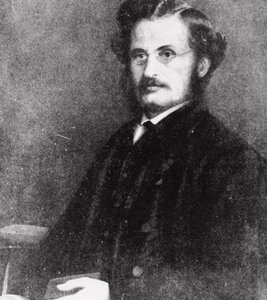
Alfred Russel Wallace and Henry Walter Bates were pioneering naturalists who explored the Amazon and contributed significantly to evolutionary biology. Their observations of Amazonian biodiversity, especially butterflies, provided early evidence for natural selection and speciation.
Wallace and Bates documented the diversity of species and their adaptations to different ecological niches.
Their work laid the foundation for later studies on speciation and mimicry.

Heliconius Butterflies as a Model System
Wing Patterns and Speciation
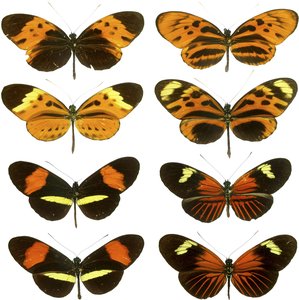
Heliconius butterflies are a classic example of ecological speciation. Their wing colors and patterns serve dual functions: as aposematic (warning) signals to predators and as mate recognition cues. These traits are subject to strong natural and sexual selection, driving reproductive isolation between populations.
Aposematism: Bright colors warn predators of toxicity.
Mate recognition: Specific patterns help butterflies identify suitable mates, reducing hybridization.
Different environments select for different wing patterns, leading to divergence.
Sympatric vs. Allopatric Populations
Populations of Heliconius that live in the same geographic area as closely related species (sympatric) are more likely to evolve strong mate discrimination than those living in separate areas (allopatric). This reinforces reproductive isolation and reduces hybridization.
Sympatric males avoid mating with similar-looking sister species.
Allopatric males may not show this discrimination, leading to potential gene flow if populations come into contact.
Genetic Mechanisms: Supergenes
Definition and Role in Adaptation
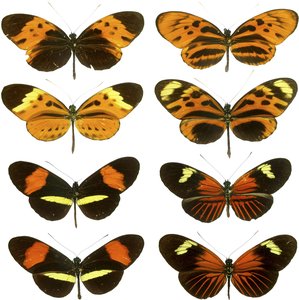
Supergenes are groups of loci in linkage disequilibrium that provide integrated control of adaptive phenotypes. In Heliconius, supergenes control the complex wing patterns that are crucial for both survival and reproduction.
Supergenes allow for the coordinated expression of multiple traits that function together.
They facilitate rapid adaptation to new environments and the evolution of reproductive barriers.
Reproductive Isolation and Hybridization
Types of Reproductive Barriers
Reproductive isolation can be incomplete, especially when diverged populations come into secondary contact. Two main outcomes are possible:
Reinforcement: Selection reduces the fitness of hybrids, strengthening reproductive isolation.
Hybridization: Fertile interbreeding occurs, leading to gene flow and reduced genetic differentiation.
Reproductive barriers can be:
Prezygotic: Traits that prevent fertilization (e.g., mate recognition, behavioral isolation).
Postzygotic: Hybrids are infertile or inviable.
Summary Table: Types of Reproductive Isolation
Type | Mechanism | Outcome |
|---|---|---|
Prezygotic | Divergence in mate recognition, behavioral isolation | Prevents fertilization |
Postzygotic | Hybrid infertility or inviability | Reduces hybrid fitness |
Hybridization | Fertile interbreeding | Gene flow between populations |
Reinforcement | Selection against hybrids | Strengthens reproductive isolation |
Conclusion
The study of Heliconius butterflies illustrates how ecological factors, genetic mechanisms (such as supergenes), and reproductive barriers interact to drive speciation. These processes are fundamental to understanding the origin and maintenance of biodiversity.
