 Back
Ecological Succession: Patterns and Processes
Study Guide - Smart Notes
 Tailored notes based on your materials, expanded with key definitions, examples, and context.
Ecological Succession
Definition and Overview
Ecological succession is the process of change in the species structure and community composition of an ecosystem over time. It is driven by ecological interactions and not directly caused by disturbances, though disturbances can initiate or interrupt succession. Succession leads to a series of predictable stages, ultimately resulting in a stable climax community.
Disturbance: An event (e.g., fire, flood, human activity) that alters the structure of a community. Disturbances may start or end succession but are not the direct cause.
Community change: Succession involves the replacement of one community by another over time due to interactions such as competition, facilitation, and tolerance.
Succession Timeline Example
Consider what would happen if a managed area, such as a university campus, were abandoned:
1-2 years: Early colonizing plants (weeds, grasses) establish.
5 years: Shrubs and fast-growing trees begin to appear.
10 years: Young forests with a mix of species develop.
50 years: Mature forest (climax community) forms, with stable species composition.
Types of Succession
Primary vs. Secondary Succession
Primary Succession: Occurs in lifeless areas where soil has not yet formed (e.g., after a lava flow, retreating glacier). Pioneer species are the first to colonize.
Secondary Succession: Follows a disturbance that leaves the soil intact (e.g., after fire, hurricane, or human activity). Some organisms and organic matter remain.
Pioneer and Intermediate Stages: The species that first colonize (pioneer species) differ between primary and secondary succession. Intermediate stages involve more complex plant and animal communities.
Climax Community: The final, stable community reached at the end of succession. Often similar regardless of whether succession was primary or secondary.
Adaptation to Disturbance: Some species are adapted to regular disturbances (e.g., fire-adapted species).
Case Study: Succession in Glacier Bay, Alaska
Stages of Primary Succession
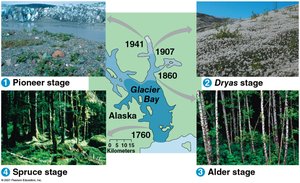
Glacier Bay provides a classic example of primary succession following glacial retreat. The process involves several distinct stages:
Pioneer Stage: Bare rock is colonized by lichens, mosses, and a few hardy plants.
Dryas Stage: Dryas species (a type of flowering plant) dominate as soil begins to form.
Alder Stage: Alders (nitrogen-fixing trees) enrich the soil, allowing more plant species to establish.
Spruce Stage: Spruce trees become dominant, forming a mature forest.
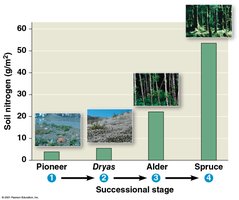
Soil Nitrogen Changes During Succession
As succession progresses, soil nitrogen content increases, supporting more complex plant communities. Nitrogen-fixing species (e.g., alders) play a key role in this process.
Secondary Succession: Fire Recovery
Example: Forest Recovery After Fire
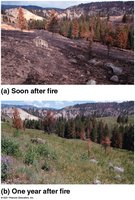
Secondary succession is common in areas where disturbances such as fire occur. The soil remains, allowing rapid recolonization by plants and animals.
Soon after fire: The landscape is dominated by bare soil and charred remains.
One year after fire: Grasses and herbaceous plants quickly recolonize, followed by shrubs and trees in later years.
Succession in South Carolina (SC)
Patterns of Succession
Mostly Secondary Succession: Most succession in SC occurs after disturbances such as agriculture or fire.
Old Field Succession: Abandoned agricultural fields undergo secondary succession, progressing from grasses to forests.
Fire Recovery: Many SC ecosystems are adapted to periodic fire, which shapes community structure.
Minimal Primary Succession: Rare, but occurs in old-growth forests and on rock outcrops where soil formation is slow.
Summary Table: Primary vs. Secondary Succession
Feature | Primary Succession | Secondary Succession |
|---|---|---|
Starting Condition | No soil, lifeless area | Soil present, some life remains |
Pioneer Species | Lichens, mosses | Grasses, herbaceous plants |
Time Scale | Hundreds to thousands of years | Decades to centuries |
Examples | Glacial retreat, lava flows | Fire, abandoned fields |
