 Back
Ecology and Biomes: Foundations of Ecological Study
Study Guide - Smart Notes
 Tailored notes based on your materials, expanded with key definitions, examples, and context.
Ecology: The Study of Interactions in the Biosphere
Definition and Scope
Ecology is the scientific study of interactions between organisms and the living (biotic) and nonliving (abiotic) components of their environment. These interactions determine the distribution and abundance of organisms on Earth. Ecologists investigate these relationships at multiple levels of biological organization, from individual organisms to the entire biosphere.
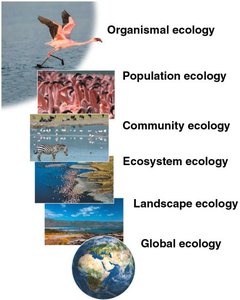
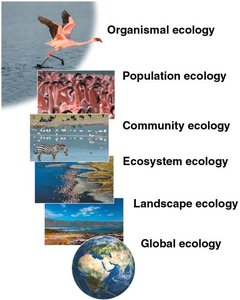
Levels of Ecological Research
Hierarchy of Ecological Study
Organismal Ecology: Examines how an organism’s structure, physiology, and behavior enable it to survive and reproduce in its environment. This includes physiological, evolutionary, and behavioral ecology. Example: How do flamingos select a mate?
Population Ecology: Focuses on groups of individuals of the same species living in a particular area, analyzing factors that affect population size and changes over time. Example: What environmental factors affect the reproductive rate of flamingos?
Community Ecology: Studies groups of populations of different species in an area, emphasizing interspecific interactions and their effects on community structure and organization. Example: What factors influence the diversity of species at an African lake?
Ecosystem Ecology: Investigates communities of organisms and their interactions with physical factors, emphasizing energy flow and chemical cycling. Example: What factors control photosynthetic productivity in an aquatic ecosystem?
Landscape Ecology: Explores mosaics of connected ecosystems, focusing on exchanges of energy, materials, and organisms across multiple ecosystems. Example: How do nutrients from terrestrial ecosystems affect organisms in a lake?
Global Ecology: Examines the biosphere, the sum of all ecosystems and landscapes, and studies how energy and material exchanges influence the distribution and function of organisms globally. Example: How do global air circulation patterns affect organism distribution?
Determinants of Species Distribution
Environmental Factors
Climate: The most significant influence on terrestrial organism distribution, especially temperature and precipitation.
Light and Nutrient Availability: Strongly affect aquatic organisms and plant distribution.
Dispersal and Interactions: The ability of organisms to move and interact with others also shapes their distribution.
Major Components of Climate
Physical Factors Shaping Climate
Climate is defined as the long-term prevailing weather conditions in an area. The four major physical components of climate are:
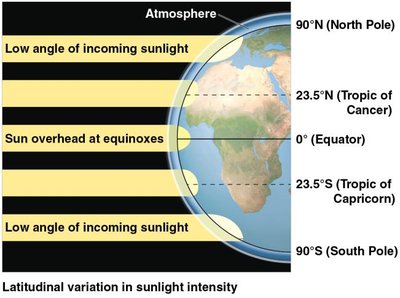
Sunlight: Solar energy drives temperature variations, air and water movement, and evaporation. Sunlight intensity is greatest at the equator and decreases toward the poles due to the angle of incidence.
Precipitation: Patterns of rainfall are influenced by the movement of air masses. Warm, moist air rises at the equator, releasing precipitation, while dry air descends at around 30° latitude, creating arid zones.
Wind: Global wind patterns are shaped by Earth's rotation and the movement of air masses. Trade winds and westerlies are examples of predictable wind patterns.
Temperature: Driven by solar intensity and varies with latitude and season.

Seasonality and Its Effects
Earth’s Tilt and Orbit
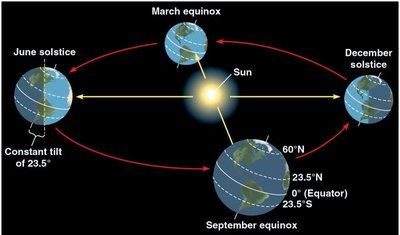
Seasonal changes in climate are caused by the tilt of Earth's axis and its annual orbit around the sun. This results in variations in day length, solar radiation, and temperature, which become more pronounced at higher latitudes.
Local and Regional Climate Influences
Mountains, Oceans, and Vegetation
Mountains: Affect air flow and precipitation. Windward sides receive more rain, while leeward sides are drier (rain shadow effect). Elevation also influences temperature (approximate drop of 6°C per 1,000 m increase).
Oceans: Moderate climate due to water’s high specific heat and influence on wind and precipitation patterns. Ocean currents can cause upwelling, bringing nutrients to surface waters.
Vegetation: Forests absorb more solar energy, increasing transpiration and precipitation, while deforestation can lead to hotter, drier climates.
Microclimate
Localized Climate Patterns
Microclimate refers to fine-scale variations in climate, often influenced by features such as shade, soil moisture, and wind patterns. Abiotic factors (temperature, light, water, nutrients) and biotic factors (other organisms) both shape microclimates.
Weather vs. Climate
Key Differences
Weather: Short-term variation in atmospheric conditions.
Climate: Long-term patterns, typically averaged over 30 years.
Earth’s average temperature has increased by 0.9°C since 1900 and is projected to rise further, impacting species distributions, biodiversity, economics, food supplies, and human health.
Biomes: Major Life Zones
Terrestrial Biomes
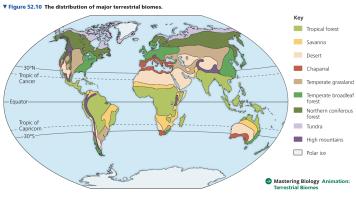
Terrestrial biomes are defined by their climatic features and predominant vegetation. Boundaries between biomes are often gradual (ecotones). Vertical layering in forests creates diverse habitats (canopy, understory, forest floor, root layer).
Aquatic Biomes
Aquatic biomes are primarily influenced by light penetration and depth. They exhibit less latitudinal variation than terrestrial biomes and are characterized by their physical and chemical environment. Zonation includes:
Photic Zone: Sufficient light for photosynthesis.
Aphotic Zone: Little light penetration.
Pelagic Zone: Open water, includes photic and aphotic zones.
Abyssal Zone: Deep aphotic region (2,000–6,000 m).
Benthic Zone: Sediment at the bottom, inhabited by benthos.
Detritus: Dead organic matter, a key food source for benthic organisms.
Species Distributions and Evolutionary History
Ecology and Evolution Interactions
The distribution of species is shaped by both ecological factors (such as climate and interactions) and evolutionary history. Ecological interactions can drive evolutionary change, and evolutionary adaptations can influence ecological dynamics. For example, coloration in guppies is influenced by sexual selection and predation, while predation risk can alter dietary habits and ecosystem structure.
Summary Table: Levels of Ecological Study
Level | Focus | Example Question |
|---|---|---|
Organismal | Individual adaptations | How do flamingos select a mate? |
Population | Population size and dynamics | What affects flamingo reproductive rates? |
Community | Species interactions | What influences species diversity at a lake? |
Ecosystem | Energy flow, nutrient cycling | What controls aquatic productivity? |
Landscape | Multiple ecosystems | How do nutrients move between land and lake? |
Global | Biosphere-wide processes | How does air circulation affect distributions? |
Key Equations and Concepts
Solar Energy and Latitude: Sunlight intensity varies with latitude due to the angle of incidence.
Temperature Lapse Rate: For every 1,000 m increase in elevation, temperature drops by approximately 6°C.
Climate Change: Quantified by long-term temperature trends and their ecological impacts.
Additional info: This guide integrates foundational concepts from Ch. 52 (An Introduction to Ecology and the Biosphere) and Ch. 53 (Population Ecology), providing a comprehensive overview suitable for exam preparation in introductory biology courses.
