 Back
BackEcology and Community Interactions: Foundations, Population, and Community Dynamics
Study Guide - Smart Notes
 Tailored notes based on your materials, expanded with key definitions, examples, and context.
Introduction to Ecology
Definition and Scope of Ecology
Ecology is the scientific study of how organisms interact with both the living (biotic) and non-living (abiotic) components of their environment. These interactions are shaped by factors present in both the current and historical context of the ecosystem.
Biotic factors: Living components such as plants, animals, bacteria, and fungi.
Abiotic factors: Non-living components such as climate, soil, water, and physical geography.
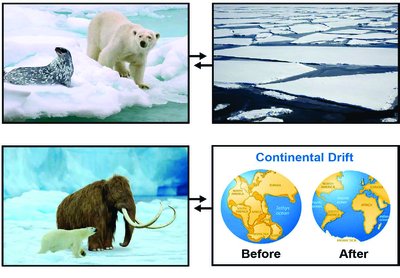
Additional info: The image above illustrates how both present and past abiotic factors (e.g., ice, continental drift) and biotic factors (e.g., polar bears, mammoths) influence ecological interactions.
Environment, Habitat, and Niche
Understanding the distinctions between environment, habitat, and niche is fundamental in ecology:
Environment: The total sum of all external biotic and abiotic factors surrounding an organism.
Habitat: The specific part of the environment where an organism lives and reproduces.
Niche: The ecological role a species performs in its habitat, including resource use and interactions with other species.
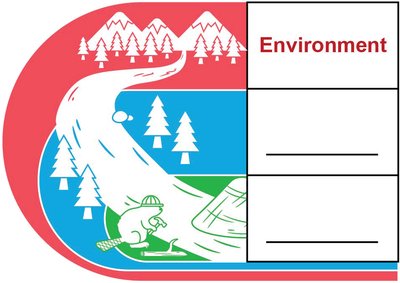
Additional info: The diagram visually distinguishes the broad environment, the more specific habitat, and the unique niche of an organism.
Levels of Ecological Study
Hierarchical Organization in Ecology
Ecology can be studied at several hierarchical levels, each focusing on different aspects of biological organization:
Organismal Ecology: Examines how individual organisms adapt to their environment through behavior, physiology, and evolution.
Population Ecology: Studies populations of a single species, focusing on size, density, and dynamics (birth, death, immigration, emigration).
Community Ecology: Investigates interactions among different species within a defined area.
Ecosystem Ecology: Explores energy flow and nutrient cycling among biotic and abiotic components.
Landscape/Seascape Ecology: Looks at spatial patterns and interactions across multiple ecosystems.
Global Ecology: Considers the biosphere as a whole, studying global patterns and processes.
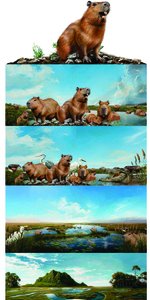

Additional info: The capybara example shows how questions about diet, population size, predator-prey interactions, and global distribution can be addressed at different ecological levels.
Animal Behavior and Behavioral Ecology
Concepts in Animal Behavior
Behavior refers to the actions of organisms in response to stimuli, including interactions with other organisms and the environment. Behavioral ecology studies how ecological pressures shape animal behavior.
Proximate causation: Explains how behaviors occur (mechanisms, genetics, neurology).
Ultimate causation: Explains why behaviors occur (evolutionary function, fitness impact).
Innate behavior: Genetically programmed, often inflexible behaviors.
Fixed action pattern: A sequence of innate behaviors triggered by a specific stimulus (sign stimulus).
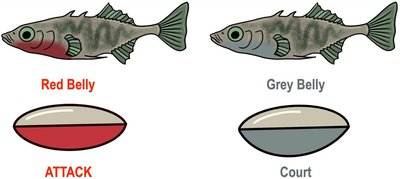
Additional info: The stickleback fish example demonstrates how a red belly (sign stimulus) triggers aggressive or courtship behaviors, illustrating fixed action patterns.
Population Ecology
Population Size and Density
Population ecology examines how and why populations change over time. Key concepts include:
Population: All individuals of the same species in a given area at a given time.
Population size (N): The total number of individuals in the population.
Population density: Number of individuals per unit area or volume, allowing standardized comparisons.
Factors Influencing Population Size
Births (B): Number of individuals born.
Deaths (D): Number of individuals dying.
Immigration (I): Individuals entering the population.
Emigration (E): Individuals leaving the population.
The change in population size can be represented as:
Population Growth Models
Exponential Growth: Occurs when resources are unlimited; population grows at a constant rate.
Logistic Growth: Accounts for environmental limits; population growth slows as it approaches carrying capacity (K).
Exponential growth equation:
Logistic growth equation:
Community Ecology
Community Interactions
A community consists of multiple populations of different species living and interacting in the same area. Community interactions include:
Competition (–/–): Both species are harmed by the interaction.
Exploitation (+/–): One species benefits at the expense of another (includes predation, herbivory, parasitism).
Mutualism (+/+): Both species benefit.
Commensalism (+/0): One species benefits, the other is unaffected.
Competition and Niche Concepts
Competitive Exclusion Principle: Two species with completely overlapping niches cannot coexist indefinitely; one will outcompete the other.
Resource Partitioning: Species with partially overlapping niches may evolve to use different resources, reducing competition.
Fundamental niche: The full range of resources a species could use in the absence of competition.
Realized niche: The actual range used due to competition.
Types of Exploitation
Predation: Predator kills and eats prey; leads to coevolutionary adaptations.
Herbivory: Herbivore eats plants or algae; plants may evolve mechanical or chemical defenses.
Parasitism: Parasite lives on or in a host, deriving resources and often harming the host.
Community Structure and Dynamics
Species richness: Number of different species in a community.
Relative abundance: Proportion of each species relative to the total number of individuals.
Trophic structure: Feeding relationships among organisms (food chains and webs).
Keystone species: Species with a disproportionately large effect on community structure despite low abundance.
Foundation species: Species with high biomass that shape community structure by providing habitat or food.
Ecosystem engineers: Species that modify the physical environment.
Community Dynamics: Disturbance and Succession
Disturbance: An event that disrupts community structure (e.g., fire, flood).
Ecological succession: Gradual change in community composition over time.
Primary succession: Occurs in lifeless areas with no soil.
Secondary succession: Occurs in areas where a disturbance has left soil intact.
Climax community: Stable, mature community at the end of succession.
Geographic Impacts and Island Biogeography
Latitude: Species diversity generally decreases with increasing distance from the equator.
Area: Larger areas tend to support more species.
Island Equilibrium Model: The number of species on an island reflects a balance between immigration and extinction, influenced by island size and distance from the mainland.
