 Back
Ecology and Evolution: Foundations, Mechanisms, and Community Interactions
Study Guide - Smart Notes
 Tailored notes based on your materials, expanded with key definitions, examples, and context.
Introduction to Ecology and Evolution
Ecology and evolution are central fields in biology, providing the framework for understanding biodiversity, the origin and diversification of life, and the complexity of interactions among organisms and their environments. Evolution is the unifying concept in biology, explaining both the diversity of life and the mechanisms underlying adaptation, disease, and behavior. Ecology extends biological inquiry from the level of cells and individuals to the interactions that shape populations, communities, and ecosystems.
Evolution: Concepts and Mechanisms
Traits and Variation
Evolution acts on traits, which are any measurable or observable characteristics of an organism (e.g., body size, coloration, growth rate, behavior, timing of reproduction). Variation in traits among individuals is essential for evolution, as some traits influence survival and reproduction and can become more or less common over time.
Example: Darwin’s finches exhibit variation in beak size, which is adapted to specific diets.
Descent with Modification and Speciation
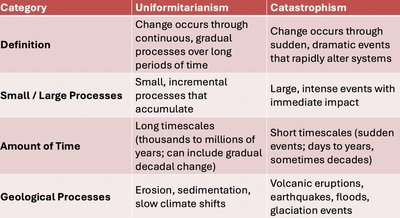
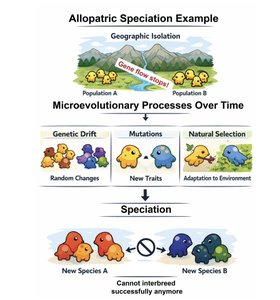
Over long periods, populations accumulate changes, diverge, and may form new species. Speciation often begins when gene flow is reduced or stopped, allowing populations to diverge through mutation, natural selection, and genetic drift.
Gene flow: Movement of genes between populations via migration and reproduction, maintaining genetic similarity.
Allopatric speciation: Geographic separation leads to divergence and formation of new species.
Sympatric speciation: Speciation without geographic isolation, often through mechanisms like polyploidy.
Species Concepts and Reproductive Isolation
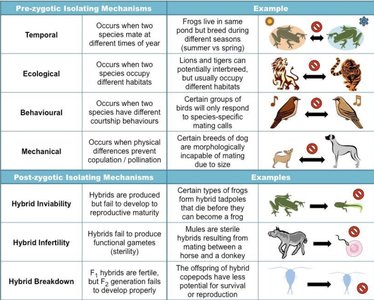
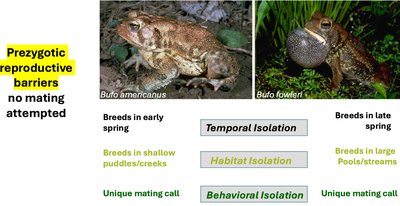
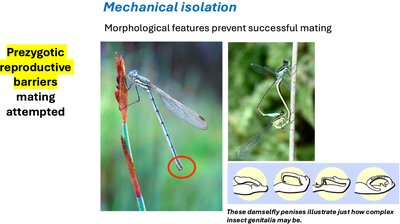
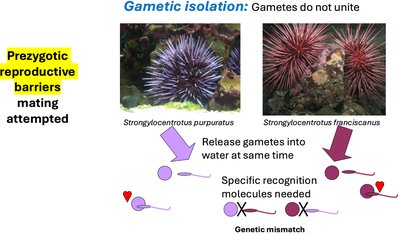
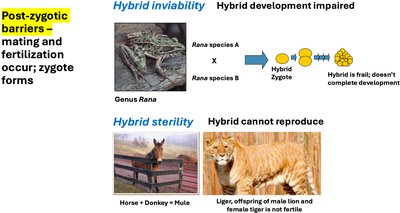
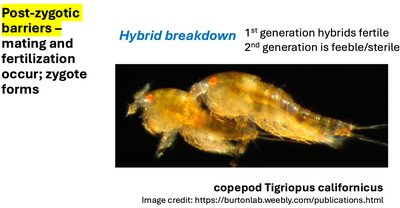
The biological species concept defines a species as a group of individuals that can interbreed and produce fertile offspring. However, this concept has limitations (e.g., fossils, asexual organisms). Reproductive isolation mechanisms prevent gene flow between species and are classified as prezygotic or postzygotic barriers.
Prezygotic barriers: Prevent mating or fertilization (e.g., temporal, ecological, behavioral, mechanical, gametic isolation).
Postzygotic barriers: Occur after fertilization, reducing hybrid viability or fertility.
Mechanisms of Microevolution
Mutation, Selection, Drift, and Gene Flow
Microevolution refers to generation-to-generation changes in allele frequencies within a population. The main mechanisms are:
Mutation: Random changes in DNA sequence, the ultimate source of new genetic variation.
Natural selection: Differential survival and reproduction of individuals with certain traits, leading to adaptation.
Genetic drift: Random fluctuations in allele frequencies, especially significant in small populations (e.g., founder effect, bottleneck effect).
Gene flow: Movement of alleles between populations, which can increase genetic diversity and affect fitness.
Modes of Selection
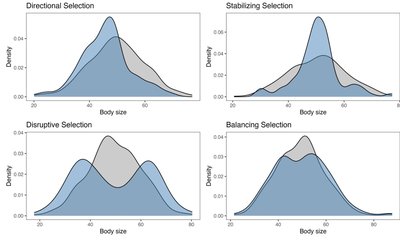
Natural selection can take several forms, shaping the distribution of traits in populations:
Directional selection: Favors individuals at one extreme of a trait distribution.
Stabilizing selection: Favors intermediate phenotypes.
Disruptive selection: Favors individuals at both extremes.
Balancing selection: Maintains genetic diversity (e.g., frequency-dependent selection, heterozygote advantage).
Sexual and Artificial Selection
Sexual selection: Acts on traits affecting reproductive success, including mate choice (intersexual selection) and competition (intrasexual selection).
Artificial selection: Humans intentionally select for desirable traits, as seen in domesticated animals and plants.
Macroevolution: Patterns and Processes
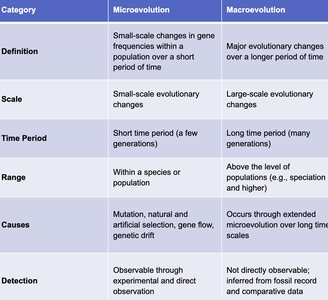
Macroevolution vs. Microevolution
Macroevolution refers to evolutionary changes above the species level, including speciation, extinction, and large-scale diversification. It is the cumulative result of microevolutionary processes over long time scales.
Fossil Record and Evolutionary Patterns
Fossil record: Preserves evidence of past life and environments, allowing reconstruction of macroevolutionary events.
Adaptive radiation: Rapid diversification of a single ancestral species into multiple species adapted to different environments.
Mass extinction: Rapid, widespread loss of species, creating opportunities for new lineages to evolve.
Gradualism vs. punctuated equilibrium: Gradualism describes slow, continuous change; punctuated equilibrium describes rapid bursts of change separated by periods of stasis.
Homologous structures: Anatomical features inherited from a common ancestor.
Analogous structures: Features with similar function but independent evolutionary origins (convergent evolution).
Vestigial structures: Reduced or non-functional features inherited from ancestors.
Population Ecology
Population Growth and Limiting Factors
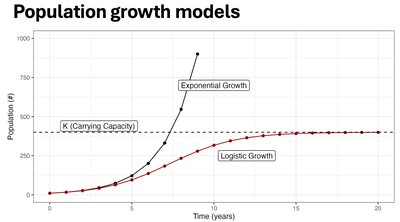
Population ecology studies the dynamics, interactions, and characteristics of populations. Population growth is influenced by birth, death, immigration, and emigration rates. Two main models describe population growth:
Exponential growth: Occurs when resources are abundant and population grows at its physiological capacity.
Logistic growth: Population growth slows as it approaches the carrying capacity (K), the maximum population size an environment can sustain.
Population Structure and Life History Strategies
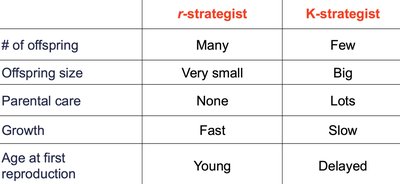
Population structure (age distribution, sex ratio, dispersion) and life history traits (reproductive schedule, survival) influence population dynamics and future growth potential.
r-strategists: Many small offspring, little parental care, fast growth, early reproduction.
K-strategists: Few large offspring, high parental care, slow growth, delayed reproduction.
Survivorship Curves
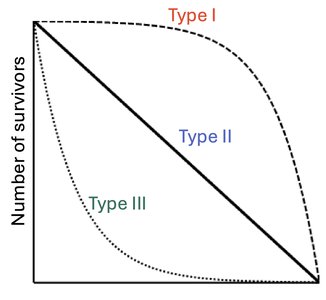
Survivorship curves illustrate the proportion of individuals surviving at each age:
Type I: High survival until old age (e.g., humans).
Type II: Constant death rate across ages (e.g., rodents).
Type III: High mortality in young, survivors live long (e.g., sea turtles).
Community Ecology and Species Interactions
Types of Interactions
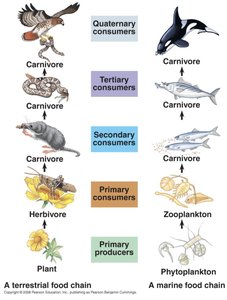
Communities consist of populations of different species living together and interacting. Key interspecific interactions include:
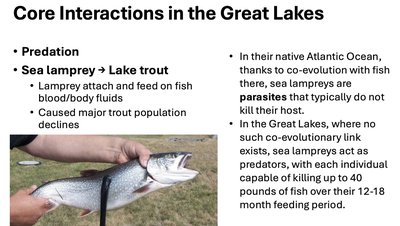
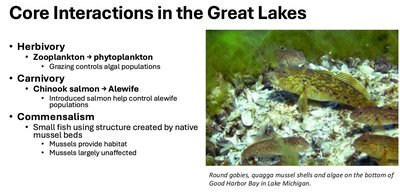
Predation: One organism consumes another (herbivory, carnivory, parasitism).
Symbiosis: Close, long-term interactions (mutualism, commensalism, parasitism).
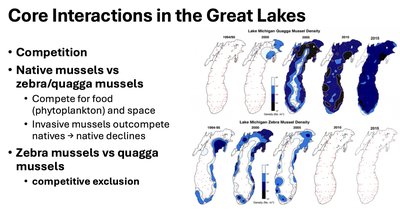
Competition: Two species use the same limited resource, leading to negative effects for both.
Predator-Prey and Coevolution
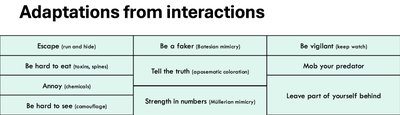
Predation is a strong evolutionary force, leading to adaptations such as camouflage, warning coloration, mimicry, and defensive structures. Coevolution describes reciprocal evolutionary changes between interacting species.
Symbiosis and Competition
Mutualism: Both species benefit (e.g., pollinators and flowering plants).
Commensalism: One species benefits, the other is unaffected.
Parasitism: Parasite benefits, host is harmed.
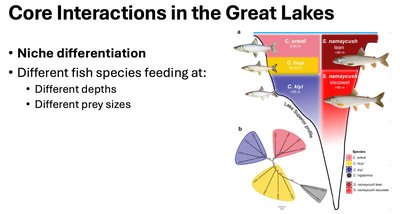
Competition: Can lead to resource partitioning, character displacement, and competitive exclusion.
Summary Table: Microevolution vs. Macroevolution
Category | Microevolution | Macroevolution |
|---|---|---|
Definition | Small-scale changes in gene frequencies within a population over a short period | Major evolutionary changes above the species level over long periods |
Scale | Within species/population | Above species level (speciation, extinction) |
Time Period | Short (few generations) | Long (many generations) |
Causes | Mutation, selection, drift, gene flow | Accumulation of microevolutionary changes |
Detection | Direct observation, experiments | Fossil record, comparative data |
Key Takeaways
Evolution and ecology are foundational to understanding biodiversity and the complexity of life.
Microevolutionary processes (mutation, selection, drift, gene flow) drive changes within populations and set the stage for macroevolutionary patterns (speciation, extinction, diversification).
Population and community dynamics depend on interactions among individuals and species, shaped by both ecological and evolutionary forces.
