 Back
BackEcology and the Biosphere: Climate, Biomes, and Species Distribution
Study Guide - Smart Notes
 Tailored notes based on your materials, expanded with key definitions, examples, and context.
Ecology and the Biosphere
Introduction to Ecology
Ecology is the scientific study of the interactions between organisms and their environment, encompassing both living (biotic) and nonliving (abiotic) components. These interactions determine the distribution and abundance of organisms across the planet.
Distribution: Where organisms are found geographically.
Abundance: The number of individuals of a species in a given area.
Levels of Ecology: Organismal, population, community, ecosystem, landscape, and global ecology.
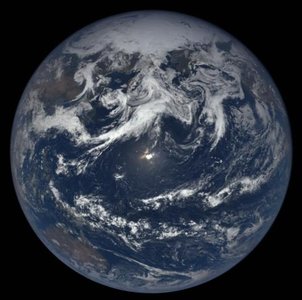
Levels of Ecological Study
Organismal Ecology: Focuses on how an organism's physiology, morphology, behavior, and evolution enable it to survive and reproduce in its environment.
Population Ecology: Examines groups of individuals of the same species, analyzing factors that affect population size and changes over time.
Community Ecology: Studies interactions among populations of different species in an area and how these interactions affect community structure and organization.
Ecosystem Ecology: Investigates energy flow and chemical cycling among organisms and their physical environment.
Landscape Ecology: Explores how spatial arrangement of ecosystems influences the exchange of energy, materials, and organisms.
Global Ecology: Considers the biosphere as a whole, focusing on global patterns and processes.
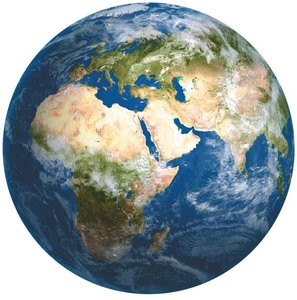
Climate and the Physical Environment
Components of Climate
Climate is the long-term prevailing weather conditions in a region and is a fundamental driver of ecological patterns. The main physical components of climate are:
Temperature
Precipitation
Sunlight
Wind
Climate varies by latitude and season, and is rapidly changing due to human activities.
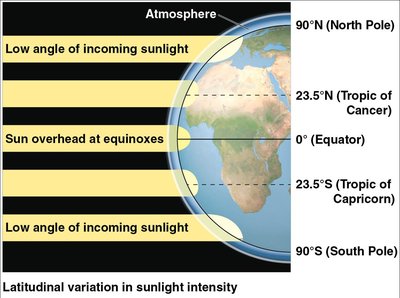
Latitudinal Variation in Sunlight
Sunlight intensity is strongest at the equator and decreases toward the poles due to the curvature of the Earth. This variation drives global climate patterns.
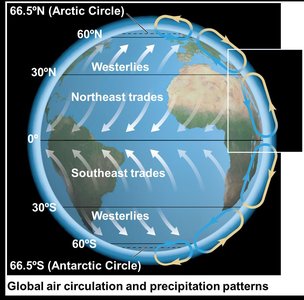
Global Air Circulation and Precipitation Patterns
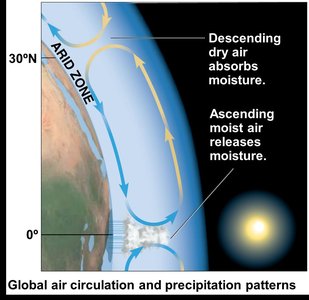
Global patterns of air circulation and precipitation are determined by the uneven heating of the Earth's surface by the sun. Warm, moist air rises at the equator, releasing precipitation, while dry air descends at around 30° latitude, creating arid zones.
Trade Winds: Blow east to west in the tropics.
Westerlies: Blow west to east in temperate zones.
Seasonality
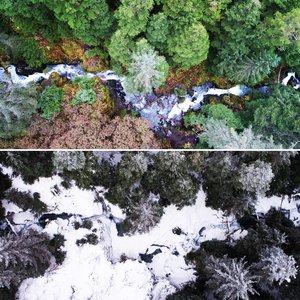
Seasonal variation in climate is caused by the tilt of Earth's axis and its annual orbit around the sun. This results in changes in day length, solar radiation, and temperature, especially at higher latitudes.
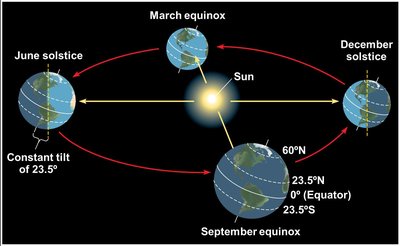
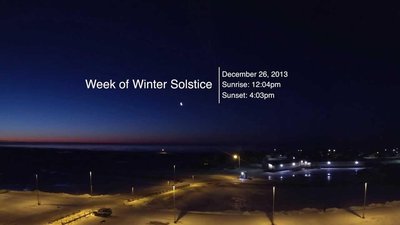
High Latitudes: Experience extreme differences in day length and temperature between seasons.
Low Latitudes (Tropics): Day length remains relatively constant; main seasonal difference is precipitation (wet and dry seasons).
Regional and Local Climate Influences
Large Water Bodies: Moderate climate by absorbing and releasing heat.
Mountains: Affect precipitation and temperature patterns on their windward and leeward sides.
Microclimate: Very fine, localized climate patterns, such as those found under a log or in a forest fragment.
Climate Change
Global Climate Change
Climate change refers to a directional change in the global climate lasting three or more decades. It is distinct from weather, which describes short-term atmospheric conditions.
Causes: Increased greenhouse gases from burning fossil fuels and deforestation.
Effects: Changes in wind and precipitation patterns, increased global temperatures, and more frequent extreme weather events.
Biomes
Terrestrial Biomes
Biomes are major life zones characterized by vegetation type (terrestrial) or physical environment (aquatic). Terrestrial biomes grade into each other at ecotones and are shaped by disturbances such as fire and storms.
Layering of Vegetation: Provides diverse habitats for animals (e.g., canopy, understory, forest floor).
Biome | Key Features |
|---|---|
Tropical Forest | Equatorial, high temperature and rainfall, high biodiversity |
Desert | Low precipitation, extreme temperatures, drought-adapted plants |
Savanna | Grasslands with scattered trees, maintained by fire and grazing |
Chaparral | Coastal, hot dry summers, mild wet winters, fire-adapted vegetation |
Temperate Grassland | Seasonal precipitation, maintained by fire and grazing, fertile soils |
Temperate Broadleaf Forest | Deciduous trees, rich soils, seasonal resources |
Boreal Forest (Taiga) | Coniferous trees, cold, short growing season, permafrost |
Tundra | Very cold, low diversity, permafrost restricts plant growth |
Aquatic Biomes
Aquatic biomes are defined by physical factors such as salinity, depth, flow, and light penetration. Examples include lakes, rivers, wetlands, estuaries, and oceans.
Zonation: Aquatic biomes often display distinct zones based on depth, light, and distance from shore.
Species Distribution and Limiting Factors
Factors Limiting Distribution
The distribution of species is determined by a combination of ecological factors and evolutionary history. Ecologists ask what environmental factors limit where a species is found, including:
Abiotic Factors: Climate, precipitation, light, nutrient availability, temperature, salinity, pH, etc.
Biotic Factors: Predation, herbivory, competition, mutualism, parasitism.
Dispersal
Dispersal is the movement of individuals or gametes away from their area of origin or centers of high population density. It is a key process in the global distribution of organisms.
Testing Hypotheses in Ecology
Ecologists use experiments to test whether differences in species distribution are due to genetic differences between populations or developmental flexibility in response to local abiotic factors.
Summary
Ecology studies the interactions that determine the distribution and abundance of organisms.
Climate, driven by solar radiation and atmospheric/oceanic circulation, shapes ecological patterns and biomes.
Species distributions are influenced by both abiotic and biotic factors, as well as evolutionary history and dispersal.
