 Back
Ecology and the Biosphere: Structure, Climate, and Biomes
Study Guide - Smart Notes
 Tailored notes based on your materials, expanded with key definitions, examples, and context.
Chapter 52: An Introduction to Ecology and the Biosphere
Discovering Ecology
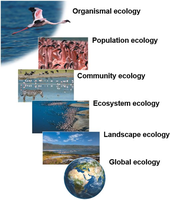
Ecology is the scientific study of interactions between organisms and their environment, encompassing both living (biotic) and nonliving (abiotic) components. These interactions determine the distribution and abundance of organisms. Ecologists investigate questions at various levels of biological organization, from individual organisms to the biosphere.
Organismal Ecology: Examines how an organism’s structure, physiology, and behavior meet environmental challenges.
Population Ecology: Focuses on factors affecting population size and dynamics over time.
Community Ecology: Studies interspecific interactions and their effects on community structure.
Ecosystem Ecology: Emphasizes energy flow and chemical cycling between organisms and their environment.
Landscape Ecology: Investigates exchanges of energy, materials, and organisms across multiple ecosystems.
Global Ecology: Considers the biosphere as the sum of all ecosystems, examining global influences on organism distribution.
Earth’s Climate: Patterns and Influences
Global Climate Patterns
Climate, the long-term prevailing weather conditions in an area, is the most significant factor influencing the distribution of terrestrial organisms. The four major physical components of climate are temperature, precipitation, sunlight, and wind. Global climate patterns are largely determined by solar energy and Earth’s movement in space, resulting in latitudinal variations.
Latitudinal Variation: Sunlight is most intense in the tropics; at higher latitudes, sunlight is more diffuse.
Air Circulation: Warm, wet air rises in the tropics, causing high precipitation; dry air descends at 30º latitude, creating arid climates.
Wind Patterns: Earth's rotation causes trade winds in the tropics and westerlies in temperate zones.
Regional and Local Effects on Climate
Climate is further modified by local factors such as bodies of water, mountain ranges, and vegetation. These factors create microclimates and influence regional weather patterns.
Mountains and Rain Shadows
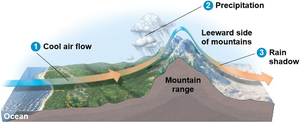
Mountains affect air flow and precipitation. As moist air rises up a mountain, it cools and releases moisture on the windward side. Descending air on the leeward side absorbs moisture, creating a rain shadow and often resulting in desert conditions.
Effects of Vegetation on Climate
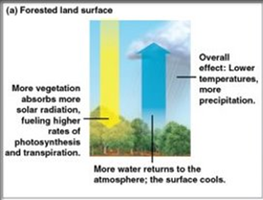
Forests can alter local and regional climate by increasing transpiration and photosynthesis, which cools the surface and increases precipitation. Deforestation leads to hotter, drier climates, while reforestation has the opposite effect.
Biomes: Terrestrial and Aquatic
Terrestrial Biomes
Biomes are major life zones characterized by vegetation type (terrestrial) or physical environment (aquatic). Climate is a major determinant of biome distribution, influencing plant types and ecological interactions. Biomes often grade into each other, forming ecotones, and exhibit vertical layering of vegetation.
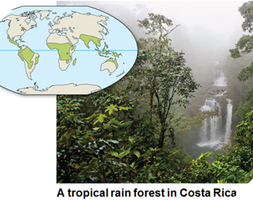
Tropical Forest: High rainfall, constant warm temperatures, high biodiversity, dominated by broadleaf evergreen or deciduous trees.
Desert: Low precipitation, extreme temperature variation, plants adapted for water conservation, nocturnal animals.
Savanna: Seasonal rainfall, warm temperatures, fire-adapted grasses and forbs, large herbivores.
Chaparral: Highly seasonal precipitation, hot summers, fire- and drought-adapted shrubs and small trees.
Temperate Grassland: Seasonal precipitation, cold winters, hot summers, drought- and fire-adapted grasses.
Northern Coniferous Forest (Taiga): Largest terrestrial biome, cold winters, hot summers, evergreen conifers.
Temperate Broadleaf Forest: Significant precipitation, vertical layers, deciduous trees, hibernating mammals.
Tundra: Cold, low precipitation, herbaceous vegetation, permafrost, migratory birds.
Aquatic Biomes
Aquatic biomes cover most of Earth and are characterized by physical and chemical properties, such as salt concentration and water flow. Oceans have a major impact on global climate and oxygen production. Aquatic biomes are stratified into zones based on light penetration, temperature, and depth.
Lakes: Oligotrophic (nutrient-poor, O2-rich) and eutrophic (nutrient-rich, O2-poor) types; zonation includes littoral, limnetic, and benthic zones.
Wetlands: Water-saturated soils, high productivity, diverse plant and animal life, important for water purification.
Streams and Rivers: Current is the main feature; headwaters are cold and clear, downstream is warm and turbid.
Estuaries: Transition zones between river and sea, variable salinity, high productivity.
Intertidal Zones: Periodically submerged, high variation in temperature and salinity, diverse adaptations.
Ocean Pelagic Zone: Open water, high oxygen, low nutrients, dominated by plankton.
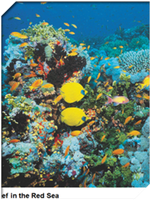
Coral Reefs: Calcium carbonate structures, high biodiversity, mutualism between corals and algae.
Marine Benthic Zone: Seafloor, adapted to cold and high pressure, hydrothermal vent communities.
Species Distribution: Ecological and Evolutionary Factors
Interactions Limiting Distribution
Species distributions are shaped by both ecological factors and evolutionary history. Biotic factors (such as predation, competition, and mutualism) and abiotic factors (such as temperature, water, oxygen, salinity, sunlight, and soil) all play roles in limiting where species can live.
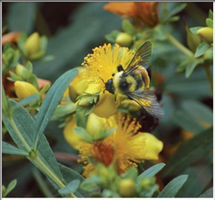
Biotic Factors: Presence or absence of pollinators, food resources, parasites, pathogens, and competitors.
Abiotic Factors: Environmental conditions like temperature, water availability, oxygen concentration, salinity, sunlight, and soil composition.
Temperature and Range Shifts
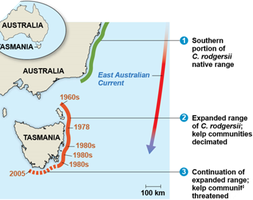
Temperature is a critical abiotic factor. Organisms function best within specific temperature ranges, and climate change can cause range shifts that affect community structure. For example, the long-spined sea urchin (Centrostephanus rodgersii) expanded its range in response to warming waters, impacting kelp communities.
Ecological Change and Evolution
Feedback Between Ecology and Evolution
Ecological interactions can drive evolutionary change, and evolutionary adaptations can alter ecological dynamics. This feedback can occur rapidly or over long periods, influencing the diversity and distribution of species.
Example: Diversification of plants provided new habitats for animals, stimulating bursts of speciation and further ecological change.
Rapid Feedback: Removal of predators can lead to rapid evolution in prey species, affecting ecosystem structure.
Summary Table: Major Terrestrial Biomes
Biome | Location | Climate | Dominant Vegetation | Key Animals |
|---|---|---|---|---|
Tropical Forest | Equatorial, subequatorial | High rainfall, warm | Broadleaf evergreen/deciduous trees | High diversity: insects, birds, mammals |
Desert | 30º N/S, continental interiors | Low precipitation, extreme temps | Cacti, succulents | Nocturnal mammals, reptiles |
Savanna | Equatorial, subequatorial | Seasonal rainfall, warm | Grasses, forbs | Large herbivores, insects |
Chaparral | Midlatitude coastal | Seasonal, hot summers | Shrubs, small trees | Small mammals, birds |
Temperate Grassland | Continental | Seasonal, cold winters | Grasses, forbs | Bison, prairie dogs |
Taiga | Northern N. America, Eurasia | Cold winters, hot summers | Evergreen conifers | Moose, bears, birds |
Temperate Broadleaf Forest | Midlatitudes | Rain/snow, hot summers | Deciduous trees | Mammals, birds, insects |
Tundra | Arctic, alpine | Cold, low precipitation | Mosses, grasses | Caribou, migratory birds |
