 Back
BackEcology and the Biosphere: Structure, Climate, and Biomes
Study Guide - Smart Notes
 Tailored notes based on your materials, expanded with key definitions, examples, and context.
Ecology and the Biosphere
Introduction to Ecology
Ecology is the scientific study of the interactions between organisms and their environment, encompassing both living (biotic) and nonliving (abiotic) components. These interactions determine the distribution and abundance of organisms across the planet. Ecologists investigate these relationships at multiple levels of biological organization, from molecules to the entire biosphere.
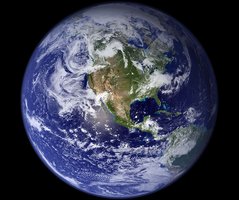
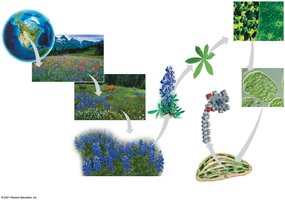
Levels of Ecological Organization
Biosphere: The global ecosystem, comprising all of Earth's ecosystems and landscapes.
Ecosystem: A community of organisms in an area and the abiotic factors with which they interact.
Community: Groups of populations of different species living in the same area.
Population: Individuals of the same species living in a particular area.
Organism: An individual living entity.
Organ System/Organs/Tissues/Cells/Organelles/Molecules: Increasingly smaller levels of biological organization.
Major Subfields of Ecology
Organismal Ecology
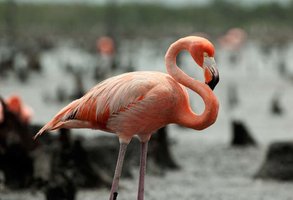
Organismal ecology focuses on how an organism's structure, physiology, and behavior enable it to meet environmental challenges. For example, researchers may study how flamingos select mates based on environmental cues.
Population Ecology
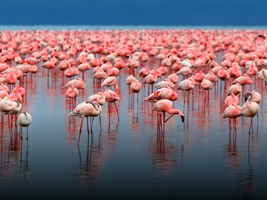
Population ecology analyzes factors that affect population size and how and why it changes over time. This includes studying birth rates, death rates, immigration, and emigration. For example, what environmental factors affect the reproductive rate of flamingos?
Community Ecology
Community ecology examines how interactions between species, such as predation, competition, and mutualism, affect community structure and organization. For example, what factors influence the diversity of species that interact at an African lake?
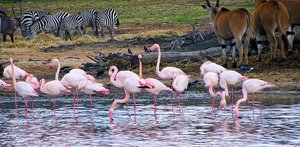
Ecosystem Ecology
Ecosystem ecology emphasizes energy flow and chemical cycling between organisms and the environment. It investigates how factors such as photosynthetic productivity are controlled in aquatic and terrestrial ecosystems.
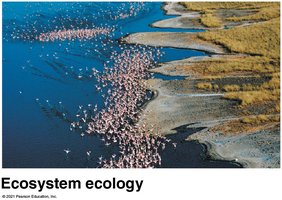
Landscape Ecology
Landscape ecology studies the exchanges of energy, materials, and organisms across multiple ecosystems, often focusing on the effects of spatial arrangement and connectivity of habitats.
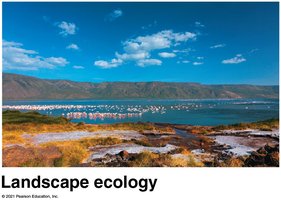
Global Ecology
Global ecology examines the biosphere as a whole, focusing on how the exchange of energy and materials influences the distribution and function of organisms worldwide.
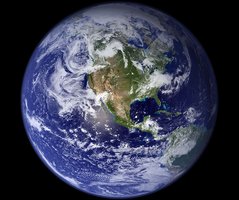
Climate and the Biosphere
Climate: Definition and Components
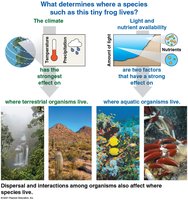
Climate is the long-term prevailing weather conditions in a given area. The major components of climate include temperature, precipitation, sunlight, and wind. Climate is the primary factor determining the distribution of terrestrial biomes and the organisms within them.
Global Climate Patterns
Global climate patterns are largely determined by solar energy and Earth's movement in space. The unequal distribution of solar radiation leads to temperature variations, air and water circulation, and water evaporation, which in turn create three major climate zones (tropical, temperate, polar) and drive global wind and ocean current patterns.
Latitudinal Variation in Sunlight Intensity
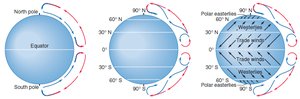
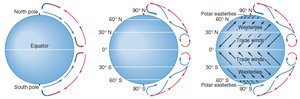
The angle at which sunlight strikes Earth affects the intensity of solar energy received at different latitudes, resulting in warmer temperatures at the equator and cooler temperatures toward the poles.
Air Circulation and Precipitation Patterns
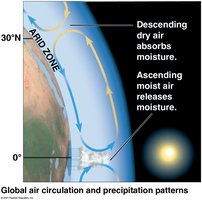
Warm, moist air rises at the equator, cools, and releases precipitation, creating tropical rainforests. Dry air descends at around 30° north and south, creating deserts. Air rises again at 60° latitude, causing precipitation, and descends at the poles, creating cold, dry climates.
Regional and Local Effects on Climate
Seasonality: Caused by Earth's tilt and orbit, leading to variation in day length, solar radiation, and temperature, especially at higher latitudes.
Bodies of Water: Oceans and lakes moderate climate by heating or cooling air masses that pass over land.
Mountains: Affect air flow, precipitation, and sunlight exposure, creating rain shadows and temperature gradients with elevation.
Global Climate Change
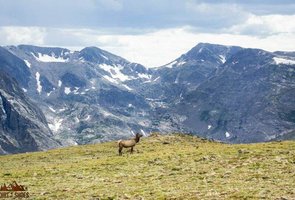
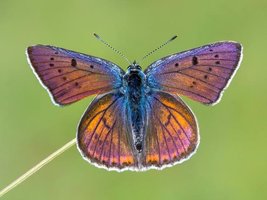
Increased greenhouse gas concentrations have led to a rise in global temperatures, altered wind and precipitation patterns, and more frequent extreme weather events. Species are shifting their ranges in response to these changes, as seen in European butterflies and North American plants.
Biomes: Major Life Zones
Definition and Classification
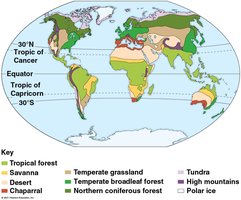
A biome is a major life zone characterized by its dominant vegetation type, climate, and associated fauna. Biomes are distributed according to climate patterns and usually lack sharp boundaries. Convergent evolution can result in similar adaptations among unrelated species in similar biomes.
Examples of Terrestrial Biomes
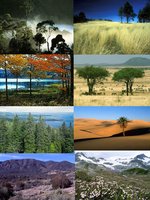
Tropical Forest: Equatorial regions, high biodiversity, little temperature variation, high rainfall.
Desert: Near 30° latitude, low precipitation, extreme temperature variation.
Savanna: Tropical grassland, seasonal rainfall, fire-adapted species.
Temperate Grassland: Highly seasonal precipitation, rich soils, periodic drought.
Temperate Deciduous Forest: Midlatitudes, significant precipitation, vertical layering.
Taiga (Northern Coniferous Forest): Largest biome, cold, moderate precipitation.
Tundra: Arctic, low precipitation, permafrost, short growing season.
Aquatic Life Zones
Characteristics and Zonation
Aquatic biomes are classified by salinity (freshwater or marine), light penetration, temperature, and depth. Zonation includes photic (light-penetrated) and aphotic (dark) zones, as well as benthic (bottom) and pelagic (open water) zones. The thermocline is a narrow layer of abrupt temperature change.
Types of Aquatic Biomes
Lakes: Vary in size, nutrient content (oligotrophic vs. eutrophic), and oxygen levels.
Wetlands: Water-saturated soils, high productivity, important for water purification and flood control.
Streams and Rivers: Flowing water, oxygenation by currents, headwaters are cold and clear, downstream is warmer and more turbid.
Estuaries: Transition zones between rivers and oceans, variable salinity, high productivity.
Intertidal Zones: Periodically submerged and exposed, stratified by exposure to air.
Coral Reefs: Formed by coral skeletons, high biodiversity, require clear, warm, oxygen-rich water.
Oceanic Pelagic Zone: Open ocean, covers most of Earth's surface, nutrient-poor, oxygen-rich.
Marine Benthic Zone: Ocean floor, includes deep-sea (abyssal) environments, organisms adapted to cold and high pressure.
Summary Table: Major Terrestrial Biomes
Biome | Climate | Vegetation | Location |
|---|---|---|---|
Tropical Forest | Warm, high rainfall | Broadleaf evergreen trees | Equatorial regions |
Desert | Low rainfall, extreme temps | Cacti, succulents | 30° N/S, continental interiors |
Savanna | Warm, seasonal rainfall | Grasses, scattered trees | Equatorial/subequatorial |
Temperate Grassland | Cold winters, hot summers | Grasses, few trees | Continental interiors |
Temperate Deciduous Forest | Moderate, year-round rainfall | Deciduous trees | Midlatitudes |
Taiga | Cold, moderate rainfall | Conifers | Northern continents |
Tundra | Cold, low rainfall | Mosses, lichens | Arctic, high mountains |
Key Terms
Biosphere: The sum of all Earth's ecosystems.
Biome: Major life zone defined by vegetation and climate.
Thermocline: Layer of rapid temperature change in aquatic environments.
Rain Shadow: Dry area on the leeward side of a mountain.
Oligotrophic: Nutrient-poor, oxygen-rich aquatic environment.
Eutrophic: Nutrient-rich, often oxygen-depleted aquatic environment.
