 Back
BackEcology and the Biosphere: Structure, Function, and Human Impact
Study Guide - Smart Notes
 Tailored notes based on your materials, expanded with key definitions, examples, and context.
Introduction to Ecology
Definition and Scope
Ecology is the scientific study of interactions between organisms and their environments, encompassing both biotic (living) and abiotic (nonliving) components. Ecologists use observation, experimentation, and modeling to test hypotheses about these interactions.
Abiotic factors: Sunlight, water, nutrients, temperature, wind, fire, dissolved oxygen, salinity, currents, and tides.
Biotic factors: All living organisms within an environment.
Ecology and Environmentalism
Human activities have impacted all parts of the biosphere. Ecology provides the scientific foundation for understanding and addressing environmental problems, such as pollution, habitat destruction, and climate change.
Hierarchy of Ecological Interactions
Levels of Ecological Study
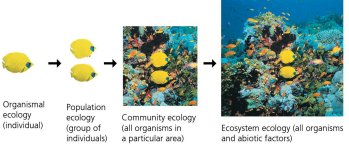
Ecologists study interactions at four increasingly complex levels:
Organismal ecology: Focuses on individual organisms and their adaptations to the environment.
Population ecology: Examines groups of individuals of the same species living in a particular area.
Community ecology: Studies all organisms in a particular area and their interactions.
Ecosystem ecology: Investigates all organisms and abiotic factors in a given area.
Living in Earth's Diverse Environments
Abiotic Factors of the Biosphere
The distribution and abundance of organisms are influenced by abiotic factors such as sunlight, water, nutrients, and temperature. In aquatic habitats, dissolved oxygen, salinity, current, and tides are also important. Terrestrial environments are further affected by wind and fire.
Evolutionary Adaptations of Organisms
Adaptation via natural selection results from interactions between organisms and their environments. Organisms develop physiological, behavioral, and anatomical responses to cope with environmental variability.
Biomes
Definition and Types
A biome is a major terrestrial or aquatic life zone characterized by its climate, predominant vegetation, and adapted organisms.
Freshwater Biomes
Include lakes, ponds, rivers, streams, and wetlands.
Characterized by light penetration (photic and aphotic zones), temperature, nutrients, oxygen levels, and community structure.
The benthic realm is the bottom of an aquatic biome.
Marine Biomes
Divided into realms (benthic and pelagic) and zones (photic, aphotic, intertidal).
Include pelagic and benthic realms, coral reefs, intertidal zones, and estuaries.
Coral reefs are highly diverse and found in warm tropical waters above the continental shelf.
Hydrothermal vent ecosystems are powered by chemical energy rather than sunlight.
Estuaries, where freshwater merges with the ocean, are among the most productive environments on Earth.
Terrestrial Biomes
Named for their climate and predominant vegetation.
Major types: tropical forest, savanna, desert, chaparral, temperate grassland, temperate broadleaf forest, coniferous forest, tundra, and polar ice.
Similar climates in different regions can result in similar biomes.
How Climate Affects Terrestrial Biome Distribution
The geographic distribution of terrestrial biomes is mainly determined by regional variations in climate, which are influenced by the uneven distribution of solar energy, proximity to large bodies of water, and landforms such as mountains.
The Water Cycle
Linking Aquatic and Terrestrial Biomes
The global water cycle connects aquatic and terrestrial biomes through processes such as evaporation, condensation, precipitation, and runoff. Human activities are disrupting the water cycle, affecting ecosystem health and water availability.
Human Impact on Biomes
Land Use and Pollution
Human land use has altered forests and degraded ecosystem services.
Unsustainable agriculture has depleted soil fertility.
Pollution has affected freshwater ecosystems, which are vital for life.
Factors such as agriculture, population growth, drought, and declining snowfall contribute to freshwater depletion.
Climate Change
The Greenhouse Effect and Global Warming
Greenhouse gases (e.g., CO2, methane) trap heat in Earth's atmosphere, increasing global temperatures.
Human activities, especially fossil fuel burning, have increased greenhouse gas concentrations beyond what natural processes can absorb.
Effects of Climate Change on Ecosystems
Disrupts species interactions and shifts biome boundaries.
Increases the frequency and severity of wildfires in some ecosystems.
Looking to Our Future
Each person has a carbon footprint, representing their share of global greenhouse gas emissions.
Actions can be taken to reduce individual and collective carbon footprints.
Key Concepts in Scientific Method and Biological Organization
Application of the Scientific Method
Hypothesis testing: Formulating and testing explanations for observations.
Hypothesis vs. theory vs. fact: A hypothesis is a testable explanation; a theory is a well-supported, broad explanation; a fact is an observation repeatedly confirmed.
Variables in experiments: Independent variables are manipulated; dependent variables are measured.
Organization of Living Things
Single-cell organization: Prokaryotic vs. eukaryotic cells.
Cellular organization and interactions in multicellular organisms.
Structure and function of cellular organelles.
Role of nucleic acids in directing protein production.
Active and passive transport mechanisms.
Endothermic and ectothermic homeostasis.
Evidence for Evolution
Darwin’s theory of evolution by natural selection.
Mechanisms for evolution at the population level.
Taxonomy and phylogeny for interpreting historic relationships.
Mechanisms of speciation.
Structure and Function of Ecological Systems
Abiotic and biotic factors affecting diversity and ecosystem function.
Human impact on ecological systems.
Chemical cycling in ecosystems.
