 Back
BackEcology: Biomes, Population Dynamics, and Community Interactions
Study Guide - Smart Notes
 Tailored notes based on your materials, expanded with key definitions, examples, and context.
Ecology and Biogeography
Abiotic and Biotic Factors
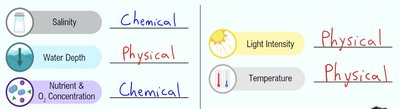
Ecology is the study of how organisms interact with both living (biotic) and non-living (abiotic) components of their environment. Abiotic factors include temperature, moisture, pH, water depth, salinity, and light intensity, while biotic factors encompass all living organisms such as trees, bacteria, and animals.
Abiotic Variables: Non-living environmental factors that influence species distribution and abundance.
Biotic Variables: Living components that affect ecological interactions.
Ecological Interactions: Influenced by both present and past biotic and abiotic factors.
Biogeography and Species Distribution
Biogeography examines the spatial and temporal distribution of organisms. Dispersal, endemic species, and net primary productivity (NPP) are key concepts in understanding why species are found in certain regions.
Dispersal: Movement of individuals or gametes away from their birthplace.
Endemic Species: Species found only in one specific area.
NPP: Net Primary Productivity, the total organic matter available as food in a region.
Weather, Climate, and Global Patterns
Weather refers to short-term atmospheric conditions, while climate is the long-term average. The angle of sunlight and Earth's tilted axis create distinct climate zones and seasons.
Latitudes: Measure distance north or south of the equator.
Earth's Tilt: Causes seasonal variation in climate.
Global Air Circulation and Precipitation
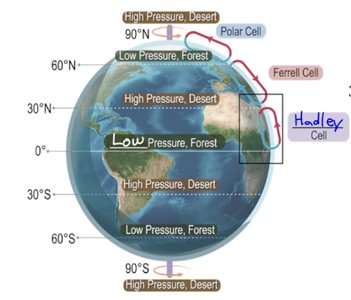
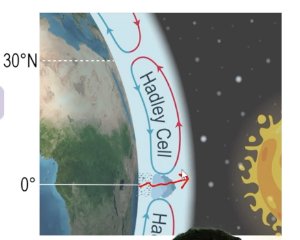
Large-scale air circulation cells (Hadley, Ferrel, Polar) create alternating patterns of high and low pressure, influencing precipitation and biome distribution.
Hadley Cell: Drives wet forests near the equator and dry deserts at 30ºN/S.
Ferrel and Polar Cells: Create additional climate zones at higher latitudes.
Coriolis Effect and Prevailing Winds
The Coriolis effect, caused by Earth's rotation, curves the paths of prevailing winds, affecting climate and biome placement.
Winds: Curve eastward or westward depending on direction relative to the equator.
Disturbances and Biome Dynamics
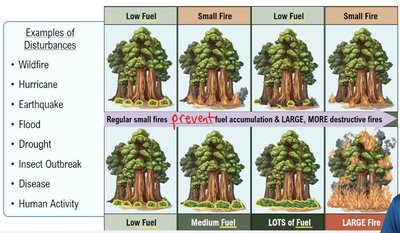
Disturbances are short-lived events that disrupt ecosystem structure and function, influencing resource availability and species distribution. Regular small fires prevent fuel accumulation and reduce the risk of large, destructive fires.
Disturbance Regime: Predictable disturbances that shape community structure.
Terrestrial and Aquatic Biomes
Terrestrial Biomes
Biomes are large ecological zones characterized by climate, vegetation, and animal life. Examples include tropical rainforests, savannas, deserts, chaparrals, grasslands, temperate forests, boreal forests, and tundras.
Tropical Rainforests: High biomass and biodiversity, constant warm temperatures, abundant rainfall.
Deserts: Low precipitation, variable temperatures, adaptations for water conservation.
Temperate Regions: Include chaparrals, grasslands, and broadleaf forests with moderate productivity.
Boreal Forests and Tundras: Low biomass, cold temperatures, adaptations for snow and permafrost.
Aquatic Biomes and Zonation
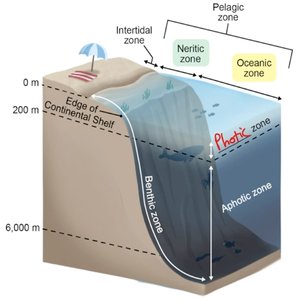
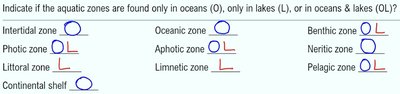
Aquatic biomes are divided into freshwater and marine categories, each with distinct physical and chemical environments. Zonation refers to the division of aquatic habitats into zones based on depth, light, and proximity to shore.
Freshwater Biomes: Lakes, rivers, streams, wetlands, estuaries.
Marine Biomes: Intertidal, pelagic, neritic, oceanic, benthic zones.
Seasonal Turnover and Ocean Upwelling
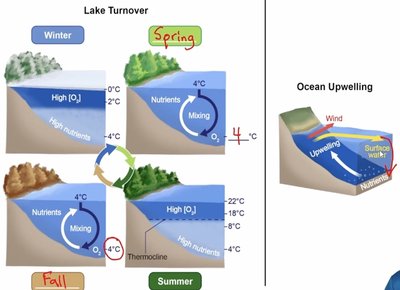
Seasonal turnover in lakes and ocean upwelling are processes that replenish nutrients and oxygen, supporting aquatic life.
Turnover: Vertical mixing of water layers during spring and fall.
Upwelling: Deep, nutrient-rich water rises to replace surface water.
Population Ecology
Population Structure and Dispersion
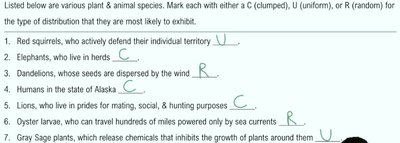
Population ecology studies the dynamics of populations, including size, density, dispersion, and boundaries. Dispersion patterns can be clumped, uniform, or random, influenced by resource distribution and social behavior.
Population Size (N): Total number of individuals.
Population Density: Individuals per unit area or volume.
Dispersion Patterns: Clumped, uniform, random.
Life History Strategies
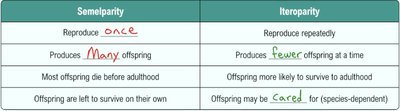
Life history traits influence survival, growth, and reproduction. Semelparity and iteroparity are two reproductive strategies.
Semelparity: Single, massive reproductive event; many offspring, low survival.
Iteroparity: Multiple reproductive events; fewer offspring, higher survival, possible parental care.
Population Growth Models
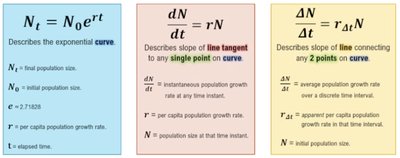
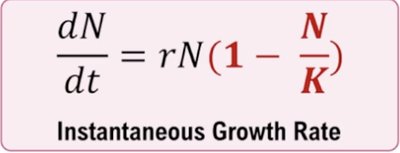
Population growth can be modeled mathematically using linear, exponential, and logistic equations. These models help predict changes in population size over time.
Linear Model: Constant growth rate.
Exponential Model: Rapid, uninhibited growth;
Logistic Model: Growth slows as population approaches carrying capacity;
r/K Selection Theory
Species are classified by their reproductive strategies: r-selected species maximize growth rate in unstable environments, while K-selected species optimize fitness near carrying capacity in stable environments.
r-Selection: Many offspring, low investment, rapid growth, Type 3 survivorship.
K-Selection: Few offspring, high investment, stable populations, Type 1 survivorship.
Community Ecology
Community Interactions
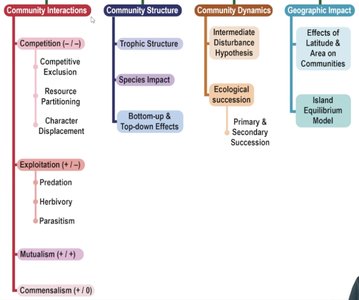
Community ecology examines interactions among species, including competition, exploitation, mutualism, and commensalism. These interactions shape community structure and dynamics.
Competition: (-/-) Both species are harmed by competing for resources.
Exploitation: (+/-) One species benefits at the expense of another (predation, herbivory, parasitism).
Mutualism: (+/+) Both species benefit.
Commensalism: (+/0) One species benefits, the other is unaffected.
Ecological Succession
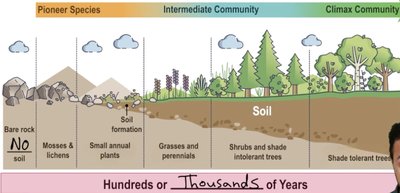
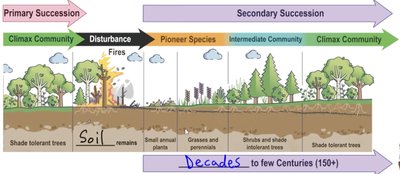
Succession is the gradual change in community structure over time, often following disturbance. Primary succession occurs in areas without soil, while secondary succession happens where soil remains after disturbance.
Primary Succession: Colonization of bare rock by pioneer species, followed by soil formation and community development.
Secondary Succession: Recovery after disturbance, with soil intact, leading to intermediate and climax communities.
Geographic Impact and Island Equilibrium Model
Community diversity is influenced by latitude and area. The island equilibrium model predicts the number of species on an island based on immigration and extinction rates, affected by island size and distance from the mainland.
Latitude: Diversity decreases with distance from the equator.
Area: Larger areas support more species.
Island Equilibrium Model: Equilibrium reached when immigration equals extinction.
